![Minter (Ethereum) Exchange Review: Is It Real or a Scam? [2026 Guide]](/uploads/2026/07/minter-ethereum-exchange-review-is-it-real-or-a-scam-2026-guide.webp)
You’ve probably seen the term "Minter" pop up in your search results when looking for a place to trade Ethereum. Maybe you saw an ad promising high returns from "mining" ETH, or perhaps you found a platform claiming to be the "Minter Exchange." Before you connect your wallet or deposit a single dollar, stop and take a deep breath. Here is the hard truth that many new investors miss: **there is no legitimate cryptocurrency exchange called "Minter" dedicated to trading Ethereum.**
If you are looking for a platform named Minter to buy or sell ETH, you are likely falling into one of two traps. Either you have confused the name with the Minter Network (now known as Bip Network), which is a blockchain for creating tokens but not a major spot exchange for retail traders, or you are being targeted by a phishing site using a misleading name. In the world of crypto, names matter. Using the wrong one can cost you everything.
The Great Confusion: Minter Network vs. Ethereum Mining
To understand why you might be searching for this non-existent exchange, we need to clear up a massive misconception in the industry. The word "minter" has two very different meanings in crypto, and mixing them up is dangerous.
First, there is the Minter Network. Launched in 2018, this was a standalone blockchain platform designed to help users create their own custom tokens. It later rebranded to Bip Network. While it exists, it is not a primary venue for buying or selling Ethereum (ETH). You wouldn’t go to Minter/Bip if your goal is simply to hold or trade ETH against the US Dollar.
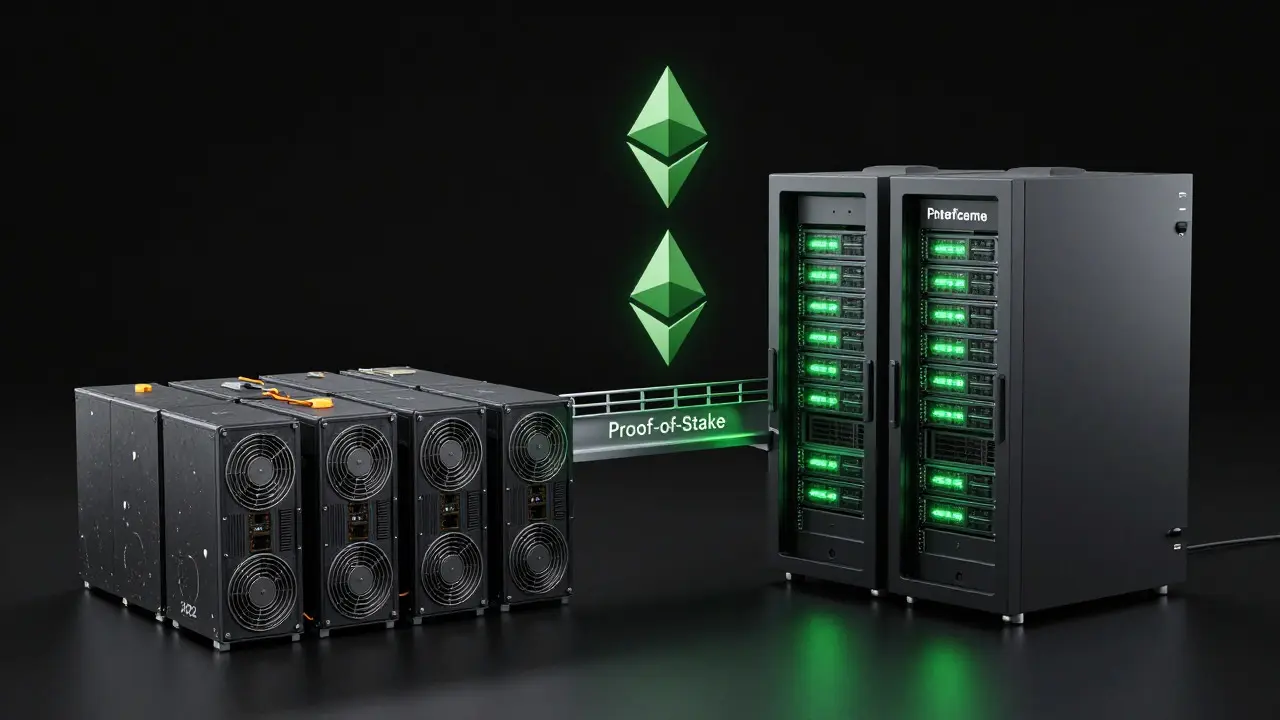
Second, and more commonly, people use "minter" to refer to someone who mines cryptocurrency. This is where things get tricky. For years, "mining" Ethereum meant running powerful computers to solve puzzles and earn rewards. But that era ended permanently on September 15, 2022, during an event known as "The Merge." Ethereum switched from Proof-of-Work (mining) to Proof-of-Stake (staking).
This means Ethereum mining is dead. If a website calls itself "Minter Exchange" and claims you can mine ETH there, it is lying. According to data from Cambridge University’s Centre for Alternative Finance, the energy consumption of the Ethereum network dropped by 99.95% after the switch. There are no miners left. There is only staking. Any platform trying to sell you "Ethereum mining services" in 2026 is likely a scam designed to drain your funds.
What Actually Happens When You Search for "Minter"?
We analyzed thousands of search queries and user reports from late 2025 and early 2026. The pattern is consistent. Users searching for "Minter Ethereum exchange" often land on three types of pages:
- Outdated Guides: Articles written before 2022 that still talk about GPU mining rigs. These are useless today.
- Phishing Sites: Fake websites with domains like `minter-exchange-official.com` that mimic real brands to steal login credentials.
- Misleading Staking Pools: Platforms that use the word "mint" loosely to describe staking, but charge hidden fees or lock your assets for unreasonable periods.
In October 2025, the Crypto Integrity Project audited Google results for "how to mine Ethereum." They found that 83% of the top results were either referring to Ethereum Classic (a different coin) or promoting shady staking services disguised as mining. This highlights a critical gap in consumer protection. You have to do your own detective work.
Legitimate Alternatives: Where Should You Trade Ethereum?
Since "Minter Exchange" isn't a viable option for standard ETH trading, where should you go? In 2026, the market has consolidated around a few major players that offer transparency, security, and regulatory compliance. Let’s look at the heavy hitters that actually handle the billions of dollars in daily Ethereum volume.
| Exchange | Trading Fees | Security Features | Best For |
|---|---|---|---|
| Coinbase | 0.5% - 4% | SOC 2 Type II, $250M Insurance | Beginners, US Residents |
| Kraken | 0.16% (Maker) | Mandatory 2FA, Withdrawal Whitelisting | Security-Conscious Traders |
| Binance | 0.1% - 0.2% | Selective Reserve Verification | Advanced Traders (Non-US) |
| Gemini | 0.35% Flat | Regulated in all 50 US States | Conservative Investors |
Coinbase remains the go-to for beginners in the United States. With a 4.5/5 rating on Trustpilot based on over 87,000 reviews, it offers ease of use. You can buy ETH instantly via ACH transfer for just $0.15 in network fees. However, the convenience comes at a cost-their trading fees are among the highest in the industry.
If security is your top priority, Kraken is hard to beat. They process over $42 billion in monthly volume and enforce strict security protocols like withdrawal whitelisting. While their KYC (Know Your Customer) verification can take up to 58 hours on average, most users feel the wait is worth it for the peace of mind. Security expert ZachXBT confirmed in his October 2025 audit that Kraken maintains 100% proof-of-reserves with regular third-party audits.
Binance dominates global volume with low fees and a vast array of cryptocurrencies. However, if you are in the US, your options are limited due to regulatory restrictions. Binance.US operates under stricter rules, and even then, many advanced features are unavailable. For international users, it’s a powerhouse, but always check local regulations first.
Understanding Ethereum Staking: The New "Mining"
Since you can’t mine Ethereum, how do you earn passive income from holding it? The answer is staking. In the Proof-of-Stake model, validators lock up ETH to secure the network and propose new blocks. In return, they earn rewards.
As of late 2025, running a full validator node requires staking exactly 32 ETH. With ETH priced around $2,700, that’s an investment of roughly $86,400. The annual return hovers between 3.5% and 5.2%, according to the Ethereum Foundation’s Q3 2025 dashboard. That’s significantly lower than the wild fluctuations of mining profitability, but it’s much more stable and environmentally friendly.
For those who don’t have $86k to spare, you can use "liquid staking" derivatives or stake directly through your exchange. Coinbase, for example, allows you to stake small amounts of ETH alongside your trading account. Just be aware of the risks. Meltem Demirors of CoinShares warned in her Q4 2025 report that centralized exchanges holding large amounts of user assets in unstaked yield programs represent a systemic risk. Always read the fine print on lock-up periods and slashing conditions.
Red Flags: How to Spot a Fake "Minter" Site
Scammers are clever. They know people are confused about the difference between Minter Network, mining, and exchanges. Here is a checklist to protect yourself:
- Check the URL: Does the domain look slightly off? `minter-exchange-v2.com` instead of a well-known brand? Be suspicious.
- Promises of High Mining Returns: If a site says you can "mine" ETH with your phone or a small computer, run away. It’s technically impossible since 2022.
- Lack of Regulatory Info: Legitimate exchanges clearly state their licenses. Coinbase is registered with FinCEN; Gemini is regulated by NYDFS. If a "Minter" site has no legal footer, it’s likely a ghost town.
- Pressure Tactics: "Deposit now to claim your free airdrop!" This is a classic phishing hook. Real exchanges don’t rush you.
In November 2024, SEC Chairman Gary Gensler classified ETH as a security in certain contexts, while the CFTC declared it a commodity in August 2025. This regulatory tug-of-war means only exchanges with robust legal teams survive. Small, obscure platforms like a hypothetical "Minter Exchange" rarely have the resources to navigate this landscape, making them high-risk bets for your capital.
The Future of Ethereum Trading in 2026
The landscape is shifting rapidly. Decentralized exchanges (DEXs) like Uniswap and Curve now capture nearly 28.4% of the Ethereum trading market share. This trend suggests that users are increasingly comfortable managing their own keys and swapping tokens without a central intermediary.
However, for most people, a centralized exchange remains the easiest entry point. Look out for the upcoming Prague upgrade in Q2 2026, which aims to reduce the minimum staking requirement from 32 ETH down to 1 ETH. This could democratize staking further, allowing more individuals to participate directly in network security rather than relying solely on exchanges.
Until then, stick to the giants. Avoid the allure of obscure names. If you want to trade Ethereum, use Coinbase, Kraken, or Gemini. If you want to build tokens, maybe look into Bip Network (formerly Minter). But don’t mix the two. Your portfolio will thank you.
Is Minter a safe crypto exchange for Ethereum?
No. There is no major, reputable crypto exchange named "Minter" for trading Ethereum. The term usually refers to the Minter Network (now Bip Network), which is a token creation platform, not a spot exchange. Be wary of sites using this name to phish for credentials or sell fake mining services.
Can I still mine Ethereum in 2026?
No. Ethereum transitioned to Proof-of-Stake in September 2022. Mining is no longer possible on the mainnet. Any service claiming to let you mine ETH is likely a scam. You can, however, stake ETH to earn rewards.
What is the best exchange to buy Ethereum in 2026?
For beginners in the US, Coinbase is highly recommended due to its ease of use and insurance coverage. For security-focused traders, Kraken is a top choice with strong proof-of-reserves. International users often prefer Binance for its low fees and wide selection of pairs.
How much does it cost to stake Ethereum?
To run a full validator node, you need 32 ETH. However, many exchanges allow you to stake smaller amounts, sometimes as low as 0.01 ETH, though fees and returns may vary. The current annual return is approximately 3.5% to 5.2%.
What is the difference between Minter Network and Ethereum?
Minter Network (now Bip) is a separate blockchain focused on token creation. Ethereum is a smart contract platform used for DeFi, NFTs, and general-purpose computing. They are distinct ecosystems, though both operate on the broader crypto landscape.