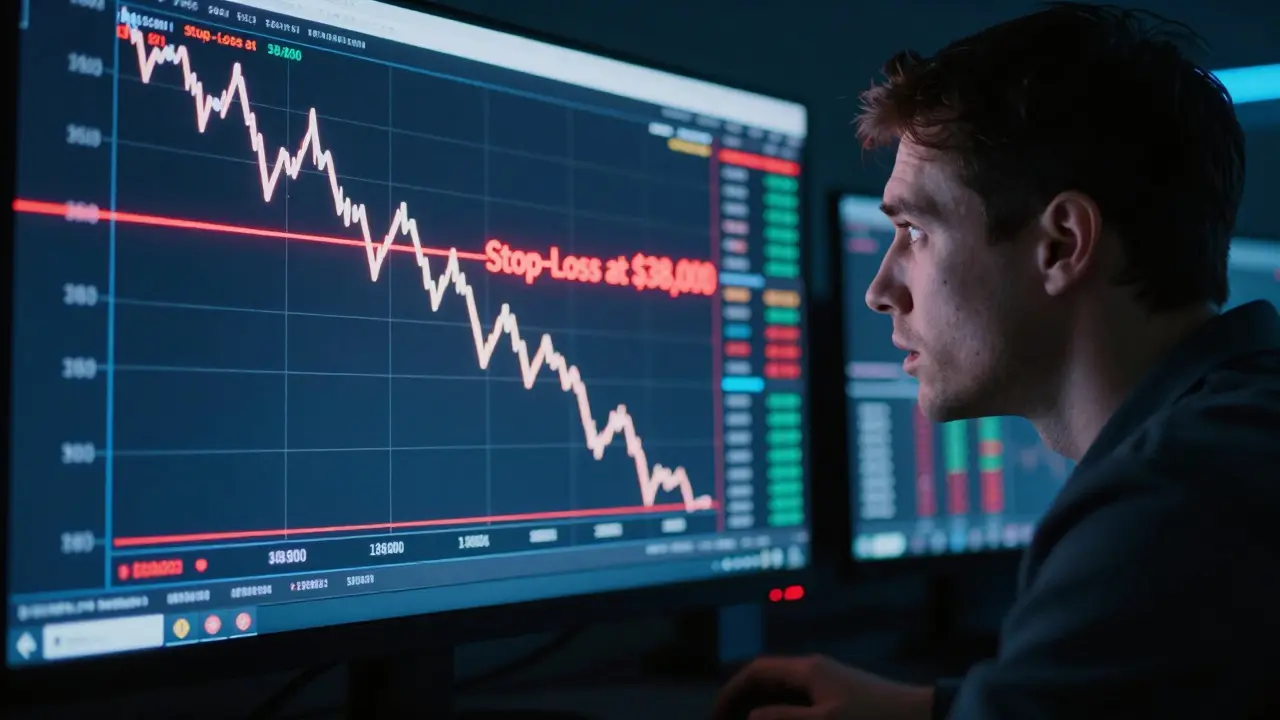
Imagine buying Bitcoin at $42,000. A few hours later, news breaks - a major exchange freezes withdrawals, panic spreads, and Bitcoin drops 25% in 90 minutes. Without a plan, you’re stuck watching your investment bleed out. That’s where a stop-loss order comes in. It’s not magic. It’s not a guarantee. But it’s the closest thing traders have to an emergency brake in crypto’s wild rides.
What Exactly Is a Stop-Loss Order?
A stop-loss order is a pre-set instruction to sell your crypto when it hits a price you’ve chosen. You don’t need to stare at your screen 24/7. You set it once, and if the market moves against you, the exchange automatically sells your asset to limit your loss. It’s not about predicting the future. It’s about controlling what you can: your exposure. Crypto doesn’t care if you’re sleeping, at work, or on vacation. Prices can crash faster than a dropped phone. Stop-loss orders help you act before emotion takes over. According to Crypto.com’s 2023 survey, 78% of professional crypto traders use stop-losses. That’s not a coincidence. It’s discipline. The University of Chicago Booth School found traders using stop-losses had 19.3% better risk-adjusted returns over 18 months than those who didn’t. But only if they set them right.Types of Stop-Loss Orders in Crypto
Not all stop-losses are the same. Different types work better in different situations. Here are the three main ones you’ll see on exchanges like Binance, Coinbase, and Kraken.1. Stop-Market Order
This is the simplest. You set a trigger price - say, $38,000 for Bitcoin. When the price hits that level, the exchange immediately places a market order to sell. It sells at whatever price is available next. Pros: Guaranteed execution. Once triggered, it sells - no matter what. Cons: Slippage. During a crash, liquidity dries up. Your $38,000 stop might execute at $35,000 or lower. Bitstamp documented cases during Bitcoin’s May 2021 crash where stop-market orders executed 12-15% below the trigger price because no buyers were around. Best for: Fast, violent drops. If you’re holding a high-risk altcoin and the market turns sour, this gets you out fast.2. Stop-Limit Order
This one has two prices: a stop price and a limit price. Say you buy Ethereum at $2,000. You set a stop at $1,800 and a limit at $1,700. When ETH hits $1,800, the order turns into a limit order to sell at $1,700 or better. Pros: You control the minimum price you’ll accept. No nasty surprises. Cons: It might not execute at all. If ETH crashes past $1,800 and keeps falling - say, to $1,650 - your order stays open forever. You’re still holding a losing position. Bitstamp’s case study showed this exact scenario: ETH dropped to $1,760 but never hit $1,700. The stop triggered, but the limit order never filled. The trader stayed exposed. Best for: Stable markets with clear support levels. If you believe the price will bounce after a dip, this protects you from selling too low.3. Trailing Stop-Loss
This one moves with the price. You set a distance - like 8% or $1,500. If you buy Solana at $120 and set a 10% trailing stop, your stop-loss starts at $108. If Solana rises to $150, your stop moves up to $135. If it drops to $135, you sell. Pros: Locks in profits as the price rises. You don’t have to manually adjust your stop. Cons: Gets triggered by noise. During sideways markets, small dips can trigger it. Tradesanta found trailing stops with distances under 5% triggered 38% more often during Ethereum’s June 2023 consolidation phase. Altrady’s backtesting showed trailing stops delivered 23.7% better risk-adjusted returns than fixed stops during Bitcoin’s 2022 bull run. But in choppy markets? They’re a liability. Best for: Strong trending markets. If you’re riding a bull run and don’t want to sell too early, this is your friend.Where to Set Your Stop-Loss
Setting a stop-loss at $40,000 because it’s a nice round number? That’s gambling. Setting it based on market structure? That’s trading. Successful traders don’t guess. They use real data.- Support levels: Look at where price bounced before. If BTC has held at $41,000 three times, setting your stop at $40,500 makes sense.
- ATR (Average True Range): This measures volatility. Bitpanda recommends setting stops at 1.5x the 14-period ATR. Their data showed this reduced false triggers by 42% compared to arbitrary percentages.
- Fibonacci retracements: Many pros place stops just below key Fibonacci levels like 61.8% or 78.6%. The Crypto Risk Management Handbook found 68% of successful stop-loss placements aligned with these levels.

The Dark Side: Stop-Loss Hunting and Exchange Failures
Stop-loss orders aren’t foolproof. In fact, they can be used against you. There’s a practice called “stop-loss hunting.” Big players - often called whales - watch where most retail traders place their stops. They push the price down just enough to trigger them, then buy back the asset at a lower price. Reddit user ‘CryptoNinja’ documented 14 Bitcoin events in 2023 where price briefly dipped below $40,000 - just enough to hit clusters of stop-losses - then bounced back up. Each time, it was a 0.8-1.2% dip. Not enough to matter long-term. Just enough to trap the unprepared. And exchanges aren’t always reliable. During the Silvergate Bank collapse in March 2023, Binance received 247 complaints about stop-loss orders not triggering. Kraken had a 22-minute outage during a 20% Bitcoin drop. Over 14,000 traders couldn’t exit. Andreas Antonopoulos warned in his 2022 update: “Relying on exchange-based stop-losses creates centralization risk.” When the system fails, you’re stuck.Advanced Tips: Partial Liquidation and Insurance
Some traders don’t want to sell everything. That’s where partial liquidation comes in. Instead of selling your entire 1 BTC position, you set a stop-loss to sell only 50%. You keep half your exposure in case the market recovers. Bitpanda notes this complicates tax reporting, but it balances risk and opportunity. Binance now offers something called “stop-loss insurance.” If Bitcoin drops more than 15% in an hour, they guarantee your stop-loss executes within 2% of your trigger price. It’s backed by their $1 billion SAFU fund. This is new. And it’s a big deal. Coinbase is testing AI-powered stop-loss suggestions in early 2024. The system will analyze market structure and recommend optimal stop levels - not just based on price, but on order book depth, volume, and volatility.