
Imagine you deposit money into a savings account, but instead of earning interest, the value of your deposit shrinks compared to just keeping the cash under your mattress. That is exactly what happens with impermanent loss in decentralized finance (DeFi). It is not a bug; it is a feature of how automated market makers (AMMs) work. If you are providing liquidity to pools on platforms like Uniswap or Curve, understanding this concept is the difference between making passive income and watching your capital evaporate during market swings.
The term "impermanent" is misleading. The loss only becomes permanent when you withdraw your funds while prices have diverged from when you deposited them. As long as you hold the position, the loss is theoretical. But if you need that capital now, the math is real. With over $54 billion locked in DeFi protocols as of late 2025, knowing which AMM design protects your assets best is critical.
How Impermanent Loss Actually Works
To understand why different designs matter, we first need to look at the baseline. Most people start with the constant product formula, famously used by Uniswap V2 is a decentralized exchange protocol using the x * y = k invariant. This formula ensures that the product of the two token reserves remains constant. When one asset’s price goes up, traders buy it, increasing its scarcity in the pool and driving the price higher within the pool until it matches the external market.
Here is the catch: as the price changes, the AMM automatically rebalances your holdings. You end up with more of the losing asset and less of the winning one. If ETH doubles in price, your pool sells half your ETH for USDC. When you withdraw, you have less ETH than if you had just held it. That opportunity cost is impermanent loss.
Let’s look at concrete numbers derived from Pintail’s analysis:
- 1.5x price change (50% increase): 1.26% impermanent loss
- 2x price change (100% increase): 5.72% impermanent loss
- 4x price change (300% increase): 20.00% impermanent loss
This hyperbolic curve means losses grow faster than price divergence. For uncorrelated assets, this risk is mathematically inevitable in constant product models.
Stablecoin Pools: The Curve Advantage
If volatility is the enemy of liquidity providers, stability is the friend. Curve Finance is a decentralized exchange optimized for low-slippage swaps between assets of similar value addresses this by using the StableSwap invariant. Instead of a pure constant product formula, Curve combines constant sum and constant product mechanics. This creates a flat curve near the peg, meaning small price deviations result in negligible rebalancing.
Why does this matter? Because impermanent loss is driven by price divergence. If you provide liquidity for USDC and USDT, both pegged to $1, they rarely diverge significantly. Data from Curve’s whitepaper shows that for price divergences under 10%, impermanent loss stays below 0.1%. In contrast, a standard Uniswap V2 pool would suffer much higher losses even with minor fluctuations because it treats every price change as a signal to rebalance aggressively.
However, Curve is not immune. During the USDC depeg event in 2022, users saw losses, but they were minimal compared to volatile pairs. Messari’s 2025 report confirms that Curve’s stableswap design shows an average loss of only 0.3% during 50% price movements when used with correlated assets, versus 8.7% in constant product AMMs. If your goal is safety and steady fees, stablecoin pools on Curve are the gold standard.
Weighted Pools: Balancer’s Middle Ground
Sometimes you want exposure to an asset without giving it equal weight in the pool. Balancer Protocol is an automated portfolio manager and trading platform allowing customizable weighted pools allows you to create pools with specific ratios, such as 80/20 or 98/2. The formula here is $x^w \times y^{(1-w)} = k$.
You might think weighting reduces risk, but it actually changes the risk profile. An 80/20 pool has a steeper curve for the minority asset. According to Balancer Labs’ research, a 50/50 pool experiences 5.72% IL during a 2x price change. However, an 80/20 pool with the same price change experiences 12.36% IL. The heavier weight amplifies the rebalancing effect on the smaller component.
This design is useful for concentrated exposure or managing large single-sided deposits, but it requires careful calculation. If you are new to DeFi, weighted pools can be a trap. They offer flexibility, but that flexibility comes with complex risk dynamics that are harder to predict than standard 50/50 pools.
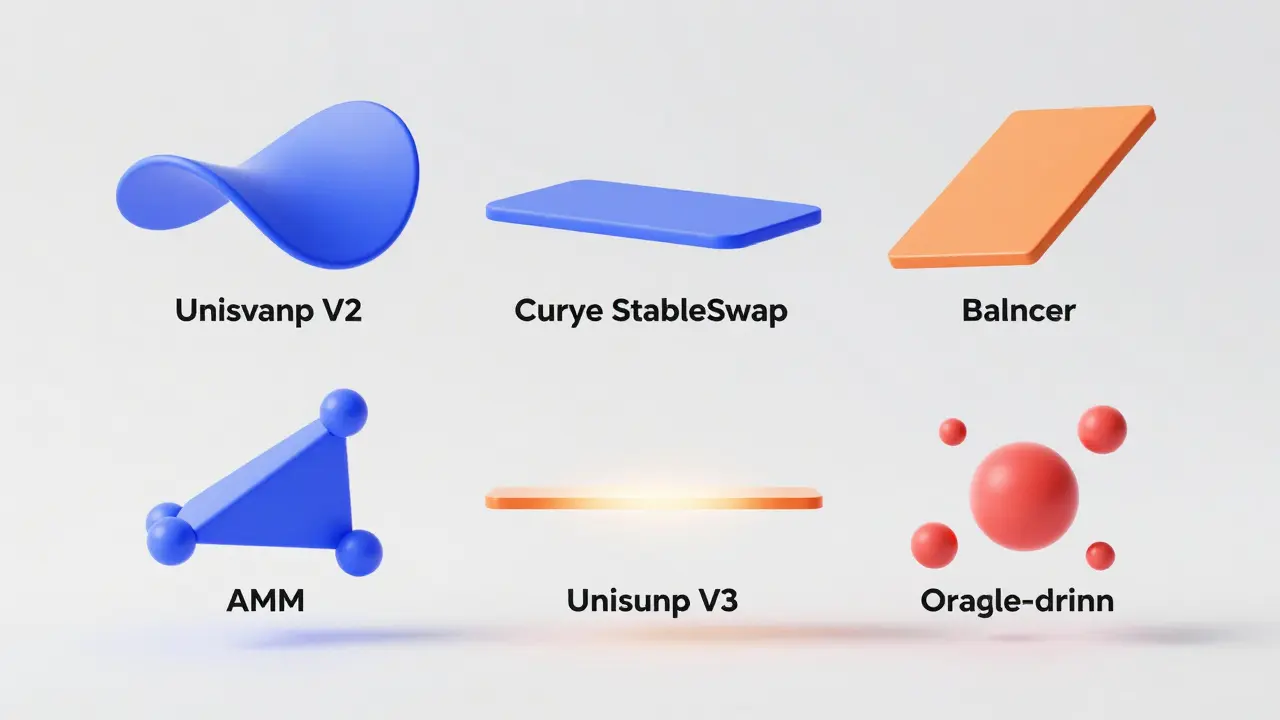
Concentrated Liquidity: Uniswap V3’s Double-Edged Sword
Uniswap V3 is an upgrade to the Uniswap protocol introducing concentrated liquidity ranges for improved capital efficiency changed the game by allowing liquidity providers to allocate capital within specific price intervals. Instead of spreading liquidity across all possible prices from zero to infinity, you pick a range, say $3,000 to $3,500 for ETH.
When the price is within your range, your capital works harder, generating more fees. Research from Gauntlet Networks shows that properly configured V3 positions can reduce impermanent loss by 30-70% compared to V2 for the same price movement. Why? Because you are not holding the losing asset outside your range. If ETH drops to $2,000 and your range starts at $3,000, your position converts entirely to USDC. You avoid the rebalancing loss because you exited the trade early.
But there is a massive downside: complexity. Misconfigured ranges can increase losses by up to 200%. If ETH crashes to $1,800 and your lower bound was $3,000, you are left with 100% USDC. While you avoided IL, you missed out on buying the dip. More importantly, if the price bounces back to $3,000, you have to re-enter manually. Active management is required. Gauntlet reports that 68.3% of new users misconfigure their ranges initially. If you cannot dedicate 15-20 hours a month to monitoring, V3 might hurt more than help.
Oracle-Driven Models: Bancor and DODO
Newer designs attempt to eliminate impermanent loss entirely by looking outside the pool. Bancor v3 is a single-sided liquidity model using Chainlink oracles to automatically rebalance pools uses oracles to track the true market price. The pool adjusts its internal pricing to match the oracle, preventing the arbitrage-driven rebalancing that causes IL.
In theory, this eliminates impermanent loss. In practice, oracle latency and failures introduce residual risks. Bancor’s transparency dashboard shows an average residual loss of 2.1% during extreme volatility due to delays in oracle updates. Similarly, DODO’s Proactive Market Maker (PMM) algorithm uses dynamic inventory management. Immunefi testing showed 1.2-3.8% residual loss during oracle failures.
These models are promising for institutional players who want predictable returns without constant monitoring. However, they rely on third-party infrastructure (oracles), which introduces smart contract and dependency risks not present in purely mathematical AMMs like Uniswap V2.
| AMM Design | Example Protocols | Avg IL (50% Price Move) | Complexity | Best For |
|---|---|---|---|---|
| Constant Product | Uniswap V2, SushiSwap | 8.7% | Low | Beginners, high-volume volatile pairs |
| StableSwap | Curve Finance | 0.3% | Low | Stablecoins, correlated assets |
| Weighted Pools | Balancer | 4.2% - 15.8% | Medium | Custom portfolio weights |
| Concentrated Liquidity | Uniswap V3 | 3.1% (Optimized) | High | Active managers, range-bound markets |
| Oracle-Driven | Bancor v3, DODO | 0.8% - 2.1% | Medium | Risk-averse investors, single-sided deposits |

Mitigating Impermanent Loss: Practical Strategies
You cannot eliminate impermanent loss completely in decentralized systems, but you can manage it. Here are three proven strategies based on user data and expert analysis.
- Pick Correlated Assets: The most effective mitigation strategy, used by 82.7% of experienced providers, is selecting highly correlated assets. Pairs like WBTC/ETH or USDC/USDT have low divergence. CoinGecko data shows IL is negligible for these pairs regardless of AMM design.
- Use Concentrated Ranges Wisely: If you use Uniswap V3, set conservative ranges. Do not try to capture every cent of price movement. Wider ranges reduce the frequency of rebalancing and lower the risk of being fully converted into the losing asset.
- Calculate Fee Coverage: Impermanent loss is only a problem if it exceeds your trading fee earnings. Hasu’s research shows that for ETH/USDC on Uniswap V2, the 0.3% fee generates ~45.6% annualized yield, covering IL for price movements under 150% over 30 days. Always check if the APY justifies the volatility risk.
Tools like Zapper.fi and Risk Harbor provide real-time IL calculators. Use them before depositing. If the projected IL over your holding period exceeds your expected fee income, do not provide liquidity.
Future Trends: Hybrid Models and Institutional Adoption
The DeFi landscape is evolving. Uniswap V4 proposes "concentrated liquidity 2.0" with hooks that could reduce IL by another 15-25%. Curve v2 introduced adaptive peg technology to handle volatile assets better. Bancor v3.1 added multi-oracle redundancy to cut residual loss to 0.8%.
Regulatory pressure is also shaping the industry. The SEC’s 2024 framework requires AMMs to disclose IL risks, pushing protocols toward greater transparency. Institutional adoption remains low (only 12.3% of participants) largely due to IL concerns. However, hybrid models combining oracle inputs with traditional formulas are predicted to reduce losses to 1-3% across diverse conditions, potentially unlocking mainstream capital.
For now, impermanent loss remains the price of decentralization. Traditional market makers adjust quotes instantly; AMMs rely on math. Understanding which math works for your risk tolerance is the key to success.
What is impermanent loss in simple terms?
Impermanent loss is the difference in value between providing liquidity to an AMM pool and simply holding those assets in your wallet. It occurs when the price of the deposited assets changes relative to each other, causing the pool to rebalance in a way that leaves you with fewer profitable assets and more depreciated ones.
Does Uniswap V3 eliminate impermanent loss?
No, Uniswap V3 does not eliminate impermanent loss. It allows you to concentrate liquidity in specific price ranges, which can reduce IL by 30-70% if configured correctly. However, misconfigured ranges can actually increase losses significantly compared to V2.
Which AMM has the lowest impermanent loss?
Curve Finance generally has the lowest impermanent loss for stablecoin pairs, often staying below 0.1% due to its StableSwap invariant. For volatile assets, oracle-driven models like Bancor v3 aim for near-zero IL, though residual risks remain due to oracle latency.
Can trading fees cover impermanent loss?
Yes, in many cases. If the trading volume is high enough, the fees earned can exceed the impermanent loss. Research suggests that for moderate price movements (under 150%), the annualized yield from fees often covers the IL. However, during extreme volatility, IL can outpace fees.
Is impermanent loss permanent?
It is only permanent when you withdraw your liquidity while the asset prices have diverged from your entry point. If prices return to your original ratio, the impermanent loss disappears. However, if you sell during a downturn, the loss becomes realized.