
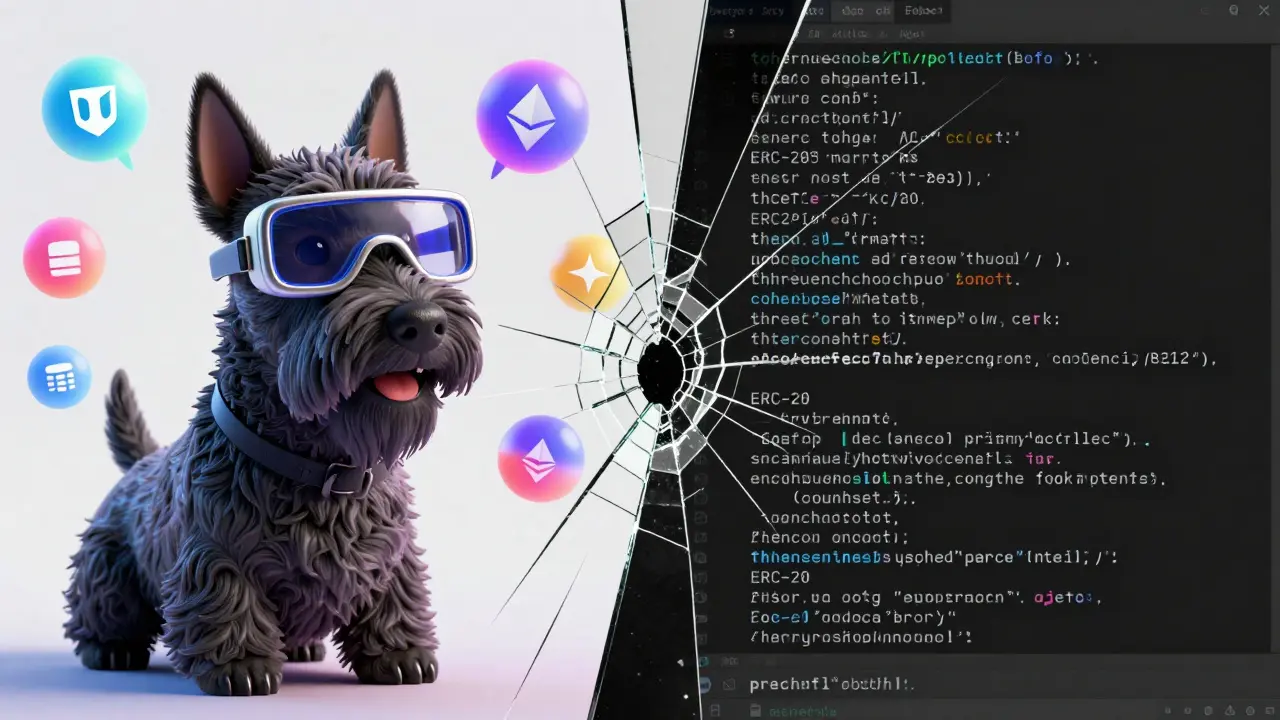
Have you ever seen a black Scottish Terrier and thought it looked like the guardian of the blockchain universe? That’s exactly the vibe Scotty The AI, known by its ticker SCOTTY, is going for. It’s a cryptocurrency that sits at the messy intersection of two massive trends: artificial intelligence and meme coins.
If you’ve stumbled upon this name on social media or a decentralized exchange, you’re probably wondering if there’s any real tech behind the cute mascot or if it’s just another speculative bet. The short answer is complicated. SCOTTY markets itself as an "AI-powered guardian" of crypto secrets, but under the hood, it operates primarily as a high-risk, micro-cap token traded on Ethereum.
The Story Behind the Mascot
To understand what SCOTTY is, you first have to look at how it brands itself. Most meme coins rely on dogs-think Dogecoin or Shiba Inu. SCOTTY tries to differentiate itself by adding a layer of sci-fi lore. The project describes its mascot, a jet-black Scottish Terrier, not just as a funny dog, but as a "wise digital guardian."
According to their narrative, Scotty uses "advanced artificial intelligence" to protect the balance and accessibility of the digital world. They frame the token as a hybrid: part community joke, part futuristic AI tool. You’ll see comparisons in marketing materials where Scotty supposedly outsmarts other "Shiba Inu Titans" in a fictional crypto arena. It’s a creative story, sure, but stories don’t pay gas fees. The key question remains: does the AI part actually exist?
Technical Reality: An ERC-20 Token on Ethereum
Let’s strip away the marketing fluff and look at the code. Technically, SCOTTY is an ERC-20 token deployed on the Ethereum blockchain. This means it follows the standard format for utility tokens on Ethereum. You can find it on Uniswap v3, the leading decentralized exchange for Ethereum assets.
The contract address starts with 0xc0db17bc..., which confirms its presence on the mainnet. Because it’s an ERC-20 token, you need an Ethereum wallet like MetaMask or Trust Wallet to hold it. If you want to buy it, you aren’t clicking "Buy" on a centralized app; you are swapping ETH (or USDT) for SCOTTY through a liquidity pool. This makes it accessible to anyone with a Web3 wallet, but it also means you are responsible for your own security and transaction costs.
While the presale allowed purchases via BNB Chain and Polygon (MATIC), the core staking mechanics and primary liquidity remain tied to Ethereum. This creates a dependency on Ethereum gas fees. When the network is congested, trading SCOTTY becomes expensive relative to its tiny price per token.
Tokenomics and Supply Distribution
When evaluating any small-cap coin, the supply structure tells you who holds the power. For SCOTTY, the numbers are relatively transparent but heavily skewed toward development and marketing rather than public circulation initially.
| Category | Amount (Approx.) | Percentage |
|---|---|---|
| Total Supply | 1.73 Billion | 100% |
| Public Sale / Presale | 520 Million | ~30% |
| Staking Rewards | 346 Million | ~20% |
| Development | 520 Million | ~30% |
| Marketing & CEX Listings | 173 Million + Reserve | ~10% + |
Notice that about 70% of the tokens were reserved for staking, development, and marketing. Only roughly 30% went to the public during the initial sale phases. This is common in early-stage projects to fund growth, but it also means a large portion of the supply could be unlocked later, potentially increasing selling pressure if the team decides to dump their holdings. Always check the vesting schedule-if those developer tokens unlock all at once, the price could crash instantly.

Price History and Volatility
Here is where things get serious for investors. SCOTTY has experienced extreme volatility, which is typical for micro-cap meme coins but dangerous for your portfolio. The token first appeared on major trackers around March 2024. It saw a massive hype cycle later that year, reaching an All-Time High (ATH) of approximately $0.0364 in November 2024.
Since that peak, the price has retraced sharply. Recent data shows the price hovering around fractions of a cent (e.g., $0.0004). That represents a drop of nearly 99% from its highest point. To put that in perspective, if you bought at the top, you would need the price to increase by 8,900% just to break even.
This level of drawdown isn't unusual for this sector, but it highlights the speculative nature of the asset. Analytical platforms like CoinCodex often classify such tokens as having "Extreme Fear" sentiment due to low volume and high downward momentum. The 30-day volatility rate frequently exceeds 14%, meaning the price swings wildly day-to-day based on small trades.
Is There Real AI Utility?
The biggest promise of Scotty The AI is the integration of artificial intelligence. But what does that actually mean for you as a user? Currently, the evidence points more to branding than to functional software.
There is no publicly available API, whitepaper detailing neural network architectures, or open-source GitHub repository linked to a working AI product. The "AI companion" mentioned in promotional videos appears to be a conceptual feature rather than a live application. While the roadmap mentions future developments, right now, SCOTTY functions as a governance-less, community-driven token without distinct utility beyond speculation and staking.
Compare this to projects like Fetch.ai or Render Network, which provide tangible services using blockchain and AI. SCOTTY lacks that infrastructure. Until a verifiable AI tool launches that requires SCOTTY tokens to operate, the "AI" label serves mainly as a marketing hook to attract trend-chasers.
How to Buy and Trade SCOTTY
If you decide the risk is worth it, here is how you actually acquire the token. You won’t find SCOTTY on major centralized exchanges like Binance Spot or Coinbase. Instead, you must use Decentralized Finance (DeFi).
- Set up a Wallet: Download MetaMask or similar Ethereum-compatible wallets.
- Fund with ETH: Buy Ethereum on a central exchange and transfer it to your wallet. Remember to keep some extra ETH for gas fees.
- Connect to Uniswap: Go to the Uniswap interface and connect your wallet.
- Swap for SCOTTY: Paste the official SCOTTY contract address into the input field. Double-check the address against official sources to avoid scams.
- Confirm Transaction: Approve the swap in your wallet. Be aware of slippage settings; due to low liquidity, you may need to set higher slippage tolerance.
Binance users can also use the "Web3 Wallet" feature within the Binance app to access DEXs directly, bridging stablecoins into Ethereum to perform the swap. This method is slightly easier for beginners but still carries the same smart contract risks.
Risks You Cannot Ignore
Before you stake your savings, consider these critical factors:
- Liquidity Risk: With a market cap under $1 million, large sell orders can wipe out the price. Exiting your position might be difficult if there aren't enough buyers.
- No Doxxed Team: The developers behind SCOTTY are anonymous. In crypto, anonymity increases the risk of "rug pulls," where creators abandon the project and take the funds.
- Regulatory Uncertainty: Meme coins face stricter scrutiny globally. Without clear utility, regulators may classify them as securities, limiting their future listing options.
- Smart Contract Vulnerabilities: While audits are planned or claimed, independent verification is crucial. Unaudited code can contain bugs that allow hackers to drain funds.
The staking rewards advertised during presales (up to 174% APR) are unsustainable long-term. High yields usually come from printing new tokens, which dilutes the value of existing holders. As more people stake, the APR drops significantly.
Final Thoughts on Scotty The AI
Scotty The AI (SCOTTY) is a classic example of a narrative-driven crypto asset. It combines the viral appeal of a dog mascot with the buzzword potential of AI. However, beneath the surface, it remains a highly speculative ERC-20 token with no proven technological advantage over competitors.
For seasoned degens looking for a lottery ticket, SCOTTY offers the possibility of massive gains if the community explodes. For rational investors seeking value, the lack of utility, extreme volatility, and anonymous team present significant red flags. Treat any money you put into SCOTTY as entertainment expense, not an investment. Never invest more than you can afford to lose completely.
Is Scotty The AI (SCOTTY) a scam?
It is difficult to definitively label any anonymous crypto project a "scam" without proof of malicious intent, but SCOTTY carries high risk characteristics. The lack of a doxxed team, extreme price volatility, and absence of a functioning AI product make it highly speculative. Users should exercise extreme caution and assume the worst-case scenario regarding capital loss.
Where can I buy SCOTTY tokens?
SCOTTY is primarily traded on decentralized exchanges (DEXs) like Uniswap on the Ethereum network. You cannot buy it directly on major centralized exchanges like Coinbase or Binance Spot. You will need a Web3 wallet (like MetaMask) and ETH to perform swaps.
Does SCOTTY have any actual AI technology?
Currently, there is no publicly verified AI software or utility associated with the SCOTTY token. The "AI" aspect is largely part of the marketing narrative and branding. Future roadmaps mention AI companions, but no operational products have been demonstrated to date.
What is the total supply of SCOTTY?
The total supply of SCOTTY is approximately 1.73 billion tokens. A significant portion of this supply was allocated to development, marketing, and staking rewards, with only about 30% released to the public during initial sales.
Is staking SCOTTY profitable?
Staking yields vary and are typically very high initially (e.g., 174% APR) but decrease rapidly as more users join. These high returns are often inflationary, meaning new tokens are created to pay rewards, which can dilute the value of your holdings. Profitability depends entirely on the token's price appreciation outpacing the inflation rate.