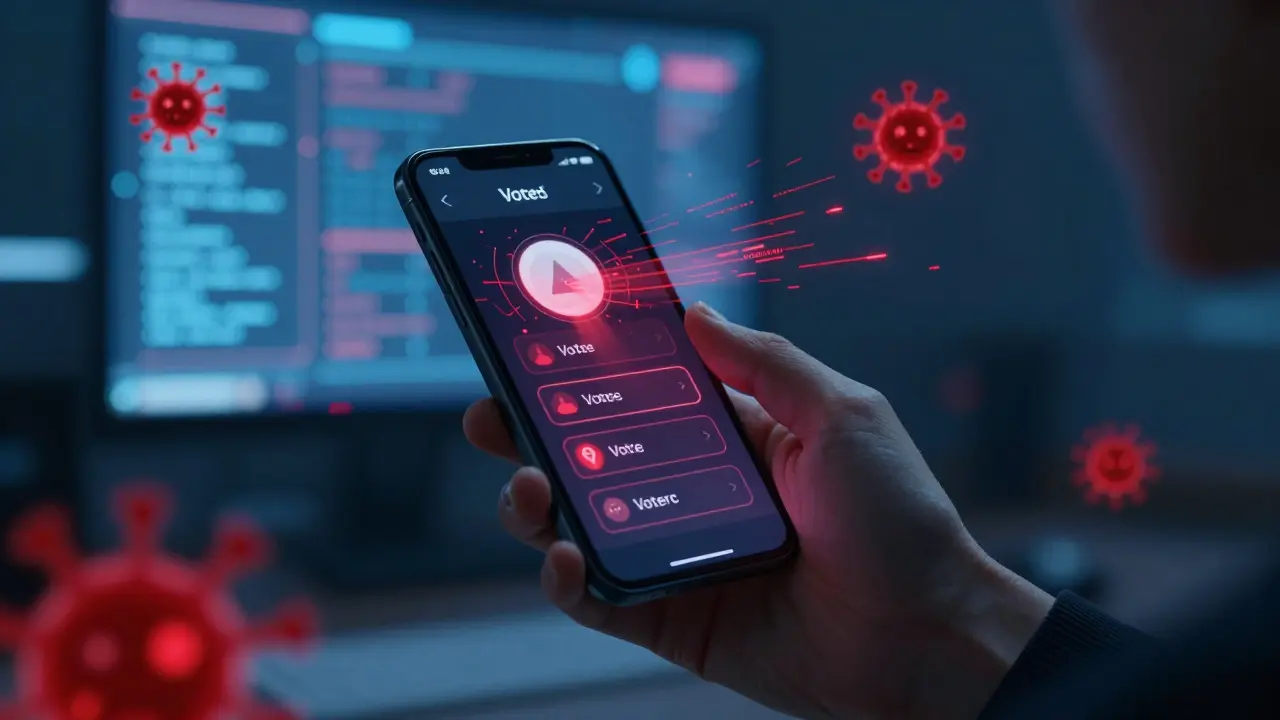
Imagine casting your ballot from your phone, watching it get recorded on an immutable ledger, and knowing for a fact that no one could tamper with the count. It sounds like the perfect democratic upgrade. But despite years of hype and pilot programs, blockchain voting has barely scratched the surface of actual adoption in major elections. Why? Because the gap between theoretical promise and practical reality is wider than most tech enthusiasts admit.
In 2025, researchers and election officials alike are hitting a wall. The U.S. Vote Foundation is a nonpartisan organization dedicated to ensuring the integrity of elections has been blunt about it: blockchain cannot currently deliver the security guarantees required for safe online elections. This isn't just skepticism; it's based on hard data showing that malware, regulatory gray areas, and privacy paradoxes make widespread adoption nearly impossible right now. If you're wondering why your country hasn't switched yet, the answer lies in these deep-rooted technical and legal headaches.
The Malware Problem: Your Phone Is Not a Secure Ballot Box
The biggest myth about blockchain voting is that the blockchain itself is the weak link. It’s not. The weak link is the device you use to vote. When you cast a vote digitally, it happens on a personal computer or smartphone before it ever reaches the distributed ledger. That initial step is vulnerable.
Malware can sit quietly on your device, changing your selection invisibly before it gets transmitted. You might think you voted for Candidate A, but the software sends Candidate B to the blockchain. Since the blockchain only records what it receives, it faithfully stores the wrong vote. Worse still, malware could silently discard your ballot entirely while sending fake confirmation data back to you. How would you know?
Foreign state actors have the resources to spread such malware to millions of devices simultaneously. Current antivirus solutions are imperfect and often lag behind new threats. In the 2000 Arizona elections, server overwhelm attacks using botnets already prevented real ballots from reaching the system. We haven't solved this basic infrastructure problem, let alone secured individual user endpoints against sophisticated cyberattacks.
Privacy vs. Transparency: The Unsolvable Paradox
Blockchain technology is built on transparency. Every transaction is visible to anyone who looks at the ledger. But democracy requires secrecy. If your vote is linked to your identity in any way, coercion becomes easy. Imagine if someone could prove how you voted to pressure you into changing your mind or to sell your political preferences to advertisers.
This creates a massive technical challenge. Systems need to be transparent enough to audit the total count without revealing individual choices. While some platforms claim to solve this with zero-knowledge proofs or anonymous credentials, implementing them correctly is incredibly difficult. A 2025 study by CoinLaw is a global law firm specializing in blockchain and cryptocurrency regulations noted that anonymity protocols boosted trust by 67% in pilot programs where users could verify their ballot was counted without exposing their ID. However, achieving 100% unlinkability while maintaining full auditability remains a cryptographic holy grail that few systems have truly mastered.
Furthermore, regulations like the GDPR is the General Data Protection Regulation, a comprehensive data privacy law in the European Union add another layer of complexity. GDPR gives citizens the "right to be forgotten." But blockchain is immutable-you can't delete data once it's written. Reconciling the permanent nature of a ledger with the temporary rights of data privacy is a legal nightmare for developers and regulators alike.
Identity Verification and Double Voting Risks
Before a vote hits the blockchain, we must know who is voting. In traditional systems, you show ID at a polling station. Online, this is far harder. How do you prove you are who you say you are without handing over sensitive biometric data to a centralized server that could be hacked?
Debut Infotech is a technology company providing digital transformation services including blockchain solutions highlights that integrating digital identity verification, such as government-issued eIDs or biometrics, is essential. Smart contracts can automate eligibility checks, but they rely on accurate input data. If the identity provider is compromised, the entire election is at risk.
Then there's the issue of double voting. In a physical booth, you can only enter once. Online, you could theoretically submit multiple votes from different devices or browser sessions. Blockchain systems attempt to fix this with one-time-use digital tokens. Once a token is used, smart contracts flag it as spent. But what if a voter loses their token? What if they forget which device they used? The friction of managing digital keys often discourages participation, especially among older demographics less familiar with crypto wallets.
| Challenge Area | Traditional Paper Voting | Blockchain Voting |
|---|---|---|
| Security Threat | Ballot stuffing, physical theft | Endpoint malware, DDoS attacks |
| Auditability | Physical recount possible | Digital audit trail, but source code opacity |
| Privacy | High (secret ballot) | Complex (requires advanced cryptography) |
| Error Correction | Easily corrected before submission | Immutable; errors are permanent |
| Accessibility | Requires physical presence | Remote access, but requires tech literacy |
Regulatory Quagmires and Legal Uncertainty
Even if the technology worked perfectly, the laws aren't ready. Many jurisdictions lack clear frameworks for accepting blockchain-based votes. Election laws are notoriously slow to change, often tied to specific physical procedures like sealed ballot boxes and witnessed counts.
A 2025 analysis by Rapid Innovation points out that regulatory hesitance is a primary barrier. Electoral bodies are risk-averse. They don't want to be the ones responsible for a rigged election due to a smart contract bug. Additionally, interoperability is a headache. If one state uses a private Ethereum fork and another uses a Hyperledger network, how do you consolidate results? Creating a universal standard for cross-jurisdictional voting is a monumental task that no single entity wants to lead.
Scalability and Cost Barriers
Let's talk money. Transitioning to blockchain voting isn't cheap. Governments have to build new infrastructure, train staff, and maintain legacy systems during the transition period. The upfront costs for specialized hardware, cybersecurity audits, and developer expertise often exceed the savings from eliminating paper ballots.
Scalability is another technical bottleneck. Public blockchains can struggle with high transaction volumes. During peak voting hours, network congestion could lead to slow confirmations or high fees. While Layer-2 scaling solutions are being proposed to handle mass elections, they add another layer of complexity and potential failure points. As noted in SSRN research, current systems simply aren't robust enough to handle the simultaneous load of national elections without significant optimization.

Voter Trust and Education Gaps
Technology fails when people don't understand it. For blockchain voting to work, voters need to trust the system. But asking the average citizen to trust a complex cryptographic protocol is a tall order. The 2025 SSRN research paper identifies lack of voter education as a primary challenge. If voters don't understand how their vote is secured, they won't participate.
Stakeholder buy-in is critical. Political parties, election officials, and the public all need assurance. While CoinLaw's data shows 91% of participants in pilots preferred blockchain for privacy, that's a controlled environment. In a high-stakes national election, the stakes are higher, and so is the scrutiny. One glitch, one perceived vulnerability, and public confidence collapses. Building that trust takes time, transparency, and flawless execution-none of which are guaranteed in early-stage tech deployments.
Current Players and Pilot Limitations
We aren't starting from zero. Platforms like Voatz is a mobile voting application that uses blockchain technology for secure remote voting, Follow My Vote is a blockchain-based voting platform designed for corporate and organizational elections, and Polyas is a European provider of secure online voting solutions compliant with strict electoral laws have run trials. Polyas, for instance, operates under strict German electoral laws, focusing on end-to-end encryption. Luxoft offers customizable systems for enterprise governance.
However, these are mostly low-stakes environments: university boards, corporate shareholder meetings, or small municipal referendums. They lack the scale, diversity, and adversarial pressure of a general election. Success here doesn't automatically translate to readiness for presidential races. The jump from counting votes for a student council to determining national leadership involves orders of magnitude more risk.
The Path Forward: Cautious Optimism
So, is blockchain voting dead? No. It's just premature. Industry experts project gradual adoption in low-stakes scenarios first. Corporate governance and internal organizational polls are likely the next frontier. These environments allow for controlled testing, better user education, and lower consequences for failure.
For government elections, the bar is much higher. We need breakthroughs in endpoint security, standardized regulatory frameworks, and perhaps hybrid models that combine digital convenience with physical verification. Until then, the dream of a fully decentralized, unhackable, and universally accessible voting system remains just that-a dream. The challenges are real, the risks are high, and the technology still has a long way to go before it earns our trust.
Is blockchain voting secure against hackers?
The blockchain ledger itself is highly secure, but the endpoints (your phone or computer) are vulnerable. Malware can alter votes before they reach the blockchain, making the system insecure at the point of entry. No current solution fully protects against sophisticated endpoint attacks.
Can blockchain voting violate GDPR?
Yes, potentially. GDPR includes the 'right to be forgotten,' allowing users to request data deletion. Blockchain is immutable, meaning data cannot be erased once written. Reconciling these conflicting requirements is a major legal and technical hurdle.
Why haven't governments adopted blockchain voting yet?
Governments face regulatory uncertainty, high implementation costs, and security concerns. The U.S. Vote Foundation and other bodies warn that current technology cannot guarantee the necessary security levels for high-stakes elections, leading to hesitation.
How does blockchain prevent double voting?
Systems use one-time-use digital tokens linked to verified voter identities. Smart contracts mark a token as 'used' after the first vote, automatically rejecting any subsequent attempts from that identity. However, this relies heavily on robust identity verification processes.
Are there any successful examples of blockchain voting?
Yes, but mostly in low-stakes environments. Companies like Polyas and Voatz have conducted pilots for corporate governance, university elections, and small municipal referendums. These tests show promise but do not yet prove readiness for large-scale national elections.