
Imagine signing a contract with your bank. You think you are agreeing to pay $100. But because of a glitch in the digital ink, the bank’s computer reads it as $100,000. Both versions look identical on paper, but the meaning is completely different. In the world of blockchain is a decentralized ledger technology that records transactions across many computers so that the record cannot be altered retroactively, this scenario is called a hash collision is an event where two different inputs produce the same output hash value using a specific hash function. If this happens, the entire foundation of trust in cryptocurrency could crumble.
You might wonder why this matters to you. Whether you hold Bitcoin, use Ethereum smart contracts, or just believe in secure digital records, hash collisions represent one of the most critical theoretical risks to cryptocurrency is a digital or virtual currency secured by cryptography that is independent of a central bank. A successful collision attack doesn’t just break a code; it breaks the immutability that makes blockchains valuable. Let’s break down what a hash collision actually is, why it’s mathematically inevitable, and how modern blockchains protect against it.
The Math Behind the Magic: How Hash Functions Work
To understand the risk, we first need to understand the tool. At the heart of every major blockchain is a cryptographic hash function is a mathematical algorithm that converts an input of arbitrary size into an output of a fixed size. Think of it like a blender. You put in a recipe (data), blend it up, and get out a smoothie (the hash). The smoothie always has the same consistency and volume, no matter if you put in a single strawberry or a whole watermelon.
For a hash function to be useful in security, it needs three specific traits:
- Deterministic: The same input always produces the exact same output. If you blend that strawberry again, you get the exact same smoothie.
- One-way: You cannot reverse the process. Looking at the smoothie, you can never figure out exactly which strawberries were used or how ripe they were.
- Avalanche Effect: A tiny change in input creates a massive change in output. If you add one grain of salt to the strawberry, the resulting smoothie looks completely different from the original.
Bitcoin uses SHA-256 is a cryptographic hash function that produces a 256-bit hash value, widely used in Bitcoin mining and security. This means every transaction gets a unique 256-bit fingerprint. This fingerprint links blocks together, creating the "chain" in blockchain. If someone tries to change a past transaction, the hash changes, breaking the link to the next block, and alerting the entire network.
What Is a Hash Collision?
So, what goes wrong? A hash collision occurs when two different inputs produce the same output hash. Going back to our blender analogy, imagine putting in a strawberry and getting a red smoothie. Then, you put in a red apple, and somehow, you get the exact same red smoothie. To anyone looking at the smoothie, it’s impossible to tell if the original ingredient was a strawberry or an apple.
In blockchain terms, this is catastrophic. If an attacker can create two different transactions that have the same hash, they could potentially swap one for the other without the network noticing. For example, they could replace a transaction sending 1 BTC to themselves with a transaction sending 0 BTC, but keep the same hash ID. The rest of the chain would still validate because the hash matches, even though the underlying data has been corrupted.
Why Collisions Are Mathematically Inevitable
You might ask, "Can’t we just make the hash longer so this never happens?" Here is the hard truth: collisions are not just possible; they are guaranteed. This comes down to a simple logic puzzle known as the Pigeonhole Principle is a mathematical principle stating that if more items are put into containers than there are containers, at least one container must contain more than one item.
If you have infinite possible inputs (any message, any transaction) but a finite number of outputs (fixed-length hashes), eventually, two inputs must share the same output. It’s like trying to fit 366 people into 365 hotel rooms. Someone has to share a room.
This leads to the Birthday Paradox is a probability phenomenon showing that in a group of just 23 people, there is a 50% chance two share the same birthday. In cryptography, this means you don’t need to check every possible input to find a collision. You only need to check a surprisingly small number. For a weak hash function, finding a collision might take seconds. For a strong one, it takes billions of years.
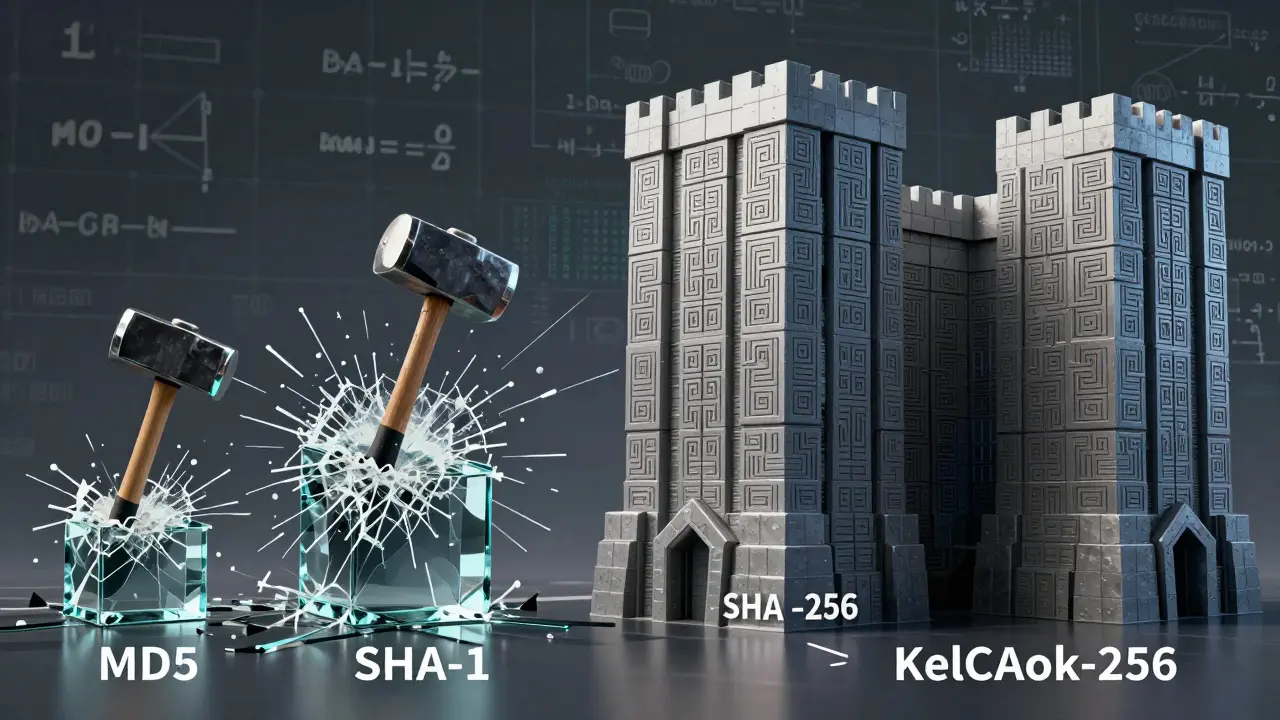
History of Broken Hashes: MD5 and SHA-1
We aren’t just theorizing about this. We have seen it happen. Years ago, the tech industry relied on MD5 is a widely used cryptographic hash function producing a 128-bit hash value, now considered cryptographically broken. It was fast and convenient. But researchers found ways to generate collisions easily. Today, MD5 is useless for security. You can create two different PDF documents that have the same MD5 hash. One could be a harmless letter, and the other a virus. Your antivirus might miss it because the "fingerprint" looks clean.
Then came SHA-1 is a cryptographic hash function designed by the NSA, producing a 160-bit hash value, deprecated due to practical collision attacks. It was stronger than MD5, but in 2017, Google and CWI Amsterdam executed the "SHAttered" attack. They created two different PDF files with the same SHA-1 hash. It took them significant computing power, but they did it. After that, SHA-1 was officially retired from security applications.
This history shows us that no hash function is safe forever. As computing power grows, what was once secure becomes vulnerable.
| Algorithm | Output Size | Security Status | Collision Resistance |
|---|---|---|---|
| MD5 | 128-bit | Broken | None (Collisions easy to generate) |
| SHA-1 | 160-bit | Deprecated | Weak (Practical attacks demonstrated) |
| SHA-256 | 256-bit | Secure | Strong (Requires ~2^128 operations) |
| Keccak-256 | 256-bit | Secure | Strong (Used in Ethereum) |
Why Blockchains Are Still Safe (For Now)
If MD5 and SHA-1 fell, why should you trust Bitcoin? The answer lies in the sheer size of the numbers involved. Bitcoin uses SHA-256. The output space is 2^256. That is a number with 78 digits. To put that in perspective, the number of atoms in the observable universe is estimated at around 10^80. SHA-256’s output space is comparable to the number of atoms in the universe.
Finding a collision in SHA-256 requires roughly 2^128 computational attempts. Even with the most powerful supercomputers on Earth, this would take millions of years. Ethereum uses Keccak-256 is a variant of the Keccak hash function, selected as the basis for the SHA-3 standard, used extensively in Ethereum, which offers similar robustness. These algorithms are not just slightly better than their predecessors; they are exponentially harder to break.
However, "hard" does not mean "impossible." Two future threats loom large: quantum computing and implementation errors.

The Quantum Threat
Classical computers search for collisions linearly. Quantum computers, however, use principles of superposition to evaluate multiple possibilities simultaneously. Algorithms like Grover’s Algorithm can speed up search processes significantly. While a quantum computer wouldn’t instantly break SHA-256, it would reduce the effective security margin. What takes millions of years today might take days or weeks with advanced quantum hardware.
This is why the National Institute of Standards and Technology (NIST) is currently standardizing post-quantum cryptography is cryptographic algorithms designed to be secure against an attack by a quantum computer. Blockchain developers are already researching how to migrate networks to these new standards before quantum computers become powerful enough to pose a real threat.
Smart Contract Vulnerabilities: It’s Not Just the Hash
Sometimes, the hash function itself isn’t the problem. The problem is how developers use it. In smart contracts are self-executing contracts with the terms of the agreement between buyer and seller being directly written into lines of code, particularly those written in Solidity for Ethereum, developers often use encoding functions to combine data before hashing it.
A common mistake involves using `abi.encodePacked`. If you concatenate two strings without a separator, you can create a collision. For example, hashing "abc" + "de" might produce the same result as "ab" + "cde" if the boundaries aren’t clear. Attackers have exploited this to drain funds from DeFi protocols. This isn’t a failure of the hash algorithm; it’s a failure of the developer’s logic. It serves as a reminder that human error remains the weakest link in security.
How to Protect Yourself and Your Projects
If you are an investor, the good news is that major blockchains like Bitcoin and Ethereum are actively monitored by thousands of experts. They will migrate away from vulnerable algorithms long before they are broken. If you are a developer building on blockchain technology, follow these rules:
- Never roll your own crypto: Use established, audited libraries for hashing.
- Avoid deprecated algorithms: Do not use MD5 or SHA-1 for any security purpose.
- Be careful with encoding: When combining data in smart contracts, use explicit separators or structured encoding methods to prevent type confusion collisions.
- Stay updated: Follow NIST guidelines and community announcements regarding cryptographic standards.
Hash collisions are a fundamental reality of mathematics, but they are not a immediate threat to current blockchain security. By understanding the difference between theoretical inevitability and practical feasibility, we can appreciate why systems like Bitcoin remain robust. The key is vigilance. As technology evolves, so must our defenses.
Can a hash collision allow me to steal Bitcoin?
Not directly. Stealing Bitcoin requires compromising private keys, which relies on elliptic curve cryptography, not just hashing. However, a hash collision could theoretically allow an attacker to alter transaction history or create invalid blocks, undermining the integrity of the ledger. Currently, the computational cost to find a SHA-256 collision is so high that it is practically impossible.
What is the difference between a pre-image attack and a collision?
A collision is finding two different inputs that produce the same hash. A pre-image attack is trying to reverse-engineer the original input from a given hash. Hash functions are designed to resist both, but they are distinct mathematical challenges. Blockchain security primarily relies on collision resistance to maintain chain integrity.
Will quantum computers break blockchain hashes?
Quantum computers will reduce the time required to find collisions and break certain encryption types. However, current estimates suggest that while they pose a long-term threat, they do not immediately invalidate SHA-256 or Keccak-256. The industry is preparing post-quantum cryptographic solutions to mitigate this risk before it becomes critical.
Why did Google's SHAttered attack matter?
The SHAttered attack proved that SHA-1, previously considered secure, could be practically broken. It showed that attackers could create two different PDFs with the same hash, one benign and one malicious. This forced the global tech industry to abandon SHA-1, highlighting the importance of moving to stronger algorithms like SHA-256.
Is Ethereum safer than Bitcoin regarding hash collisions?
Both are highly secure. Bitcoin uses SHA-256, and Ethereum uses Keccak-256. Both algorithms offer 256-bit security levels, making collision attacks computationally infeasible with current technology. Neither is inherently "safer" in this regard; both rely on robust, well-tested cryptographic primitives.