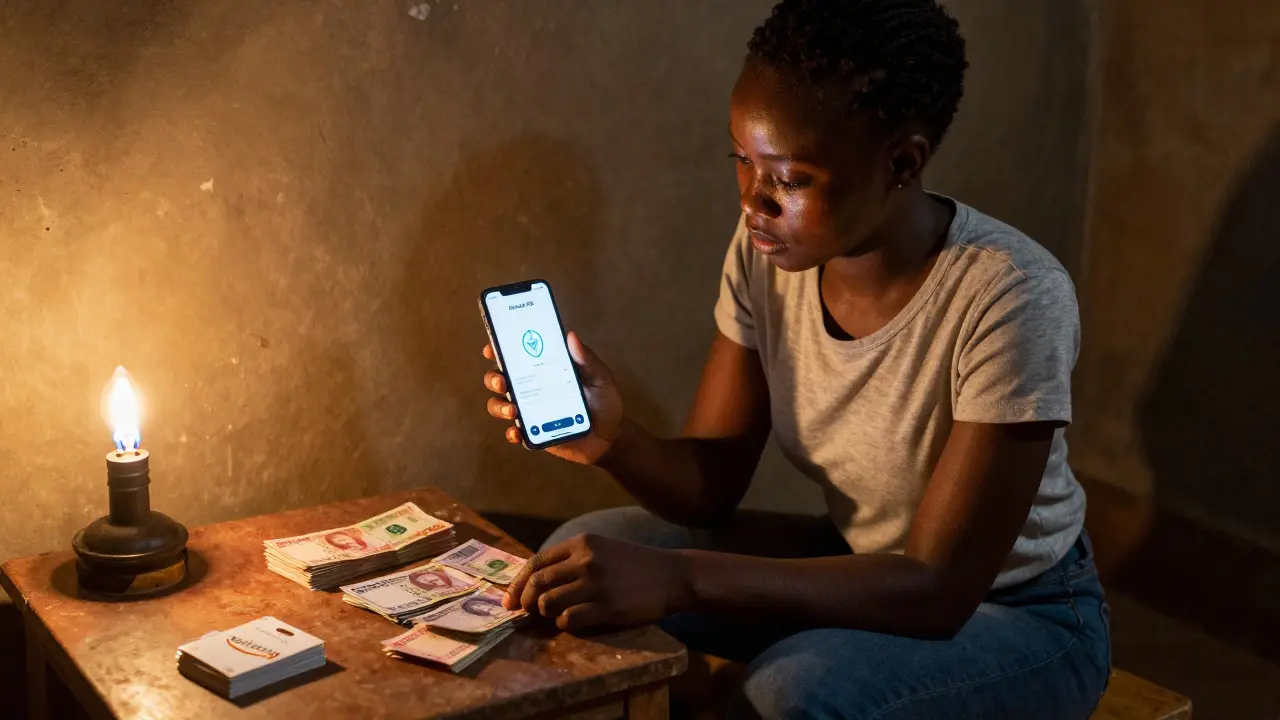
When your bank won’t let you send money abroad, when your government blocks crypto apps, and when your local currency is falling fast - what do you do? For millions of people in countries like Nigeria, Vietnam, Bangladesh, and Iran, the answer isn’t waiting for permission. It’s finding a way. And over the last five years, they’ve built an underground network of tools, tricks, and trusted peers to get access to cryptocurrency exchanges - even when it’s officially illegal.
Why banks block crypto - and why people still use it
Countries like Nigeria, China, and Bangladesh didn’t ban crypto because it was too risky. They banned it because it was too powerful. In Nigeria, the Central Bank shut down crypto transactions in 2021 after people started using Bitcoin to protect their savings from the naira’s collapse. In China, the government cracked down to stop capital flight and control energy use from mining. In Bangladesh, trading crypto became a criminal offense under anti-money laundering laws. But money doesn’t disappear just because a law says so. In Nigeria, 5.7 million people now own crypto. In Vietnam, over 5 million use it despite fines of up to $8,800. Why? Because crypto isn’t just about speculation. It’s about survival. It’s how people pay for medical care, send money to family overseas, or buy food when banks freeze accounts. When inflation hits 50%, and your salary buys less each week, crypto becomes the only tool that moves faster than the government.The top 5 ways people get around banking bans
People don’t use one method. They stack them. Like layers of armor. Here’s what actually works in 2026:- Peer-to-peer (P2P) platforms - This is the #1 method. Sites like Paxful, LocalBitcoins, and Binance P2P connect buyers and sellers directly. You pay someone in cash, mobile money, or bank transfer. They send you Bitcoin or USDT. No bank needs to know. In Nigeria alone, Paxful processed over $1.1 billion in P2P trades in 2024. Users often trade with middlemen - trusted locals who handle the fiat side so you don’t have to link your account.
- No-KYC decentralized exchanges (DEXs) - Platforms like Uniswap, PancakeSwap, and Bisq don’t ask for ID. You connect your wallet (like Trust Wallet or MetaMask) and trade directly on the blockchain. No sign-up. No verification. Just a seed phrase and internet. These aren’t for beginners - but for those who’ve learned, they’re the most private way to trade.
- Gift card arbitrage - Buy a $500 Amazon or Steam gift card with naira, taka, or dong. Sell it on Paxful or Bitrefill for Bitcoin. It sounds weird, but it’s real. Chainalysis found $427 million in gift card crypto trades from restricted countries in 2024. People do this because gift cards are easy to get, hard to trace, and accepted everywhere.
- VPNs and Tor - If your government blocks Binance or Coinbase, you use a VPN. NordVPN saw a 342% jump in users from Nigeria in 2024. Tor Browser is used in Iran and North Korea to access hidden services. These aren’t just tools - they’re lifelines. But they’re not foolproof. Some governments now detect and block known VPN IPs. The best users rotate between multiple providers.
- Hawala networks adapted for crypto - In the Middle East and South Asia, people have used hawala - an informal money-transfer system - for centuries. Now, it’s being used to move crypto. A trader in Dubai receives cash from someone in Pakistan, then sends Bitcoin to their wallet in Karachi. No paper trail. No bank records. Over $30 billion flowed through these networks in 2023-2024, according to Sumsub.
What doesn’t work - and why
Not every trick lasts. Many users get burned because they trust the wrong tool.- Centralized exchanges with KYC - Platforms like Coinbase or Kraken require ID. If you’re in a banned country, they’ll freeze your account. Even if you use a fake passport, they’ll catch you. And when they do, your money vanishes.
- Scam “crypto banks” - A lot of people in Nigeria and Venezuela get targeted by fake apps promising 20% monthly returns. These are Ponzi schemes. The IMF says 41% of Nigerian crypto users have lost money to platforms that later disappeared.
- Using your real phone number - If you register on Paxful with a Nigerian or Iranian number, your account gets flagged. Many users buy SIM cards from neighboring countries or use virtual numbers. One user in Bangladesh told me: “I used my brother’s Indian phone number for six months. Then they locked me out. I had to start over.”
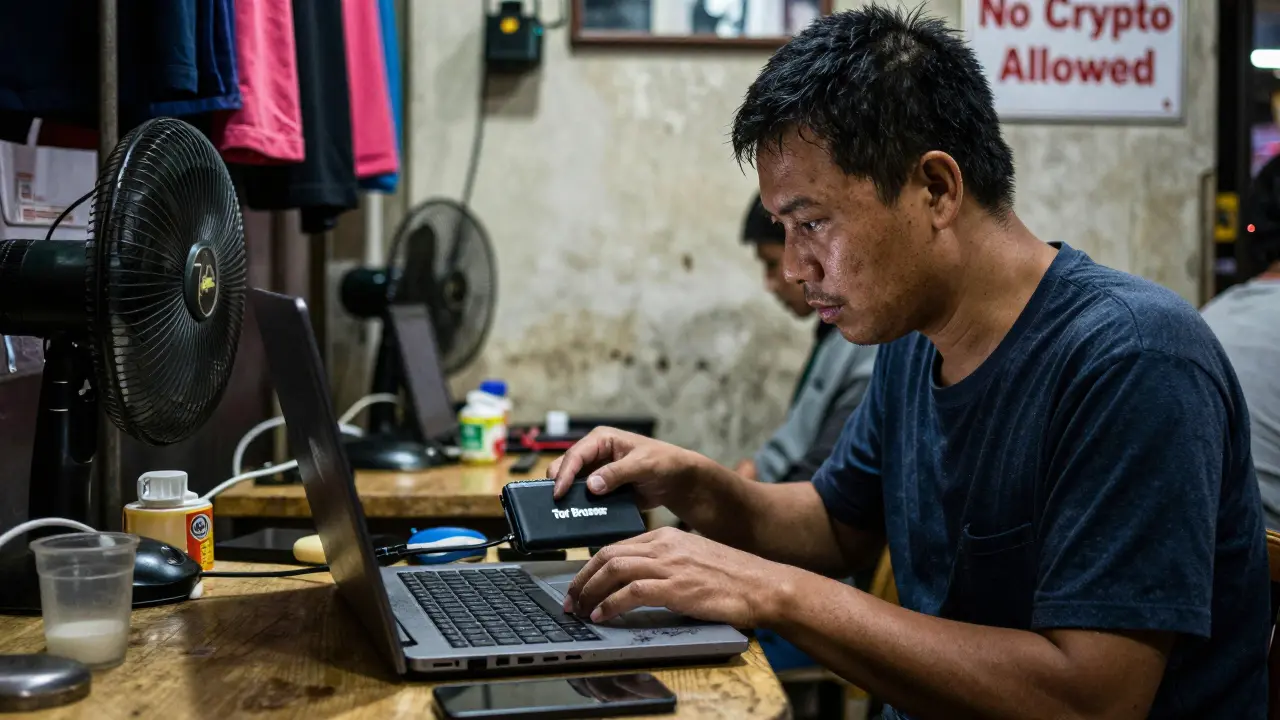
The hidden costs: Time, risk, and trust
Accessing crypto isn’t just technical. It’s emotional. It’s exhausting.- It takes weeks to learn - A CryptoSlate guide for Iranian users showed it takes 3-5 weeks to set up a reliable system. You need to understand wallets, seed phrases, gas fees, and how to spot phishing links. 78% of new users in restricted countries need help backing up their keys. Lose your seed phrase? Your money is gone forever.
- Security is a daily battle - A 2025 survey found 67% of users in restricted countries experienced a security incident. That means phishing, fake apps, or hacked wallets. One Reddit user from Nigeria lost $2,300 after clicking a link that looked like Binance. He didn’t know it was a clone site.
- Support is almost nonexistent - Most no-KYC exchanges don’t have customer service in Swahili, Bengali, or Farsi. If something goes wrong, you’re on your own. Response times for support tickets? Over 58 hours. That’s two full days of panic.
Who’s winning - and who’s losing
The biggest winners? The users who treat crypto like a utility, not a gamble. People who use it to pay rent, buy medicine, or send money home. They’re not day-trading. They’re surviving. The biggest losers? The people who think crypto is a get-rich-quick scheme. They borrow money to buy Bitcoin. They trust strangers on Telegram. They ignore warnings. And when the market dips or a platform shuts down, they lose everything. Governments are catching up. In January 2025, OKX blocked users from 20 countries, including Algeria and Bangladesh. In April, the U.S. proposed rules that could force exchanges to verify users even if they’re not American - which would cut off many workarounds. But here’s the thing: every time a government cracks down, people find a new way. When Nigeria banned bank transfers, P2P surged. When China blocked exchanges, DEXs grew. When Vietnam fined traders, Binance P2P became the default. Innovation isn’t happening in Silicon Valley. It’s happening in Lagos, Hanoi, and Tehran - in living rooms, on WhatsApp groups, and in dark web forums.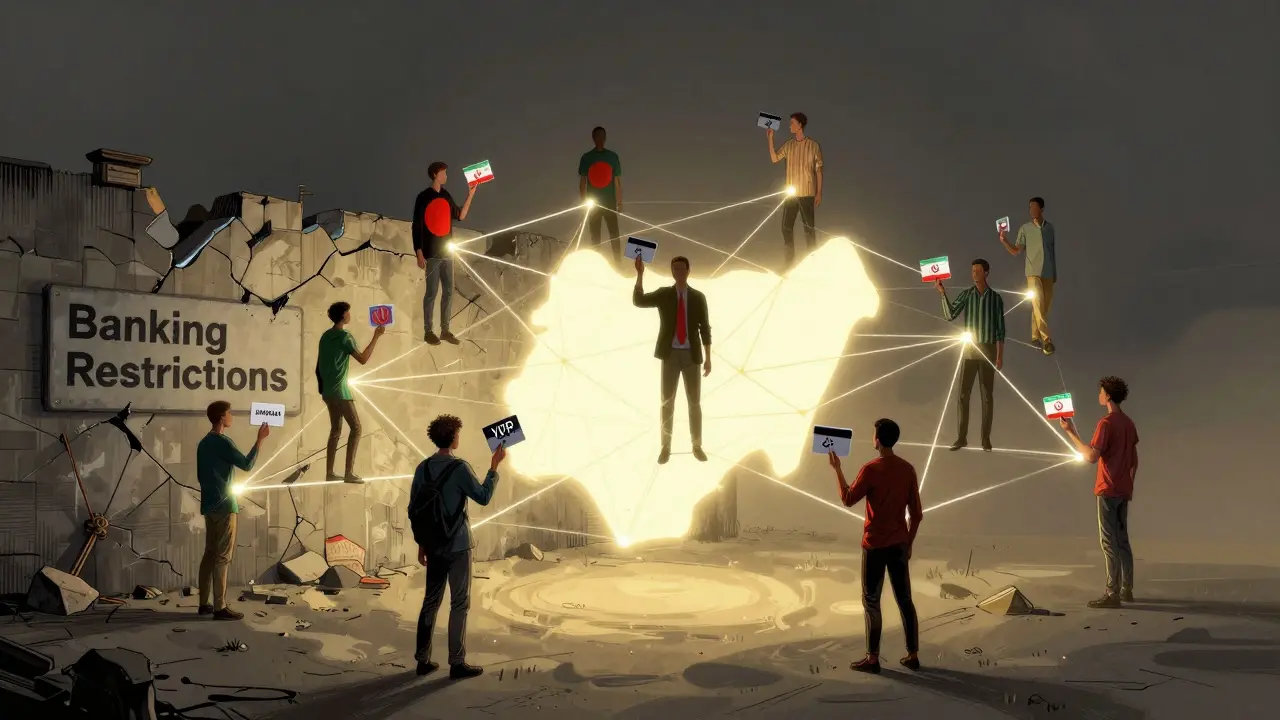
What’s next? Privacy tech and zero-knowledge proofs
The next wave isn’t about hiding your IP. It’s about hiding your transactions. Privacy coins like Monero and Zcash are growing fast. In China, Monero adoption jumped 317% since 2023. These coins make it nearly impossible to track where money goes. But they’re still small - only 2.3% of the total crypto market. The real game-changer? Zero-knowledge proofs (ZKPs). This tech lets you prove you own crypto without showing your balance or transaction history. Gartner predicts ZKP adoption in restricted countries will grow 340% by 2026. Imagine being able to trade crypto on a DEX - and your government can’t see a single detail. That’s not science fiction. It’s already being built.Final thought: It’s not about crypto. It’s about freedom
People in restricted countries aren’t using crypto because they love technology. They’re using it because they have no other choice. They’re not trying to outsmart the system. They’re trying to live in it. The banks and regulators think they’re shutting down crypto. But they’re only forcing it to get smarter, quieter, and more resilient. And every time someone in a banned country sends $50 to their sister overseas using a gift card and a VPN - they’re not breaking a law. They’re rewriting it.Can you use crypto in countries where it’s banned?
Yes, but it’s risky. In countries like Nigeria, Vietnam, and Bangladesh, using crypto isn’t legal - but millions do it anyway. People use peer-to-peer platforms, VPNs, and no-KYC exchanges to bypass restrictions. While the government can fine or jail users, enforcement is patchy. Most people avoid detection by using cash, gift cards, or trusted intermediaries instead of linking their bank accounts directly.
What’s the safest way to buy crypto without KYC?
The safest method is using a decentralized exchange (DEX) like Uniswap or PancakeSwap with a non-custodial wallet (e.g., Trust Wallet). You need to buy your first crypto through a P2P platform or gift card trade, then move it to the DEX. Avoid platforms that ask for ID or phone verification. Never share your seed phrase. Use a VPN to hide your location. The key is minimizing exposure: don’t link your real identity to any transaction.
Why do people use gift cards to buy crypto?
Gift cards (like Amazon, Steam, or Apple) are easy to buy with local currency and don’t require a bank account. You can purchase them at street vendors or supermarkets, then sell them on Paxful or Bitrefill for Bitcoin or USDT. Since gift cards aren’t tied to your identity, they’re harder for banks and regulators to track. In 2024, $427 million in crypto was bought this way from restricted countries.
Are VPNs enough to protect your crypto activity?
VPNs help hide your location, but they’re not enough alone. Governments can block known VPN servers, and some exchanges now detect VPN traffic. The best users combine a VPN with no-KYC exchanges, privacy coins, and avoiding personal details. Also, free VPNs are dangerous - many sell your data. Stick to paid ones like NordVPN or ExpressVPN. But remember: if you use your real name or phone number anywhere, the VPN won’t save you.
What happens if your crypto account gets frozen?
If you use a centralized exchange like Binance or Bybit and your account is flagged, you may lose access to your funds. Many users report being locked out for days or weeks with no explanation. For this reason, most experienced users avoid keeping large amounts on exchanges. Instead, they withdraw to their own wallet - one they control with a seed phrase. If you lose access to a platform, your crypto is safe as long as you have your private keys.
Is crypto adoption growing in restricted countries?
Yes - and it’s accelerating. Nigeria ranked 4th globally in crypto adoption in 2025, and Vietnam was 7th, according to Chainalysis. Even with bans, transaction volumes from restricted countries hit $1.27 trillion in 2024. P2P trading makes up nearly 40% of that. People aren’t waiting for permission. They’re building their own financial systems - one transaction at a time.