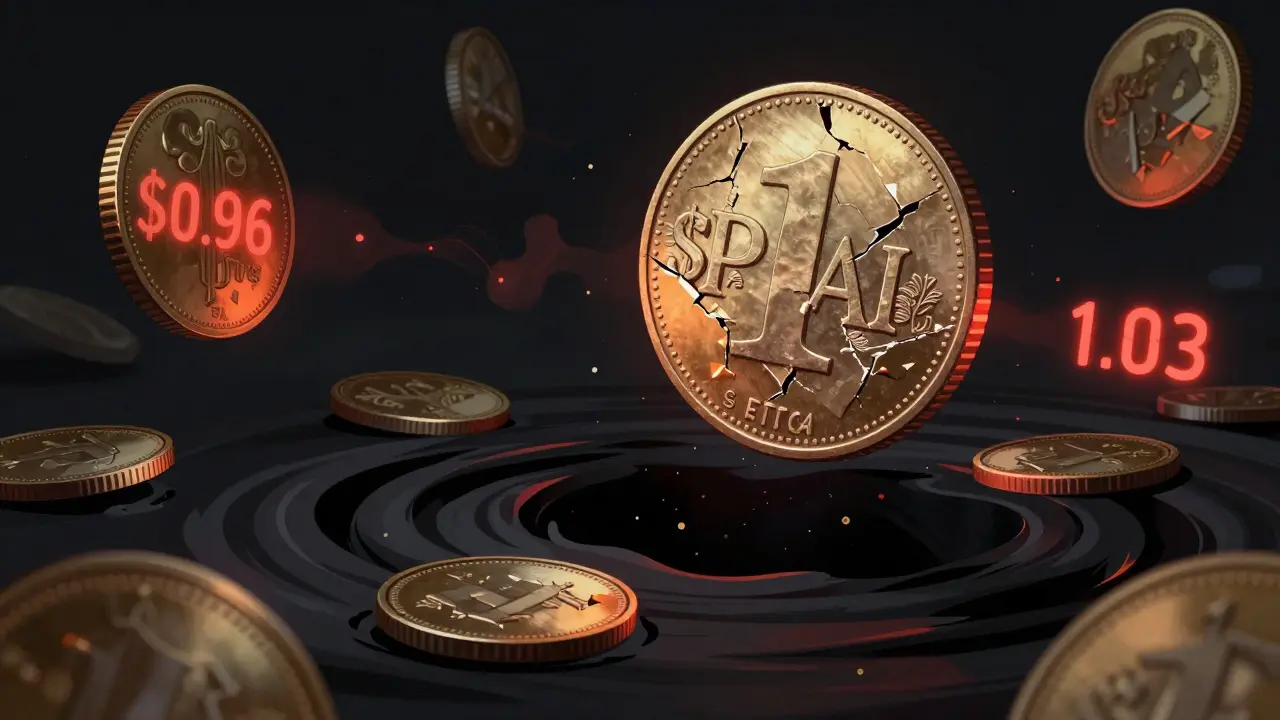
PAI Slippage Calculator
PAI trades at inconsistent prices across exchanges ($0.96 on Binance, $1.03 on LiveCoinWatch) and experiences slippage over 15% on small trades. This calculator shows how much value you could lose when trading PAI due to its instability.
Estimated Value After Trading
$0.00
Slippage: 0%
Parrot USD (PAI) is a stablecoin built on Solana that claims to unlock value trapped in DeFi liquidity pools. But here’s the truth: it’s not working like a real stablecoin should. While it promises to let users borrow against their LP tokens without selling them, the reality is messy, underused, and unstable.
What PAI is supposed to do
Most stablecoins like USDC or DAI hold cash, Treasury bills, or crypto as collateral to stay worth $1. PAI does something different. It uses liquidity provider (LP) tokens as collateral. These LP tokens come from users who deposit pairs of crypto assets into decentralized exchanges like Raydium or Orca to earn trading fees. The problem? Those LP tokens are tied to volatile assets - if the price of SOL and USDC swings, the value of the LP token swings too. PAI tries to turn that risky collateral into a $1 stablecoin.
The idea sounds clever. If you’re holding LP tokens that are locked up and earning little, why not borrow against them? That’s the promise of Parrot Protocol: mint PAI tokens, use them to trade or lend, then repay and get your LP tokens back. It’s like using your car as collateral to get a loan - except your car is changing value every minute.
Why the numbers don’t add up
Look at the data, and you’ll see confusion everywhere. On Binance, PAI trades at $0.96. On LiveCoinWatch, it’s $1.03. On LBank, it’s $0.05. That’s not a bug - it’s a red flag. A real stablecoin should trade within pennies of $1 across all exchanges. If it’s swinging wildly, it’s not stable.
Market cap numbers are just as unreliable. CoinGecko says PAI’s market cap is around $1.45 million. CoinMarketCap says it’s zero. Trading volume? One source says $202 in 24 hours. Another says over $4 million. These aren’t typos - they’re signs the market doesn’t trust the data, or the token isn’t being traded seriously.
Even the circulating supply is disputed. CoinGecko says 4.2 million PAI are in circulation. CoinMarketCap says zero. That’s not a minor disagreement - it means no one knows how many tokens are actually out there, which makes valuation impossible.
It’s not just small - it’s inactive
PAI isn’t just a tiny project. It’s a dead one. The Parrot Protocol website hasn’t updated since mid-2023. Its GitHub repository hasn’t had a commit since August 2022. That’s over two years of silence. No new features. No bug fixes. No community updates.
Compare that to DAI, which has thousands of developers, dozens of audits, and billions in TVL. PAI has no public team, no roadmap, and no active developers. The whitepaper laid out a three-phase plan: create PAI, build a lending market, add margin trading. Only the first phase was even half-implemented - and even that’s barely functional.
Users who tried to trade PAI report slippage over 15% on small trades. That’s not liquidity - that’s a graveyard. If you try to swap 10,000 PAI and lose 15% of your value just by hitting ‘swap,’ it’s not a stablecoin. It’s a trap.

Who even uses it?
There are about 5,760 wallet addresses holding PAI, according to CoinMarketCap. That’s less than the number of people who bought a single NFT from a random collection last week. Reddit has only three posts about PAI in the last year. Bitcointalk has two old threads with a total of 12 replies. No major exchange lists it prominently. No DeFi dashboard includes it in its top 100 stablecoins.
There are no reviews on Trustpilot. No YouTube tutorials. No Medium articles explaining how to use it. The only positive comment found was a single line on CoinSwitch: “Good concept, needs more liquidity.” That’s not a user base - that’s a ghost town.
Why it’s not safe - even if you believe the hype
Stablecoins need to be stable. PAI isn’t. Its all-time high was $2.19. Today, it’s around $0.96. That’s a 56% drop from its peak. And it’s not because the market crashed - it’s because the system can’t hold its peg.
Why? Because LP tokens are volatile. If the price of the assets inside them drops, the collateral backing PAI drops too. The protocol doesn’t have enough overcollateralization - meaning if the value of the LP tokens falls, there’s not enough buffer to keep PAI at $1. No emergency mechanism. No liquidation system. No reserve fund.
And now, regulators are watching. The EU’s MiCA rules, effective in 2025, require stablecoins to be backed 1:1 by cash or ultra-safe assets. LP tokens? Not allowed. PAI doesn’t meet the bar. If regulators crack down, this token has zero legal footing.
Is PAI worth anything?
Not as a currency. Not as a store of value. Not as a tool for DeFi.
It’s a proof-of-concept that never got off the ground. A creative idea that ran into the hard reality of DeFi: if you don’t have liquidity, adoption, security, or transparency, no one will use it - no matter how clever the math looks on paper.
Some early Solana DeFi builders tried PAI as a test. Most moved on. Others lost money trying to trade it. The few who still hold it are either waiting for a miracle or don’t know better.
There’s no upgrade coming. No team to fix it. No exchange to list it properly. No community to support it. It’s not a crypto coin you can use. It’s a crypto coin that exists only on paper - and even then, the paper is outdated.
What should you do?
If you’re looking for a stablecoin on Solana, use USDC. It’s issued by Circle, backed by real reserves, audited monthly, and accepted everywhere. It trades at $1.0001, not $0.96 or $1.03. It has volume. It has trust. It has a team that answers questions.
If you want to earn yield from LP tokens, use platforms like Marinade or Lido that let you stake them directly. You’ll get better returns, lower risk, and real support.
PAI? Don’t invest. Don’t trade. Don’t mint. It’s not a financial tool. It’s a relic - a quiet experiment that lost its way before it ever found one.