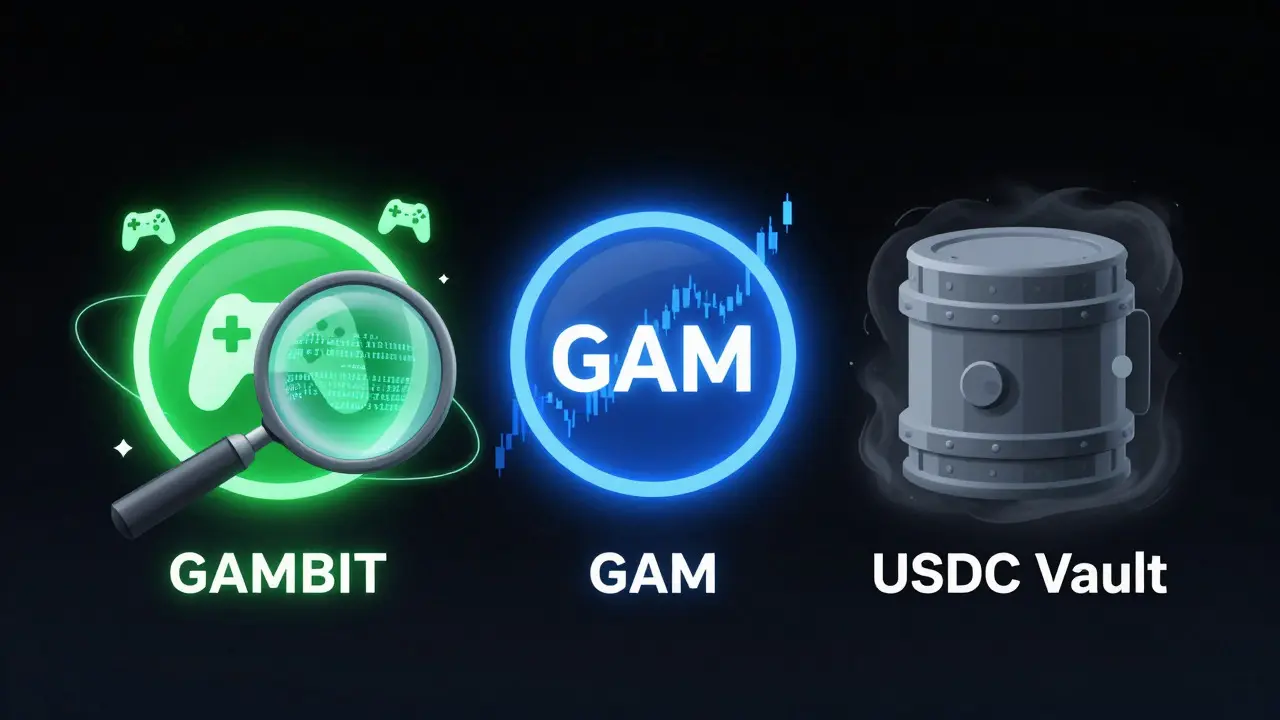
Confusion is rampant when you search for "Gambit crypto." You might find a micro-cap gaming token, an older trading utility coin, or a dormant DeFi vault. They share a name, but they are completely different assets with different risks, prices, and purposes. If you are looking at Gambit (GAMBIT), you are likely staring at a tiny, illiquid ERC-20 token tied to a blockchain betting platform. It is not a mainstream investment, and it requires careful handling if you want to avoid losing money on gas fees or scams.
This guide cuts through the noise. We will define exactly what GAMBIT is, how it differs from the older Gambit (GAM) token, and whether it holds any real value in the current market. We will also look at the technical details, liquidity issues, and the practical steps you need to take if you decide to interact with this asset.
The Three Faces of Gambit: Avoiding the Mix-Up
Before you buy or trade anything, you must identify which "Gambit" you are dealing with. There are three distinct entities using this brand, and mixing them up can lead to significant financial errors.
- Gambit (GAMBIT): The modern ERC-20 token launched in March 2024. It powers the Gambit Game betting platform. This is the most common result for new searches.
- Gambit (GAM): An older utility token launched in March 2015 by @CollinCrypto. It serves a community of traders with tools, bots, and signals. It has a much smaller supply and higher per-unit price.
- Gambit USDC Vault: A DeFi product on the Arbitrum network that allows users to deposit USDC. As of early 2026, this vault shows signs of inactivity with minimal total value locked (TVL).
When people ask "What is Gambit crypto," they usually mean the first one: the GAMBIT token. However, because the names are so similar, always check the ticker symbol and the contract address before sending funds.
| Feature | Gambit (GAMBIT) | Gambit (GAM) | Gambit USDC Vault |
|---|---|---|---|
| Launch Date | March 12, 2024 | March 2015 | Unknown (Active until 2026) |
| Network | Ethereum (ERC-20) | Ethereum/Other | Arbitrum One |
| Total Supply | 100,000,000,000 (100 Billion) | 2,590,000 (2.59 Million) | N/A (Share Token gUSDC) |
| Primary Use | Betting Platform Utility | Trading Tools & Community Access | DeFi Yield Generation |
| Market Status | Micro-cap, Low Liquidity | Niche, Moderate Activity | Inactive/Low TVL |
Deep Dive: What Is Gambit (GAMBIT)?
Gambit (GAMBIT) is an ERC-20 utility token deployed on the Ethereum blockchain that serves as the native currency for the Gambit Game betting platform. Launched on March 12, 2024, this token was designed to facilitate transactions within a blockchain-based betting ecosystem.
The core function of GAMBIT is to act as the medium of exchange for bets, rewards, and potentially governance within the Gambit Game platform. Unlike major cryptocurrencies like Bitcoin or Ethereum, which serve as stores of value or general-purpose networks, GAMBIT is a specialized utility token. Its value is directly tied to the usage and popularity of the specific betting platform it supports.
Here are the key technical attributes of the GAMBIT token:
- Contract Address: 0x2aE21DE576E0Fe0367651dDCF76e04dD0608c076
- Token Standard: ERC-20 (Ethereum)
- Decimals: 18
- Total Supply: 100,000,000,000 (100 Billion)
- Max Supply: 100,000,000,000 (100 Billion)
The massive supply of 100 billion tokens is a critical factor to understand. In cryptocurrency markets, a high supply often correlates with a very low price per unit. This does not necessarily mean the project is worthless, but it means the fully diluted valuation (FDV) is the more important metric than the price per single token.
Price, Market Cap, and Liquidity Realities
If you check the price of GAMBIT, you will see numbers that look almost zero. This is normal for micro-cap tokens with huge supplies. However, the lack of liquidity is the bigger issue.
As of mid-2026, data from aggregators like CoinMarketCap, Bitget, and Crypto.com paints a picture of extreme illiquidity:
- Spot Price: Approximately $0.000000867 USD. Some trackers round this to $0.00 due to its small size.
- All-Time High (ATH): Around $0.0001193 USD. This indicates the token has dropped significantly from its peak, showing a volatility range of over 100x between highs and lows.
- Market Cap: The fully diluted market cap hovers around $86,704 USD. This places GAMBIT far outside the top 1,000 cryptocurrencies, ranking it in the tens of thousands globally.
- Trading Volume: Daily volume is often reported as $0 or under $20 USD on decentralized exchanges like Uniswap V2.
Why does this matter? Liquidity refers to how easily you can buy or sell an asset without affecting its price. With daily volumes under $20, buying even a modest amount of GAMBIT could spike the price artificially, while selling could crash it. Furthermore, many centralized exchanges list GAMBIT but mark it as "not tradable yet," meaning you cannot simply buy it with a credit card. You must use a decentralized exchange (DEX), which adds complexity and risk.
How to Buy and Store GAMBIT Safely
Because GAMBIT is not widely available on major centralized exchanges like Coinbase or Binance, acquiring it requires interacting with decentralized finance (DeFi) protocols. Here is the step-by-step process for getting GAMBIT into your wallet.
- Set Up an Ethereum Wallet: Download a non-custodial wallet like MetaMask or Trust Wallet. Ensure you are connected to the Ethereum Mainnet.
- Fund Your Wallet with ETH: You will need Ether (ETH) to pay for gas fees (transaction costs) on the Ethereum network. Even if GAMBIT is cheap, the gas fee to swap for it can be expensive during network congestion.
- Access a Decentralized Exchange: Navigate to Uniswap (specifically Uniswap V2 or V3, depending on pair availability). Connect your wallet.
- Add the GAMBIT Token: Since GAMBIT may not appear automatically, you will need to paste the contract address:
0x2aE21DE576E0Fe0367651dDCF76e04dD0608c076. Always double-check this address against multiple sources to avoid scam tokens. - Execute the Swap: Swap ETH for GAMBIT. Be aware of the slippage tolerance; due to low liquidity, you may need to set a higher slippage percentage (e.g., 5-10%) to complete the transaction, though this increases the risk of a bad price execution.
Warning: Before swapping, verify the token contract. Scammers often create fake tokens with the same name but different addresses. Always copy the address from official project links or reputable aggregators like Coingecko or CoinMarketCap.
Risks and Considerations for Investors
Investing in micro-cap gaming tokens like GAMBIT carries significant risks. Here is what you need to weigh carefully.
1. Regulatory Uncertainty
Gambit Game is described as a "blockchain-based betting platform." Gambling regulations vary wildly by jurisdiction. In the United States, Europe, and other regions, online gambling faces strict oversight. If regulators crack down on crypto-betting platforms, projects like Gambit Game could face delistings, legal challenges, or operational shutdowns. Currently, there is no public information about specific licenses held by Gambit Game, which adds a layer of regulatory ambiguity.
2. Project Viability and Team Transparency
Unlike larger projects with detailed whitepapers and doxxed teams, GAMBIT’s founding details are sparse. Public listings do not clearly attribute the project to a specific corporate entity or named founders. This anonymity is common in crypto but makes it harder to assess the long-term commitment of the developers. If the team disappears, the token could become worthless.
3. Liquidity Traps
As mentioned, the daily trading volume is negligible. If you buy $100 worth of GAMBIT, you might find it difficult to sell that same amount later without crashing the price. This is known as a liquidity trap. Always assume that money put into such low-volume assets is at high risk of being stuck.
4. Competition
The crypto-gaming and betting space is crowded. Established players with millions in market cap and active user bases dominate the sector. For GAMBIT to succeed, it needs to attract a significant number of bettors to drive demand for the token. Current metrics suggest slow adoption.
Gambit (GAM) vs. Gambit (GAMBIT): Why the Difference Matters
If you have been in crypto since 2015, you might remember Gambit (GAM). It is crucial not to confuse the two. GAM was created by @CollinCrypto to support a community of traders with indicators, bots, and educational content. It has a total supply of only 2.59 million tokens and a market cap closer to $1.63 million USD.
GAM is considered a more established niche asset with a dedicated user base. In contrast, GAMBIT is a newer, speculative gaming token. While both carry the "Gambit" brand, their economic models, communities, and use cases are entirely separate. Investing in GAM does not give you exposure to the Gambit Game betting platform, and vice versa.
The Future Outlook for GAMBIT
What lies ahead for Gambit (GAMBIT)? The answer depends entirely on user adoption. For a utility token to gain value, the underlying service must be used. If Gambit Game attracts more bettors, the demand for GAMBIT to place wagers or claim rewards could increase, potentially boosting liquidity and price.
However, current data from 2025 to 2026 shows stagnant growth. The token remains in the sub-microcent range with minimal trading activity. Without a clear roadmap, marketing push, or strategic partnerships announced by the team, GAMBIT risks fading into obscurity like many other micro-cap tokens that fail to gain traction.
For now, GAMBIT should be viewed as a high-risk, speculative asset. It is suitable only for investors who understand the mechanics of DeFi, are comfortable with illiquidity, and are willing to lose their entire investment in pursuit of potential upside from a niche betting platform.
Is Gambit (GAMBIT) a good investment?
Gambit (GAMBIT) is a high-risk, speculative asset. With a market cap under $100,000 and daily trading volumes often below $20, it lacks the liquidity and stability of major cryptocurrencies. It may offer high returns if the Gambit Game platform becomes popular, but it also carries a high risk of losing value or becoming illiquid. Only invest what you can afford to lose.
Where can I buy Gambit (GAMBIT) tokens?
GAMBIT is primarily traded on decentralized exchanges (DEXs) like Uniswap V2 on the Ethereum network. It is not widely available on major centralized exchanges like Coinbase or Binance. To buy it, you need an Ethereum wallet (like MetaMask), some ETH for gas fees, and the correct contract address to add the token manually.
What is the difference between GAMBIT and GAM?
They are two different tokens. GAMBIT (launched 2024) is a gaming/betting token with a 100 billion supply. GAM (launched 2015) is a utility token for a trading community with a 2.59 million supply. Do not confuse them; they have different prices, contracts, and use cases.
Is the Gambit Game platform regulated?
There is no public information indicating that Gambit Game holds specific gambling licenses in major jurisdictions like the US or EU. As a blockchain-based betting platform, it operates in a regulatory gray area, which adds risk for users in regions with strict gambling laws.
What is the contract address for Gambit (GAMBIT)?
The official Ethereum contract address for Gambit (GAMBIT) is 0x2aE21DE576E0Fe0367651dDCF76e04dD0608c076. Always verify this address on reputable sites like CoinMarketCap or Coingecko before adding it to your wallet to avoid scam tokens.
Why is the price of GAMBIT so low?
The price is low because the total supply is extremely high (100 billion tokens) and the market capitalization is very small (under $100,000). In crypto, price per token is less important than the total market cap. A low price does not mean the token is "cheap" in terms of value; it reflects the large number of units in circulation.