You bought that digital artwork in 2021. It looked solid on your wallet then. Now, you click the link, and all you see is a broken image or a 404 error. This isn’t just bad luck; it’s a fundamental flaw in how most Non-Fungible Tokens (NFTs) were built. The token itself lives forever on the blockchain, but the actual art-the JPEG, the video, the music-often doesn’t.
This disconnect creates what experts call the "NFT permanence paradox." You own the receipt, but the store burned down. Understanding how to fix this requires looking past the hype and into the plumbing of decentralized storage. If you want your assets to last decades, not just days, you need to know where they live and who keeps them alive.
The Core Problem: On-Chain vs. Off-Chain Data
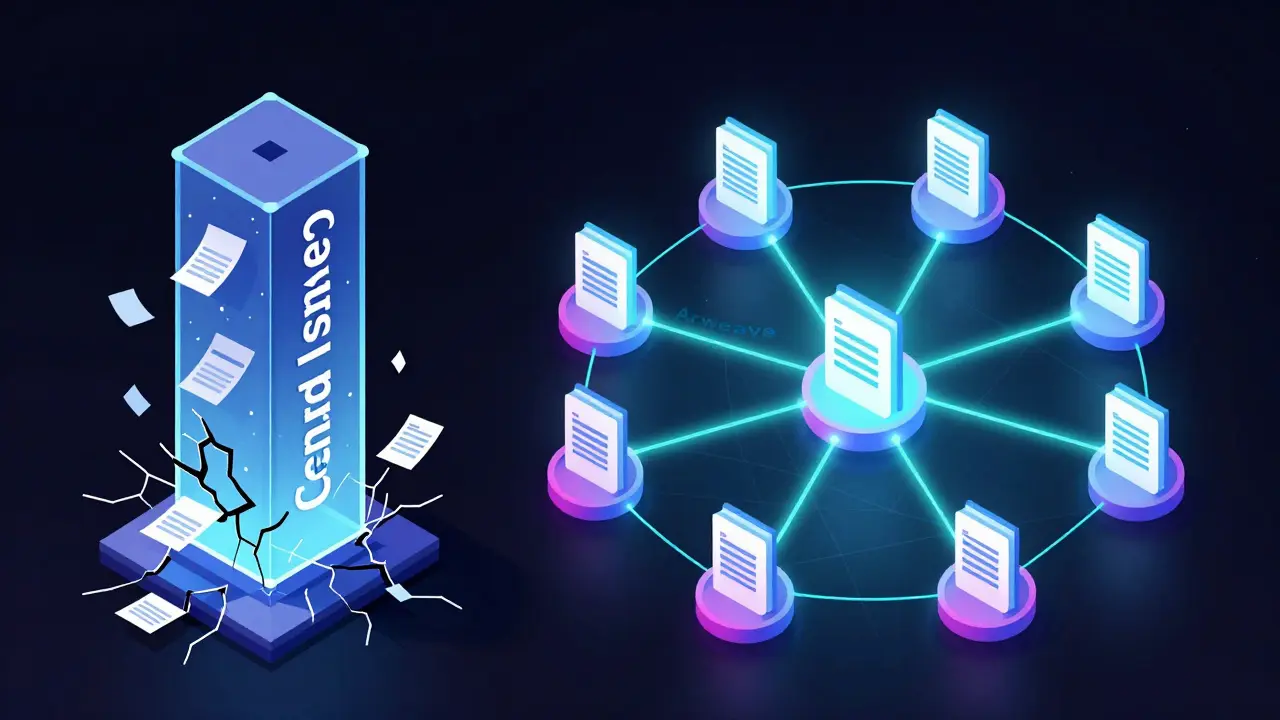
To understand why links break, we have to look at how an NFT works technically. An NFT is essentially a smart contract on a blockchain like Ethereum. This contract records ownership, transaction history, and transfer details. This part is immutable and permanent. However, blockchains are terrible at storing large files. They are expensive and slow.
Instead of putting the actual image file on the blockchain, developers store a small piece of code called metadata. This metadata contains a URL pointing to where the real file is hosted. In the early days of crypto, projects like CryptoPunks stored this data on centralized servers using standard HTTP links. When those servers shut down, or when companies went bankrupt, the links died. According to analyses from 2023, roughly 80-90% of early NFT projects suffered from this single point of failure.
The solution isn't to put every gigabyte of video on Ethereum. The solution is to use decentralized storage protocols that ensure no single server controls your data. This shifts the responsibility from a company's IT department to a distributed network of nodes.
IPFS: The Standard for Decentralized Access
The most common answer to this problem is InterPlanetary File System (IPFS). Developed by Protocol Labs, IPFS changed how we think about file addressing. Instead of finding a file by its location (like a street address), IPFS finds it by its content (like a fingerprint).
When you upload a file to IPFS, it gets split into chunks and assigned a unique cryptographic hash called a Content Identifier (CID). If even one pixel changes, the CID changes. This ensures integrity. But here is the catch: IPFS is a protocol, not a storage service. It tells computers how to find files, but it doesn't force anyone to keep them.
This leads to the "pinning problem." For your NFT to remain accessible, someone must "pin" the data. Pinning means a node operator explicitly agrees to store that specific CID indefinitely. Without pinning, the data might be garbage-collected if the node needs space. Services like Pinata, Filebase, and Fleek offer paid pinning services. As of 2024, many major platforms use these services to ensure their collections stay online. However, if you stop paying, or if the provider goes under, your data risks disappearing again.
Arweave: True Permanent Storage via One-Time Fees
If IPFS is about access, Arweave is about permanence. Arweave uses a different economic model. Instead of renting storage monthly, you pay a one-time fee upfront. This fee is calculated to cover the cost of storing your data for over 200 years. It uses a structure called "blockweave" to secure data against tampering and loss.
For NFT creators, this is attractive because it eliminates recurring costs. You pay once, and the network is economically incentivized to keep your data forever. The cost varies based on current hard drive prices, often averaging around $0.01 per MB. While this can be more expensive initially than free IPFS gateways, it removes the risk of subscription lapses. However, retrieval speeds on Arweave can be slower than IPFS, with some benchmarks showing higher latency for large files.
Filecoin: The Incentivized Storage Market
Another major player is Filecoin. Launched in 2020, Filecoin operates as a decentralized storage marketplace. Users pay miners in FIL tokens to store their data. Miners provide cryptographic proofs that they are still holding the data. If they fail to prove it, they lose their collateral.
Unlike Arweave’s one-time fee, Filecoin operates on a rental model similar to traditional cloud storage but decentralized. You sign deals with multiple miners for a set period. This offers flexibility and high redundancy, but it requires active management. You must monitor your deals and renew them before they expire. For passive NFT holders, this adds complexity. For enterprises needing temporary high-volume storage, it’s efficient.
Comparing Storage Solutions for NFTs
| Feature | IPFS | Arweave | Filecoin |
|---|---|---|---|
| Persistence Model | Pinning Required | One-Time Payment | Rental Contracts |
| Cost Structure | Variable (Service Dependent) | Upfront Fee | Ongoing Payments |
| Speed/Latency | Fast (~400ms) | Slower (~2,200ms) | Moderate |
| Permanence Guarantee | Conditional | Economic Incentive (200+ yrs) | Contractual |
| Best For | Active Projects, Metadata | Long-Term Archives | Enterprise, Large Files |
Best Practices for Ensuring Data Survival
Technology alone won't save your NFT if you don't implement it correctly. Based on guidelines from NIST and industry leaders, here is how you should approach storage:
- Use Canonical URIs: Always use the IPFS URI (ipfs://...) in your smart contract metadata, not an HTTP gateway link. Gateways can change or die; the protocol does not.
- Multi-Pin Your Data: Don't rely on one service. Pin your critical NFT data to at least two or three different providers (e.g., Pinata, Infura, and a self-hosted node).
- Consider Hybrid Approaches: Use IPFS for fast access and Arweave for permanent backup. Some advanced setups write to both simultaneously.
- Verify CIDs Regularly: Periodically check that your Content Identifiers resolve correctly. Tools exist to scan entire collections for broken links.
- Understand SLAs: If you pay for pinning, read the Service Level Agreement. Know what happens if the provider shuts down.
Dr. Dawn Song from UC Berkeley noted that IPFS solves addressability but not persistence without economic layers. This means you must actively participate in keeping your data alive. Passive ownership is risky in the current ecosystem.
The Future of NFT Storage Infrastructure
The market for decentralized storage is growing rapidly, projected to reach billions by 2030. We are seeing a shift toward "permanence as a service." Newer networks like Crust Network are focusing on reliability, reporting high uptime for pinned data. Additionally, tools like NFT Storage by Protocol Labs have simplified the process for developers, automatically pinning data across multiple backends including IPFS, Filecoin, and Arweave.
However, challenges remain. Economic sustainability is unproven at scale. Token economics can collapse during market downturns, affecting miner incentives. As regulations tighten and institutional adoption grows, we will likely see stricter standards for data provenance and longevity. For now, the burden remains on the creator and the holder to verify that the underlying asset is truly secure.
Is my NFT permanently stored on the blockchain?
No. Only the ownership record and transaction history are stored on the blockchain. The actual digital asset (image, video) is usually stored off-chain on a separate storage system like IPFS or a centralized server.
What happens if an IPFS pinning service goes out of business?
If your data is only pinned by that one service, it may become inaccessible. To mitigate this, you should pin your data to multiple providers or use a permanent storage solution like Arweave.
Why is Arweave considered more permanent than IPFS?
Arweave charges a one-time fee calculated to cover storage costs for over 200 years, creating a long-term economic incentive for the network to keep your data. IPFS requires ongoing pinning efforts or payments to maintain availability.
Can I move my NFT storage from IPFS to Arweave later?
You cannot change the metadata already written to the blockchain. However, you can create a new NFT pointing to the Arweave URL, or use wrapper contracts that allow updating the pointer if designed with that functionality.
How do I check if my NFT metadata is broken?
You can use online tools that scan Ethereum addresses for broken links. Alternatively, manually copy the token URI from your wallet and paste it into a browser to see if the JSON metadata loads correctly.