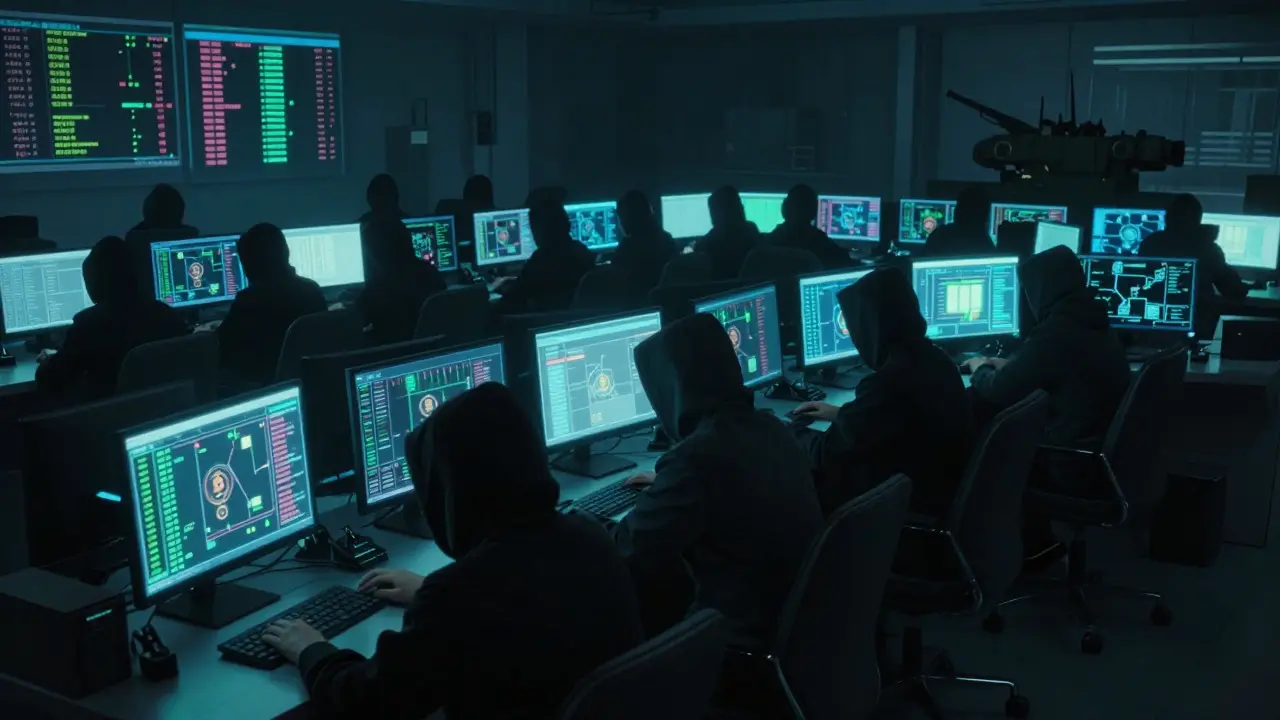
When you hear about a massive cryptocurrency heist, the first question is usually "who did it?" Too often, the answer points to one source: North Korea, officially known as the Democratic People's Republic of Korea (DPRK). What started as isolated cyber attacks has morphed into a state-sponsored criminal enterprise that funds nuclear weapons programs. In the first half of 2025 alone, these operations generated over $2.17 billion in stolen digital assets. That isn't just bad luck for exchanges; it is a strategic economic weapon.
The international community has scrambled to respond. With the United Nations Panel of Experts dissolving in May 2024, a gap opened in global enforcement. To fill it, eleven nations formed the Multilateral Sanctions Monitoring Team (MSMT) in October 2024. This team includes the United States, Australia, Canada, France, Germany, Italy, Japan, the Netherlands, New Zealand, South Korea, and the United Kingdom. Their job is simple but difficult: track, report, and stop the flow of illicit crypto from Pyongyang to the global financial system.
The Scale of the Threat: From Hackers to State Enterprise
You might think of hackers as lone wolves hiding in dark rooms. The reality behind DPRK cyber operations is far more organized. These are not rogue actors; they are employees of the state. The primary group responsible is the Lazarus Group, operating under the direction of the Reconnaissance General Bureau (RGB), a UN-designated entity within North Korea’s intelligence apparatus.
The scale of their theft is staggering. According to data from TRM Labs’ 2025 Crypto Crime Report, North Korean actors accounted for approximately 35% of all cryptocurrency funds stolen globally in 2024. By the first nine months of 2025, that number had escalated further, with Elliptic analyzing over $2 billion in thefts. The cumulative total of known DPRK-linked crypto thefts now exceeds $6 billion since tracking began.
Why does this matter to you? Because this money doesn't stay in wallets. It flows into military procurement and sanctions evasion. The MSMT describes these operations as a "sophisticated global criminal enterprise." When an exchange gets hacked, it’s not just a security failure; it’s a direct contribution to a regime that defies international law.
The Game Changer: The ByBit Hack and Its Aftermath
If there was a moment that woke up the world to the severity of this threat, it was February 21, 2025. On that day, the cryptocurrency exchange ByBit suffered a breach resulting in the loss of approximately $1.5 billion in user funds. This single event stands as the largest cryptocurrency theft in history.
How did it happen? Investigations revealed that attackers exploited a compromised multi-signature approval system during a scheduled wallet transfer. This wasn't a brute-force attack on weak passwords; it was a surgical strike on internal processes. The sophistication of the attack highlighted a critical vulnerability: even major exchanges with robust security protocols can fall if their operational procedures are infiltrated.
The aftermath forced a reckoning. Industry analysts at War on the Rocks argued in August 2025 that the international community must recognize cryptocurrency as being "at the forefront of economic warfare." They warned that traditional, slow-moving investigations would no longer keep pace with threats of this magnitude. The ByBit hack proved that speed matters. If you wait six months to freeze assets, the money is already gone, laundered through decentralized exchanges and privacy coins.
Who Is Fighting Back? The Role of the MSMT
With the UN Panel of Experts gone, the Multilateral Sanctions Monitoring Team (MSMT) became the new frontline. Established in Ottawa, Ontario, the MSMT released its first joint statement in October 2025, outlining a coordinated strategy. Unlike the UN’s consensus-based approach, which often stalled due to political disagreements, the MSMT operates as a coalition of like-minded nations. This allows for faster information sharing and more agile responses.
However, this shift creates its own challenges. As noted by ABC News in October 2025, the exclusion of non-participating nations creates "gaps in global coverage." North Korea can exploit jurisdictions that are not part of the MSMT to move funds. For example, while the US and EU tighten regulations, other regions may lack the resources or will to enforce similar standards. This fragmentation is exactly what Pyongyang relies on.
The MSMT’s strategy focuses on three pillars:
- Monitoring: Tracking transaction patterns across blockchains to identify DPRK-linked wallets.
- Reporting: Publishing detailed reports to alert financial institutions and exchanges.
- Enforcement Support: Providing evidence to national law enforcement agencies for asset forfeiture.
In October 2025, the team documented how North Korean actors have shown "remarkable adaptability," increasingly using artificial intelligence to enhance social engineering tactics. This means phishing emails are no longer poorly written scams; they are personalized, convincing, and targeted at high-value individuals in defense and tech sectors.

The Tech Behind the Chase: Blockchain Analytics
You can’t fight a digital enemy with analog tools. The backbone of the international response is blockchain analytics. Firms like Chainalysis, Elliptic, and TRM Labs provide the eyes and ears for regulators. These companies use complex algorithms to trace transactions, identify laundering patterns, and attribute activity to specific groups like the Lazarus Group.
Here is how it works in practice. When a hack occurs, analysts don’t just look at the destination wallet. They map the entire journey of the funds. Did they go through a centralized exchange? Were they swapped for privacy coins like Monero? Did they cross chains via bridges? Each step leaves a trace. By combining this on-chain data with off-chain intelligence-such as IP addresses and employee records-analysts can build a case strong enough for legal action.
| Entity | Role | Key Contribution |
|---|---|---|
| Multilateral Sanctions Monitoring Team (MSMT) | Policy & Coordination | Unifies 11 nations to monitor sanctions violations and share intelligence. |
| Chainalysis | Blockchain Analytics | Provides attribution tools and mid-year crime updates used by governments. |
| Elliptic | Transaction Tracing | Analyzes laundering patterns and documents technical evolution of hacks. |
| US Department of Justice (DOJ) | Law Enforcement | Files civil forfeiture actions to seize stolen assets. |
| Lazarus Group | Cyber Actor | State-sponsored hacking group responsible for majority of DPRK thefts. |
The effectiveness of these tools is evident in success stories. In September 2025, the Financial Action Task Force documented a coordinated effort where Chainalysis, Elliptic, and financial intelligence units from five MSMT nations froze $237 million in stolen funds from the LND.fi hack within just 72 hours. This rapid response is becoming the gold standard, proving that real-time collaboration saves money.
The Human Vector: IT Workers and Espionage
We often focus on code, but the human element remains a critical vulnerability. North Korea has a unique method of infiltration: hiring its own citizens as remote IT workers for Western companies. Thousands of North Koreans work under fake identities for tech firms abroad. They generate legitimate revenue for their employers while simultaneously conducting espionage and cybercrime.
The MSMT’s October 2025 report highlights this dual threat. These workers aren’t just stealing crypto; they are acquiring critical military technology from defense contractors. This makes the problem harder to solve because it involves corporate HR departments, immigration authorities, and cybersecurity teams all at once. A developer might be brilliant at coding but unaware that their colleague is feeding secrets to Pyongyang.
This vector requires a different kind of defense. Exchanges and tech firms must implement stricter identity verification and background checks. But it’s not just about hiring; it’s about monitoring access. Who has keys to the treasury wallets? Who approves large transfers? Compartmentalizing access reduces the risk that a single insider-or a compromised account-can drain millions.

Regulatory Shifts: MiCA II and Executive Orders
Technology alone isn’t enough; we need rules. The regulatory landscape has shifted dramatically in response to the crisis. In April 2025, the United States implemented Executive Order 14155, requiring all cryptocurrency exchanges to implement enhanced due diligence for transactions exceeding $10,000. This puts the burden on platforms to know their customers and flag suspicious activity.
Across the Atlantic, the European Union is preparing for MiCA II regulations, effective January 1, 2026. This framework will establish comprehensive cross-border cryptocurrency transaction monitoring. The goal is to close loopholes where criminals move funds between jurisdictions with weak oversight.
But compliance is expensive. A survey by the Crypto Compliance Consortium in August 2025 estimated that smaller platforms face annual compliance costs of up to $1.2 million. Major players like Coinbase and Binance have adopted MSMT-recommended protocols, but smaller exchanges struggle. This disparity creates a two-tier system: well-funded platforms are safer, while smaller ones become attractive targets for hackers looking for easy prey.
Challenges and Future Outlook
Despite these efforts, the battle is far from won. Recovery rates remain low. Between January and September 2025, the US Department of Justice filed 17 civil forfeiture cases targeting $214 million in DPRK-linked assets. Yet, only about 12.3% of seized values were actually recovered. Why? Because laundering techniques evolve faster than laws. North Korea rotated through 17 different wallet clustering techniques in the first half of 2025 alone, according to Elliptic’s technical appendix.
Privacy-enhancing technologies pose another hurdle. Coins like Monero obscure transaction details, making tracing nearly impossible without additional intelligence. Furthermore, the deepening alliance between North Korea and Russia complicates coordination. As Cyfirma noted in June 2025, this geopolitical shift creates a "challenging environment for international sanctions enforcement."
Looking ahead, the MSMT plans to launch a dedicated Cryptocurrency Intelligence Fusion Cell in early 2026. Funded with $85 million by participating nations, this cell will operate like a counterterrorism unit, focusing on real-time threat detection. The target implementation date for standardized real-time monitoring protocols is Q3 2026. Until then, vigilance is key. For users, this means choosing regulated exchanges, enabling multi-factor authentication, and staying informed about emerging threats.
What is the Multilateral Sanctions Monitoring Team (MSMT)?
The MSMT is a coalition of 11 nations established in October 2024 to replace the dissolved UN Panel of Experts. Its purpose is to monitor, report, and coordinate responses to North Korean sanctions violations, particularly those involving cryptocurrency theft and laundering.
How much money has North Korea stolen via crypto?
Since tracking began, the cumulative value of DPRK-linked crypto thefts exceeds $6 billion. In the first half of 2025 alone, they stole over $2.17 billion, with the ByBit hack accounting for $1.5 billion of that total.
Who is behind the North Korean crypto hacks?
The primary actor is the Lazarus Group, a state-sponsored hacking team operating under the Reconnaissance General Bureau (RGB) of North Korea. They act on behalf of the government to fund military programs.
What happened in the ByBit hack?
On February 21, 2025, hackers compromised ByBit’s multi-signature approval system during a wallet transfer, stealing $1.5 billion. It remains the largest single cryptocurrency theft in history and highlighted vulnerabilities in exchange security protocols.
Are my crypto funds safe from North Korean hackers?
While no system is 100% secure, using regulated exchanges that comply with MSMT guidelines and implementing strong personal security measures like hardware wallets and multi-factor authentication significantly reduces your risk.
How do blockchain analytics firms help stop crypto crime?
Firms like Chainalysis and Elliptic trace transactions on the blockchain, identify laundering patterns, and attribute activity to specific groups. This data helps law enforcement freeze assets and prosecute offenders.