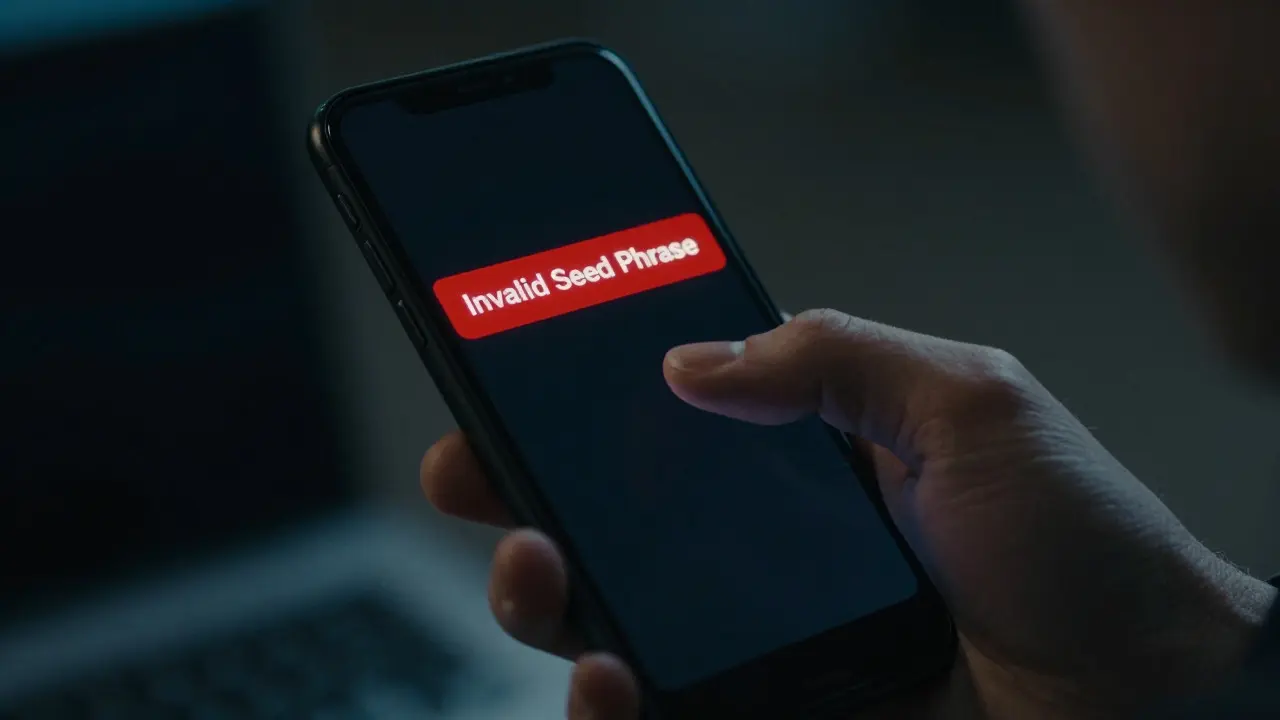
You click on your crypto portfolio app, enter your password, and get a message that stops your heart: "Invalid Seed Phrase" or "Wallet Not Found." Panic sets in. You dig through old emails, check cloud storage, and pray for a "Forgot Password" button that will reset access like it does for your email or social media accounts. But here is the harsh reality of blockchain technology: there is no customer support hotline to call. There is no admin who can override the system. If you lose your private key, the money associated with it is effectively gone forever.
This isn't just a scary story; it’s a mathematical certainty built into the design of cryptocurrencies. As of early 2026, Chainalysis estimates that approximately 3.7 million Bitcoin-worth nearly $248 billion-are sitting on the blockchain, permanently inaccessible because their owners lost the keys to unlock them. This guide breaks down exactly what happens when that key disappears, why the system is designed this way, and how you can ensure you aren’t part of that statistic.
The Hard Truth: No Backdoors, No Resets
To understand why losing a private key is so final, you have to look at how blockchain differs from traditional banking. When you forget your online banking password, a human being or an automated system verifies your identity and resets the credential. The bank holds the master key to your account. In the world of decentralized finance, that middleman doesn’t exist.
A private key is a cryptographic code, typically a 256-bit number represented as a 64-character hexadecimal string or a 12-24 word mnemonic phrase, that proves ownership of digital assets. It is the only thing that grants you control over your funds. The Bitcoin protocol, launched by Satoshi Nakamoto in 2009, established this paradigm intentionally. The core philosophy, echoed by Ethereum co-founder Vitalik Buterin in 2014, is that the system must remain secure even if every other device fails. To achieve this, blockchain protocols were designed without backdoors.
If a backdoor existed, hackers could exploit it. So, the trade-off was absolute security at the cost of user convenience. As AnchorWatch noted in January 2025, "If you lose the private keys that control your Bitcoin, no one else can access it. And no one can help you recover it - not the exchange." This creates an absolute ownership model. You are both the bank and the vault. If you lose the combination, the gold stays inside, but you can never get it out.
Where Did the Money Go? (It Didn't Disappear)
A common misconception is that the cryptocurrency itself vanishes from existence when the key is lost. It doesn't. The coins or tokens still exist on the blockchain ledger. They are still counted in the total supply. However, they become "dust"-assets that are technically present but functionally useless to anyone.
Andreas Antonopoulos, author of *Mastering Bitcoin*, famously stated, "There is no such thing as a lost bitcoin, only lost private keys." The assets remain in the wallet address, visible to anyone looking at the blockchain explorer. But without the private key to sign a transaction, those funds are frozen in time. Dr. David Yakira, Chief Scientist at CoinList, described this in a 2025 panel as "the digital equivalent of burning cash-the value is permanently destroyed from your perspective."
This distinction matters for two reasons. First, it means the network remains stable; lost keys don't crash the system. Second, it highlights the psychological impact on users. Watching millions of dollars sit in plain sight on a public ledger, knowing you can never touch it again, is a unique form of financial trauma reported frequently on forums like Reddit's r/CryptoCurrency.
Can You Actually Recover a Lost Key?
If you are reading this because you’ve already lost your key, I have some bad news and a tiny sliver of hope. For the vast majority of cases, recovery is impossible. The mathematics behind elliptic curve cryptography (specifically the secp256k1 curve used by Bitcoin) mean there are 1.1579209 x 10^77 possible key combinations. That number is larger than the estimated atoms in the observable universe. Brute-forcing a lost key is computationally impossible with current or foreseeable technology.
However, "lost" can mean different things. Here is where the nuance lies:
- Forgotten Password on an Encrypted Wallet: If you use a software wallet (like Exodus or Electrum) and forgot the *password* that encrypts the local file, but you still have the original seed phrase (the 12-24 words), you are safe. You can reinstall the wallet and restore using the seed phrase. The password is just a layer of protection on top of the key.
- Lost Hardware Wallet Device: If you dropped your Ledger or Trezor in the ocean, but you wrote down your seed phrase on paper, you are fine. Buy a new device and restore the wallet using the phrase. The key was never on the device; the device was just a tool to interact with the key.
- Lost Seed Phrase AND No Backup: This is the permanent loss scenario. If you never wrote down the 12-24 words, or if that piece of paper burned in a house fire, the funds are gone. Period.
- Corrupted Digital Backup: Some users save their seed phrase in a text file on a USB drive or cloud storage. If that file gets corrupted or deleted without a secondary copy, recovery is extremely difficult. While data recovery experts might retrieve fragments, reconstructing a complete, valid BIP-39 mnemonic phrase from partial data is often a shot in the dark.
According to an OSL Academy report from April 2025, 68.7% of users who lost access did so by forgetting passwords or recovery phrases, while 22.4% experienced hardware failures. Only a tiny fraction successfully recovered funds, usually because they had overlooked a secondary backup somewhere-a sticky note in a drawer, an old phone, or a safety deposit box.

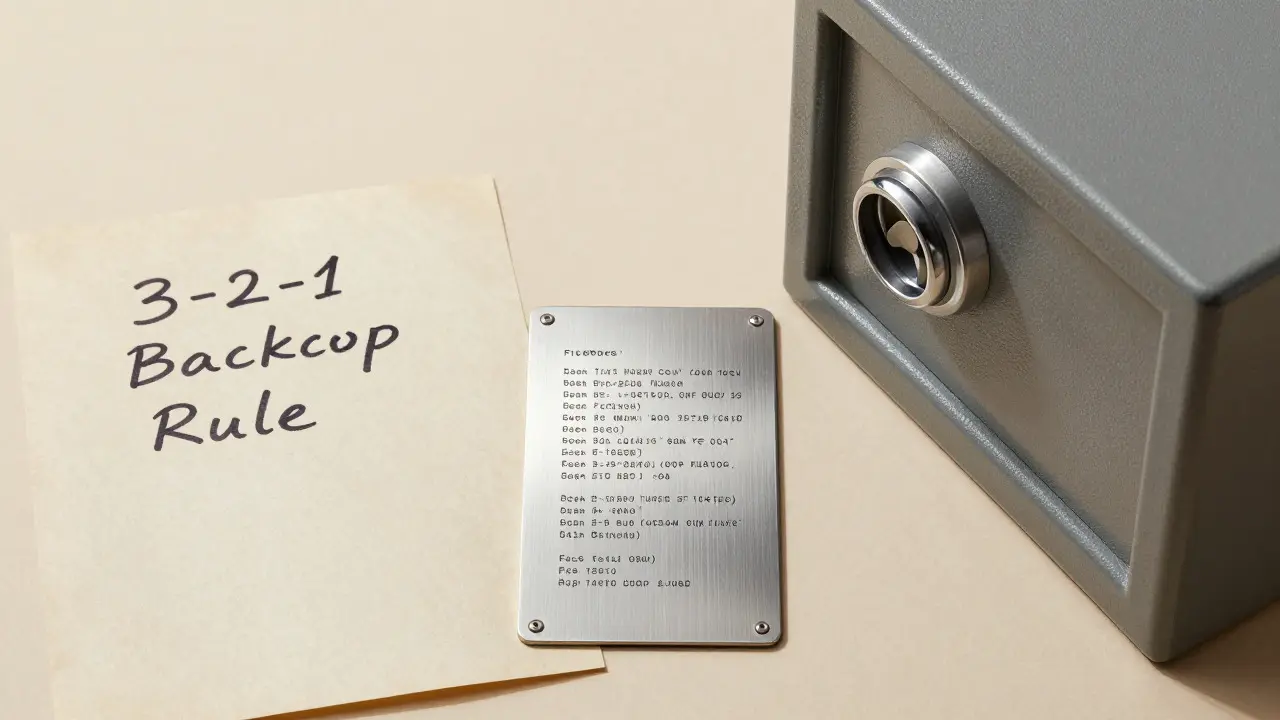
Prevention: The 3-2-1 Backup Rule
Since recovery is nearly impossible, prevention is everything. The industry standard for safeguarding private keys is the "3-2-1 Backup Rule," advocated by hardware wallet manufacturers like Trezor in their 2024 Security Guide. Here is how you apply it to crypto:
- Three Copies: Create three separate copies of your seed phrase. Do not rely on a single point of failure.
- Two Different Media Types: Don’t store all copies digitally. Use physical media. Paper is the gold standard because it cannot be hacked remotely. Metal plates (like Cryptosteel) are excellent for fire and water resistance. Avoid storing the phrase in plain text on Google Drive, iCloud, or email servers, as these are vulnerable to phishing and data breaches.
- One Offsite Copy: Keep one copy in a physically separate location from your home. A safety deposit box at a bank or a trusted family member’s house works well. This protects against house fires, floods, or theft.
The University of Cambridge Centre for Alternative Finance found in 2024 that novice users need 8-12 hours of dedicated study to properly implement key management. It feels tedious, but treating your seed phrase like a deed to a house is appropriate. You wouldn’t leave your house deed on the kitchen counter. Don’t leave your seed phrase on your desktop.
Emerging Solutions: Social Recovery and MPC
The crypto industry knows that self-custody is hard. Consequently, new technologies are emerging to mitigate the risk of total loss without reintroducing centralization. These are not magic bullets, but they offer alternatives to the "write it on paper" method.
| Method | Security Level | Recovery Ease | Best For |
|---|---|---|---|
| Paper/Metal Backup | High (if stored safely) | Low (requires physical access) | Long-term holders, purists |
| Social Recovery Wallets | Medium-High | High (requires trusted contacts) | Retail users, families |
| MPC Wallets | Very High | Medium (complex setup) | Institutions, high-net-worth individuals |
| Custodial Exchange | Low (counterparty risk) | Very High (email reset) | Beginners, active traders |
Social Recovery Wallets: Platforms like Argent (which reached 1.2 million users by January 2026) allow you to appoint "guardians"-trusted friends or family members. If you lose your device, you can request signatures from your guardians to generate a new key pair and transfer your funds to a new wallet. This adds a human element to recovery without giving anyone full control over your funds.
Multi-Party Computation (MPC): Used heavily by institutions via platforms like Fireblocks, MPC splits the private key into shards distributed across multiple devices or parties. No single shard reveals the key. Transactions require a threshold of shards to come together. This prevents a single point of failure. While complex for average users, consumer versions are becoming more accessible.
Custodial Services: For many beginners, keeping funds on a reputable exchange like Coinbase or Binance is actually safer than self-custody, provided the exchange is insured and regulated. You trade absolute control for ease of recovery. If you lose your login credentials, the exchange can verify your identity and restore access. However, you are trusting the exchange not to freeze your account or go bankrupt.
Legal and Tax Implications of Lost Keys
Losing a private key doesn’t just hurt your wallet; it complicates your legal and tax life. In the eyes of the IRS and most global tax authorities, cryptocurrency is property. If you hold it, you may owe capital gains taxes if its value increased, even if you can’t spend it.
The Northwestern Journal of Technology and Intellectual Property (2023) highlighted that "parties acting in bad faith... may claim that 'lost' or 'forgotten' private keys prevent them from complying with disclosure or turnover orders." Courts are increasingly skeptical of this defense. Professor Aaron Wright of Cardozo Law School argued in Harvard Business Review (March 2024) that the cryptographic certainty of ownership creates legal uncertainty when keys disappear. He proposed novel sanctions to lien identifiable cryptoassets.
For the average person, this means you should document the loss. Keep records of when you lost the key, what steps you took to find it, and the last known value of the assets. In some jurisdictions, you may be able to claim a casualty loss or theft loss deduction, though the process is bureaucratic and requires proof that the asset was truly unrecoverable.
Next Steps: What To Do Right Now
If you haven’t secured your keys yet, do it today. Here is your action plan:
- Audit Your Holdings: List every wallet you own. Check which ones have written-down seed phrases.
- Create Physical Backups: Write your 12-24 word phrases on paper or engrave them on metal. Store them in a fireproof safe.
- Test Your Backup: This is crucial. Take a small amount of crypto (e.g., $10 worth) and send it to a new wallet restored from your backup phrase. If it works, your backup is valid. If not, repeat until it does.
- Consider Social Recovery: If you are uncomfortable with paper backups, explore wallets like Argent or Coinbase Smart Wallet that offer guardian-based recovery.
- Educate Your Family: If you hold significant assets, tell a trusted family member where the backup is located. Death is the most common reason for permanent key loss, as seen in the tragic case of "CryptoWidow2024" who lost $1.2 million after her husband died without disclosing his wallet details.
Is it possible to hack my way back into a lost private key?
No. The mathematical probability of guessing a 256-bit private key is virtually zero. There are more possible key combinations than atoms in the universe. Any service claiming to recover a lost key for a fee is almost certainly a scam.
What if I only remember part of my seed phrase?
If you remember most of the 12 or 24 words but are missing one or two, specialized tools like John the Ripper or Hashcat can sometimes brute-force the missing words. However, this requires technical expertise and powerful computing resources. If you are missing more than a few words, recovery becomes exponentially harder and likely impossible.
Are hardware wallets safer than software wallets regarding key loss?
Hardware wallets protect against online hacks, but they do not prevent key loss if you misplace the device and have no backup. Both hardware and software wallets rely on the same seed phrase. The safety comes from having a secure, offline backup of that phrase, regardless of the wallet type.
Does insurance cover lost private keys?
Most standard cryptocurrency insurance policies exclude "user negligence," which includes losing keys or seed phrases. While the crypto insurance market grew to $612 million by Q4 2025, coverage typically focuses on exchange hacks or smart contract exploits, not personal key mismanagement.
What is the difference between a private key and a seed phrase?
The private key is the actual cryptographic number that signs transactions. The seed phrase (or recovery phrase) is a human-readable representation of that key, standardized by BIP-39. The seed phrase generates the private key. Losing either results in the same outcome: loss of access.