Concentrated Liquidity Risk Calculator
When you trade crypto on a decentralized exchange, you expect two things: low fees and your money to stay safe. KyberSwap Elastic on Polygon promised both. It let you trade tokens with tight spreads, earn fees by providing liquidity, and even auto-reinvest your earnings. But in November 2023, everything changed. A single flaw in its code wiped out over $56 million from users’ wallets. This isn’t just another DEX review. It’s a case study in what happens when innovation outpaces security.
How KyberSwap Elastic Works (Before the Crash)
KyberSwap Elastic isn’t your average crypto exchange. Unlike Uniswap V2, where liquidity is spread evenly across all price ranges, KyberSwap Elastic uses concentrated liquidity. This means if you think ETH will trade between $3,000 and $3,200, you can put all your ETH and USDC just in that range. If the price stays there, you earn more fees than if you’d spread your funds out. It’s like renting out a whole apartment instead of just a single room. The platform runs on Polygon, which keeps gas fees low and transactions fast. That’s a big win for traders who swap tokens multiple times a day. KyberSwap Elastic also supports five different fee tiers: 0.008%, 0.01%, 0.03%, 0.04%, and 1%. Higher fee tiers suit volatile pairs like new memecoins. Lower ones work for stablecoins. You pick based on how much price movement you expect. There’s also something called the Reinvestment Curve. Instead of manually claiming your fees and adding them back to your liquidity pool, the system does it automatically. That’s a huge time-saver. You don’t need to check your position every hour. Your capital keeps working for you. And unlike many DEXs, KyberSwap Elastic doesn’t just sit on Polygon. It aggregates liquidity from Ethereum, Binance Smart Chain, Arbitrum, Avalanche, and more. So when you trade, it scans multiple chains to find the best rate. That’s rare. Most DEXs are locked to one chain.Why Liquidity Providers Loved It
Before the exploit, KyberSwap Elastic had a loyal user base. Over 296,000 people followed its Twitter account. Why? Because it felt like a trader’s playground. No KYC. No identity checks. Just connect your wallet - MetaMask, WalletConnect, or any EVM-compatible one - and start trading. That’s the whole point of DeFi. Privacy matters. Liquidity providers loved the ability to fine-tune their positions. If you’re good at predicting price swings, you could outearn passive liquidity on Uniswap V3. One user on Reddit reported earning 12% APY on a stablecoin pair by adjusting their range every 48 hours. That’s not fantasy. It’s possible with active management. The platform also had clean UI. Swapping tokens was as simple as on Coinbase. You picked the pair, entered the amount, and clicked swap. Approval transactions were clear. Slippage settings were visible. For beginners, it was approachable. For pros, it was powerful.The November 2023 Exploit: What Happened
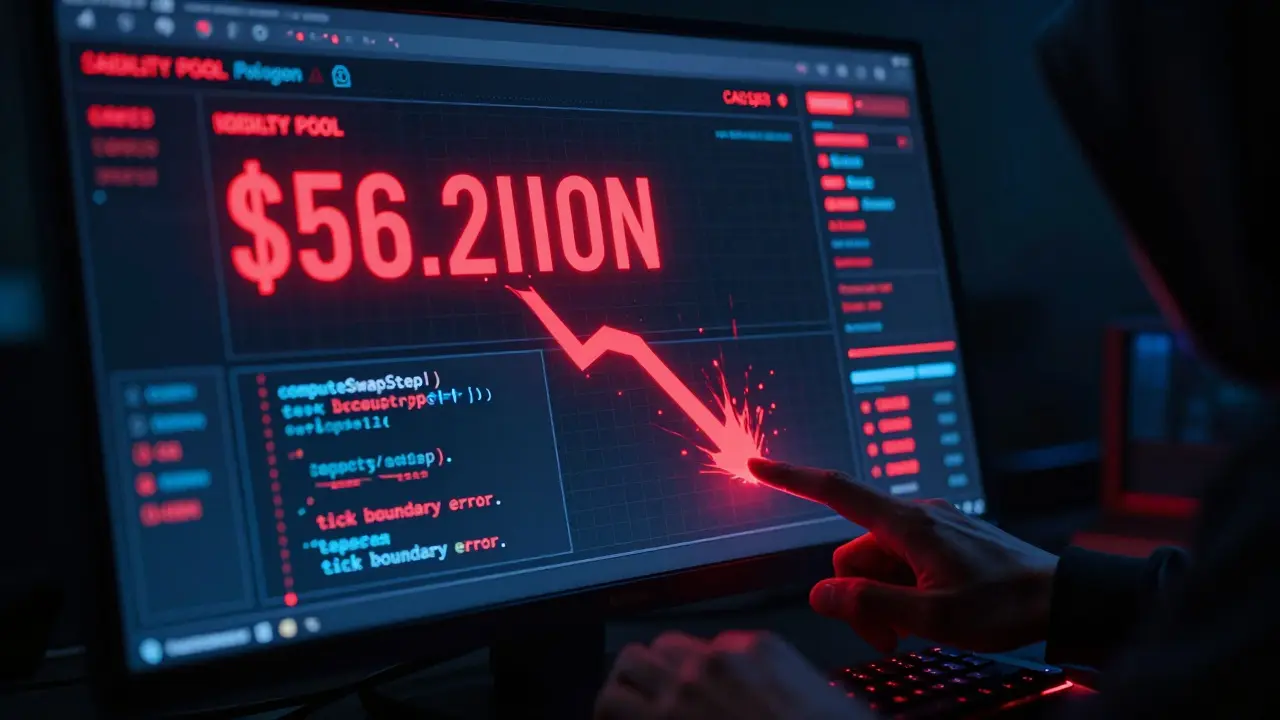
On November 12, 2023, something went terribly wrong. A hacker sent a single transaction with a very specific amount: 244,080,034,447,359,999 tokens. That number wasn’t random. It was calculated to exploit a flaw in how KyberSwap Elastic handled price boundaries when swapping across multiple ticks - the tiny price intervals the protocol uses to manage liquidity. The bug was in thecomputeSwapStep() function. When a swap crossed a tick boundary, the system miscalculated how much liquidity was available. It thought there was more than there actually was. The attacker drained liquidity from pools by making tiny swaps that triggered this error repeatedly.
CertiK, the security firm that later analyzed the attack, said the exploit required deep knowledge of the protocol’s math. This wasn’t a script kiddie. This was someone who had studied the code for months.
The result? $56.2 million stolen. Over 2,300 liquidity providers lost funds. The attacker took $48.7 million directly. Another $6.5 million was grabbed by bots that front-ran the attack - trading ahead of the exploit to profit from the chaos.
KyberSwap responded by freezing some pools and warning users to withdraw funds immediately. They recovered about $6.4 million - $5.7 million from bots and $706,000 from locked assets. But that’s less than 12% of what was lost.

What KyberSwap Did (and Didn’t) Do After
After the exploit, KyberSwap didn’t vanish. They posted updates. They said they were auditing their code. They promised fixes. But over a year later, there’s no public report on what exactly was patched. No compensation program. No refund plan. No clear timeline for security upgrades. The team stayed quiet on social media. Their Twitter account hasn’t posted a meaningful update since December 2023. Meanwhile, Uniswap V3, SushiSwap, and Curve kept improving. They added new fee tiers, improved their audit processes, and even launched insurance funds. KyberSwap didn’t. It just faded. The lack of transparency is worse than the exploit itself. When a protocol loses money, users expect honesty. They don’t need a full refund - they need to know it won’t happen again. KyberSwap gave neither.Is KyberSwap Elastic Safe to Use Today?
Short answer: No. Even if the core bug was fixed - and there’s no public proof it was - trust isn’t rebuilt with code patches. It’s rebuilt with transparency, communication, and accountability. KyberSwap provided none of that. The platform still has liquidity. You can still trade. But if you deposit funds now, you’re gambling. Not on price movements. On whether the team is hiding another vulnerability. Compare that to Uniswap V3. It’s been audited dozens of times. Its code is open. Its team responds to issues. Its users don’t live in fear of a silent exploit. KyberSwap Elastic’s multi-chain aggregation is technically impressive. Its auto-reinvestment feature is smart. But none of that matters if your money disappears overnight because no one’s watching the door.
Who Should Avoid KyberSwap Elastic
If you’re any of these people, stay away:- You’re new to DeFi and don’t understand impermanent loss or tick-based liquidity
- You’re depositing more than you can afford to lose
- You trust teams that don’t communicate after a major failure
- You want a “set and forget” liquidity strategy
Alternatives That Actually Deliver
If you want concentrated liquidity on Polygon without the risk:- Uniswap V3 on Polygon - Proven, audited, with deep liquidity. Lower yields than KyberSwap used to offer, but your funds are safe.
- SushiSwap on Polygon - Offers concentrated liquidity pools with a strong community. Regular audits and transparent team updates.
- Curve Finance - Best for stablecoin trading. Extremely low slippage and zero exploits in its core pools.
Final Verdict: A Cautionary Tale
KyberSwap Elastic had potential. It solved real problems in DeFi. Concentrated liquidity on Polygon? That’s valuable. Auto-compounding fees? Brilliant. Multi-chain aggregation? Ahead of its time. But it failed the most basic test: keeping users’ money safe. In crypto, innovation without security is just a ticking bomb. KyberSwap Elastic exploded. And now, it’s a ghost of what it once was. If you’re looking for a DEX on Polygon, go with the ones that have stayed quiet for the right reasons - because they didn’t break.Was KyberSwap Elastic hacked?
Yes. In November 2023, a sophisticated exploit targeted a flaw in the protocol’s price boundary calculations. Attackers drained approximately $56.2 million from liquidity pools by triggering a mathematical error in the swap function. The attack was precise, requiring deep knowledge of the code, and affected over 2,300 users directly.
Can I still trade on KyberSwap Elastic?
Technically, yes. The platform is still live and accepts trades. But liquidity is thin, and user trust is gone. There’s no guarantee the underlying code is secure. If you trade, you’re taking significant risk with your funds. Most experienced traders have moved to alternatives like Uniswap V3 or SushiSwap.
Did KyberSwap refund users who lost money?
No. The team recovered around $6.4 million from front-running bots and locked assets, but this covered less than 12% of total losses. There was no official compensation program, no public roadmap for reimbursement, and no communication about how affected users could recover their funds. The lack of response remains one of the biggest criticisms of the platform.
What makes KyberSwap Elastic different from Uniswap V3?
Both use concentrated liquidity, but KyberSwap Elastic adds multi-chain aggregation - meaning it pulls liquidity from Ethereum, Polygon, Arbitrum, and others to find the best price. Uniswap V3 only works on one chain at a time. KyberSwap also auto-reinvests fees; Uniswap doesn’t. However, Uniswap has far stronger security, regular audits, and a proven track record. KyberSwap’s innovation came with dangerous risks.
Is KyberSwap Elastic still active in 2025?
Yes, but barely. The platform still has a few active trading pairs and minimal daily volume. Its social media presence is dormant. There have been no major updates, audits, or team announcements since late 2023. Most industry analysts consider it effectively inactive as a trusted DeFi protocol.
Should I provide liquidity on KyberSwap Elastic?
Not unless you’re willing to risk losing your entire deposit. The exploit revealed critical flaws in its code, and there’s no evidence those flaws have been properly fixed. Even if the code is now secure, trust has been destroyed. In DeFi, trust is more important than yield. There are safer, better-documented alternatives with similar features.