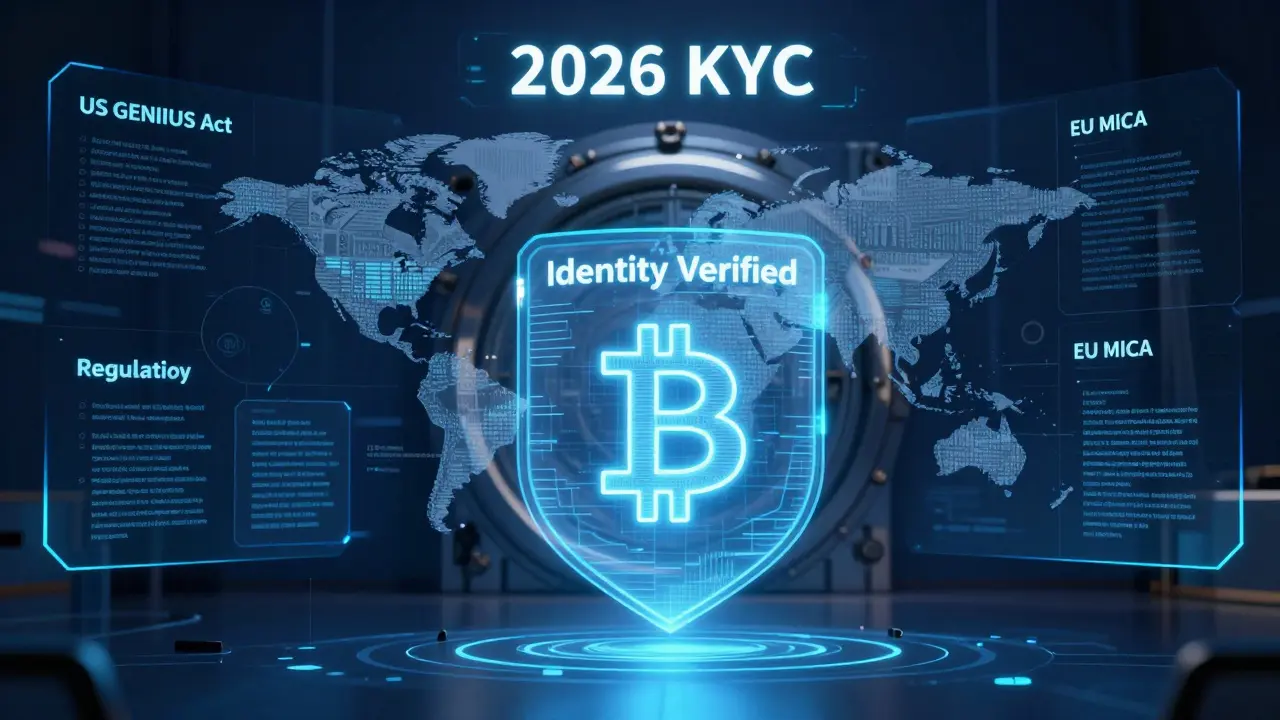
Remember when you could sign up for a crypto exchange with just an email address and start trading in seconds? Those days are gone. If you’re trying to move serious money into digital assets today, you’ll likely face a wall of questions before you even see your first chart. Know Your Customer (KYC) is the mandatory process where financial institutions verify the identity of their clients to prevent fraud, money laundering, and terrorist financing. In the crypto world, this isn’t just a bureaucratic hurdle anymore; it’s the gatekeeper to the entire industry.
By mid-2026, KYC has shifted from being an annoying compliance step to the foundational infrastructure of legitimate crypto markets. With 92% of centralized exchanges now fully compliant and global regulators tightening their grip, understanding how these systems work-and where they are heading-is critical for anyone holding or trading digital assets. The landscape is changing fast, driven by new laws like the US GENIUS Act and emerging technologies that promise to balance security with privacy.
The Regulatory Landscape: From Wild West to Wall Street
The era of regulatory ambiguity is effectively over. For years, crypto operated in a gray zone, but major jurisdictions have drawn clear lines in the sand. The Financial Action Task Force (FATF is an intergovernmental organization that sets international standards for combating money laundering and terrorist financing) updated its Recommendation 15 in recent years, explicitly classifying Virtual Asset Service Providers (VASPs) as financial institutions. This means crypto exchanges must follow the same strict Anti-Money Laundering (AML) rules as traditional banks.
In the United States, the legislative landscape solidified significantly in August 2025 with the enactment of the GENIUS Act is federal legislation establishing uniform KYC standards for crypto businesses across all states. Before this, companies faced a nightmare of conflicting state regulations. Now, there is a federal baseline. However, complexity remains. The SEC views many tokens as securities, while the CFTC treats Bitcoin and Ethereum as commodities. Regardless of the classification, the IRS taxes crypto as property, and the Financial Crimes Enforcement Network (FinCEN) demands rigorous identity verification.
Europe took a different path with the Markets in Crypto-Assets (MiCA) regulation. MiCA creates a harmonized framework across the EU, making it easier for providers to operate cross-border but enforcing stricter consumer protection and transparency rules. Meanwhile, Asian markets vary wildly. Japan enforces comprehensive KYC similar to Europe, while some Middle Eastern nations are experimenting with blockchain-based national ID systems integrated directly into financial services.
| Region | Key Regulation | Approach to KYC | Enforcement Body |
|---|---|---|---|
| United States | GENIUS Act / FinCEN Rules | Federal standardization post-2025; multi-agency oversight | SEC, CFTC, IRS, FinCEN |
| European Union | MiCA / 6th AML Directive | Harmonized high-standard compliance across member states | AMLA (Anti-Money Laundering Authority) |
| Japan | FSA Guidelines | Strict, bank-level KYC requirements for all VASPs | Financial Services Agency (FSA) |
| Global Standard | FATF Travel Rule | Requires sender/receiver data for transactions >$1,000 | Local Regulators |
The Travel Rule: Ending Anonymous Transfers
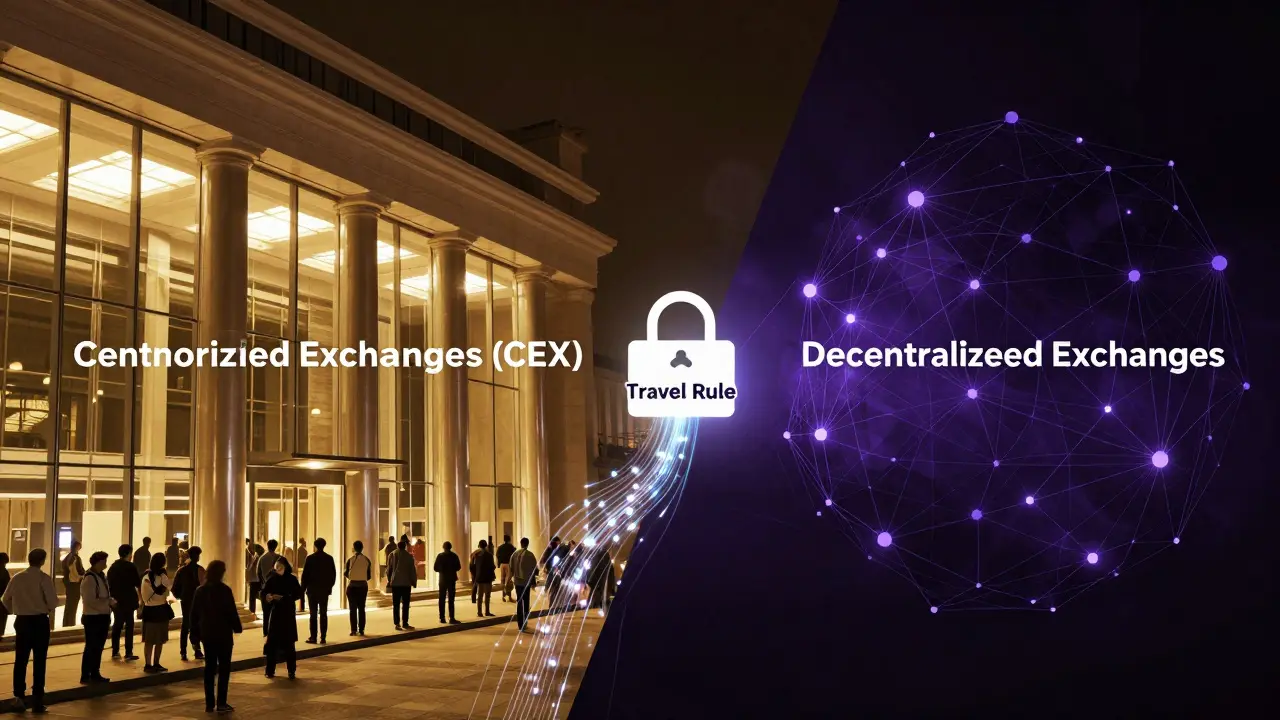
If you’ve ever sent money via wire transfer, you know the bank asks for details about who you are sending it to. The crypto world is catching up through the FATF Travel Rule. This regulation requires exchanges to share specific customer information with each other during transfers above a certain threshold (typically $1,000 or equivalent).
For centralized exchanges, this is now standard practice. When you send funds from Coinbase to Kraken, both platforms verify identities and share necessary data to ensure the transaction isn’t linked to illicit activity. But this creates a massive friction point for decentralized finance (DeFi). Less than 15% of Decentralized Exchanges (DEXs) implement meaningful verification protocols because their architecture is designed to be permissionless. As a result, we are seeing a sharp divergence: centralized platforms become safer but more intrusive, while DEXs remain anonymous but increasingly isolated from the broader financial system.
Technology Evolution: Speed vs. Privacy
The good news for users is that verifying your identity doesn’t have to take forever. In 2022, onboarding could take days. Today, AI-driven solutions have slashed average verification times to roughly 3.5 minutes. Companies like Shufti Pro and Sumsub use machine learning to scan IDs, perform biometric liveness checks, and cross-reference global watchlists in real-time. These systems achieve 99.2% accuracy with false positive rates dropping below 1%.
However, speed comes at a cost: data collection. Modern KYC systems don’t just check your passport; they monitor your behavior. Continuous KYC (cKYC) models adjust risk levels based on your transaction history, geography, and device fingerprinting. While this improves security, it raises significant privacy concerns. According to surveys, 76% of crypto users demand explicit disclosures on how their data is used, yet only 41% feel they receive adequate explanations.
This tension between security and privacy is driving the next big technological shift: Zero-Knowledge Proofs (ZKPs). ZKPs allow you to prove you meet certain criteria (like being over 18 or not being on a sanctions list) without revealing your actual identity data. Imagine proving you are old enough to buy alcohol by showing a digital token that says "Verified Adult" rather than handing over your driver’s license with your home address. By 2027, experts predict ZKPs will enable privacy-preserving verification for Web3 applications, allowing users to interact with regulated services without exposing sensitive personal information.

The DeFi Dilemma: Can Decentralization Survive?
Decentralized Finance promised a world free from central authorities. But as regulators crack down, that dream is facing reality checks. You can still trade on Uniswap or Aave without giving your name, but accessing those platforms with fiat currency (USD, EUR, etc.) usually requires going through a centralized bridge or on-ramp that performs full KYC.
We are seeing a shrinking window for truly anonymous crypto activity. Bitcoin ATMs and niche non-KYC exchanges still exist, but they represent less than 12% of total trading volume. Institutional investors, who bring billions into the market, require full compliance. JPMorgan and other major banks now mandate 100% KYC for any blockchain-based payment services. This institutional pressure forces the entire ecosystem toward compliance. If you want your crypto to be usable in the real economy-paying bills, buying real estate-it needs to pass through KYC filters.
What This Means for You in 2026 and Beyond
As a user, your role is shifting from passive participant to active data manager. Here is what you need to prepare for:
- Data Portability: Look for platforms that support decentralized identity wallets. These allow you to store your verified credentials securely and reuse them across different services, reducing the need to re-verify repeatedly.
- Tax Reporting: Starting in 2026, the US is rolling out 1099-DA reporting forms. This means exchanges will automatically report your crypto transactions to the IRS. Accurate record-keeping is no longer optional; it’s automated.
- Privacy Trade-offs: Understand that higher liquidity and safety often come with lower privacy. If anonymity is your priority, you may need to accept lower liquidity and higher slippage on unregulated DEXs.
The future of KYC isn’t about stopping crypto; it’s about integrating it into the global financial system. The technology is getting faster, smarter, and potentially more private thanks to innovations like ZKPs. But the core principle remains unchanged: in a connected world, trust is built on verified identity.
Is KYC mandatory for all crypto exchanges?
For centralized exchanges operating in regulated jurisdictions like the US, EU, and Japan, yes. Approximately 92% of major centralized exchanges now enforce strict KYC. Decentralized exchanges (DEXs) generally do not require KYC, but using them may limit your ability to convert crypto back to fiat currency easily.
What is the FATF Travel Rule?
The FATF Travel Rule is a global standard requiring virtual asset service providers to share originator and beneficiary information for transactions above a certain threshold (usually $1,000). This aims to prevent money laundering by ensuring that crypto transfers are not completely anonymous between regulated entities.
How do Zero-Knowledge Proofs improve privacy in KYC?
Zero-Knowledge Proofs (ZKPs) allow users to prove they meet specific criteria, such as age or residency, without revealing their underlying personal data. Instead of sharing your full ID, you share a cryptographic proof that you are eligible. This technology is expected to become mainstream in Web3 KYC solutions by 2027.
What happened with the GENIUS Act in the US?
Enacted in August 2025, the GENIUS Act established federal KYC standards for cryptocurrency businesses in the United States. It aimed to resolve conflicts between state-level regulations and provide a clearer legal framework for crypto companies to operate while maintaining strict anti-money laundering controls.
Can I still trade crypto anonymously?
Yes, but options are limited. You can use decentralized exchanges (DEXs) or peer-to-peer networks. However, these methods often involve higher risks, lower liquidity, and difficulty converting profits back into traditional bank accounts due to banking restrictions on unverified sources of funds.