You’ve heard the rumors. You’ve seen the chatter on Discord and Reddit. SundaeSwap is evolving, and everyone wants to know if the next iteration-often referred to as SundaeSwap v3-is actually going to change the game for Cardano traders. But here’s the hard truth you need to hear right now: as of mid-2026, there is no official "v3" release from SundaeSwap Labs that has fundamentally altered the core protocol architecture in the way Ethereum-based DEXs like Uniswap v3 did.
So, why is everyone talking about it? Because the market is demanding better capital efficiency, lower slippage, and advanced trading features. If you are holding ADA or native tokens, you are likely frustrated with the current state of liquidity on Cardano. You want to swap without eating up your profits in fees. You want to provide liquidity without getting rekt by impermanent loss. This review cuts through the hype to tell you exactly what SundaeSwap offers today, what the "v3" narrative really means, and whether you should trust your assets to this platform.
The Reality of SundaeSwap’s Current Architecture
Let’s clear the air first. When people say "SundaeSwap v3," they are often projecting expectations based on other blockchains onto Cardano. In reality, SundaeSwap operates primarily on its established Automated Market Maker (AMM) model, which launched in its public beta in January 2022. The platform remains the pioneer of DeFi on Cardano, but it hasn’t undergone a radical architectural overhaul comparable to the concentrated liquidity models seen elsewhere yet.
SundaeSwap is a decentralized exchange built specifically for the Cardano blockchain ecosystem, enabling peer-to-peer cryptocurrency trading through automated market maker protocols without centralized intermediaries. Founded by Artem Wright and Mateen Motavaf, it serves as the primary liquidity hub for native Cardano tokens.
The core technology relies on validator contracts that hold liquidity. This means your funds aren’t sitting in a smart contract that can be drained by a bug in the same way some older Ethereum contracts were. Instead, the protocol uses Cardano’s native security model. However, this also means the feature set is currently limited to standard swaps and basic liquidity provision. There are no limit orders. There is no cross-chain bridging built directly into the swap interface. If you are looking for complex trading strategies, you might feel restricted.
Fees and Costs: What You Actually Pay
One of the biggest pain points for any trader is fees. On SundaeSwap, the fee structure is tiered, which is a double-edged sword. For most retail users, you are looking at a 1% fee on swaps. That sounds high compared to Binance or Coinbase, but remember-you are paying for decentralization and network security, not a corporate middleman.
However, the platform does offer reduced rates for higher tiers. Active users and large liquidity providers can see fees drop down to 0.1%. This is where the "pro" advantage kicks in. If you are moving significant volume, the math works out. But for small transactions, that 1% fee eats into your margins quickly. Always calculate the cost before you click swap, especially during times of high network congestion when transaction fees (paid in ADA) spike.
| Feature | SundaeSwap (Current) | WingRiders (Cardano) | Uniswap v3 (Ethereum) |
|---|---|---|---|
| Standard Swap Fee | 1% | 0.3% | 0.05% - 1% |
| Minimum Fee Tier | 0.1% (High Volume) | N/A | 0.05% |
| Network Gas Fees | Low (ADA) | Low (ADA) | Variable (ETH) |
| Liquidity Model | Standard AMM | Stableswap + AMM | Concentrated Liquidity |
Liquidity and Total Value Locked (TVL)
Here is the data point that matters most for execution quality: liquidity. As of 2025-2026, SundaeSwap boasts over $7 million in Total Value Locked (TVL). While this number pales in comparison to Uniswap’s $4 billion+ TVL, it is significant within the Cardano ecosystem. In fact, SundaeSwap holds the title of "Best for Cardano" in several expert reviews because it consistently provides the deepest pools for major native tokens.
But don’t let the "#9 Global DEX" ranking fool you into thinking it’s a global powerhouse. It is a niche leader. If you are swapping ADA for a major token like SHEN or iUSD, you will get decent prices. If you are trying to swap for a low-cap meme coin, expect heavy slippage. The liquidity is concentrated in the top-tier pairs. This concentration is both a strength and a weakness-it protects major assets but leaves smaller projects exposed to volatility.
User Experience: Wallets and Interface
Getting started isn’t as simple as logging into an app. You need a compatible wallet. SundaeSwap integrates seamlessly with Nami Wallet, Flint Wallet, ccVault, and Yoroi Wallet. I recommend Nami or Flint for their speed and user-friendly interfaces. Yoroi is great for security but can feel clunky for frequent trading.
Once connected, the interface is clean. No clutter. You select your input token, your output token, and slide the slippage tolerance. The average onboarding time for someone new to crypto is about 58 minutes, according to Cardano Foundation studies. For experienced users, it takes 22 minutes. Why so long? Because you have to fund your wallet with ADA for gas fees, connect it, approve the transaction, and wait for confirmation. Cardano’s 20-second block time helps, but network congestion can still cause delays.
Security: Non-Custodial and Native
Security is the main reason people choose DEXs over CEXs. With SundaeSwap, you never give up custody of your assets. Your private keys stay in your wallet. The platform uses Cardano’s proof-of-stake consensus mechanism, which has never been hacked. As of 2026, there have been no major security breaches reported on SundaeSwap itself.
However, "non-custodial" doesn’t mean "risk-free." You are responsible for your own security. If you click a phishing link and drain your wallet, SundaeSwap can’t help you. Also, while the protocol is secure, the tokens you trade might not be. Always verify contract addresses. The platform’s reliance on validator contracts adds a layer of safety, allowing future protocol versions to spend liquidity only under strict conditions, reducing the risk of rug pulls by developers.
Comparison: SundaeSwap vs. WingRiders vs. Minswap
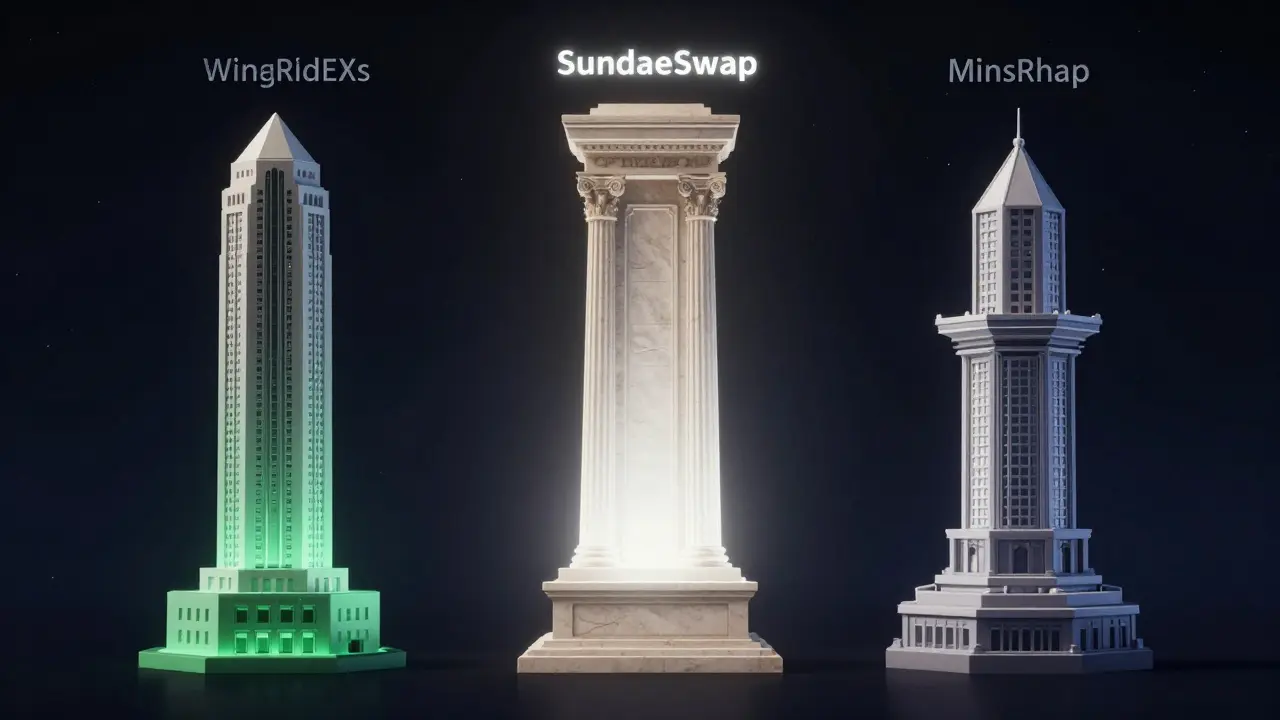
You don’t have to use SundaeSwap. Cardano has other options. Here is how they stack up:
- WingRiders: Offers lower fees (0.3%) and a stablecoin swap pool that reduces impermanent loss. Better for stablecoin pairs.
- Minswap: Known for its CLP (Capital Efficiency Liquidity Pools) which mimics concentrated liquidity. Better for advanced LPs who want higher yields.
- SundaeSwap: Best for general usability, brand recognition, and deep liquidity in major non-stablecoin pairs. It is the "default" choice for many Cardano users.
If you are a casual trader, SundaeSwap’s familiarity is a benefit. If you are a yield farmer, Minswap or WingRiders might offer better returns. Don’t lock yourself into one platform.
The "v3" Narrative: What’s Next?
So, what about v3? The development team has announced plans for governance upgrades and potential protocol enhancements in late 2025 and 2026. These updates aim to decentralize decision-making further and potentially introduce features like limit orders. However, these are incremental improvements, not a ground-up rebuild. Be wary of scams claiming to sell "v3 presale tokens." The SUNDAE token is already live. Any new governance token would be separate and officially announced via verified channels.
The roadmap focuses on maturation, not revolution. Expect better UI, smoother mobile experience, and deeper integration with Cardano’s broader DeFi ecosystem. Cross-chain bridges remain a challenge due to Cardano’s isolationist design philosophy, so don’t expect seamless ETH swaps anytime soon.
Verdict: Should You Use SundaeSwap in 2026?
If you are deeply embedded in the Cardano ecosystem, SundaeSwap is essential. It is the most reliable place to swap major tokens. The fees are fair for the service provided, and the security record is spotless. However, if you are looking for advanced trading tools or cross-chain capabilities, you will be disappointed. Use it for what it is: a robust, secure, and user-friendly gateway to Cardano DeFi. Just keep an eye on your slippage settings and always double-check your wallet connections.
Is SundaeSwap v3 officially released?
As of mid-2026, there is no official "v3" release that changes the core AMM model. The term is often used informally to refer to upcoming governance upgrades and minor protocol improvements. The current platform remains the primary version in use.
What wallets work with SundaeSwap?
SundaeSwap supports Nami, Flint, ccVault, and Yoroi wallets. Nami and Flint are recommended for their ease of use and fast transaction signing.
How much does it cost to swap on SundaeSwap?
The standard fee is 1% for most users. High-volume traders and liquidity providers can qualify for reduced fees as low as 0.1%. Additionally, you must pay ADA for network transaction fees.
Is SundaeSwap safer than centralized exchanges?
Yes, in terms of custody. You retain control of your private keys. However, you are responsible for securing your wallet. Centralized exchanges hold your funds, which poses a different set of risks related to hacking and insolvency.
Can I bridge assets from Ethereum to SundaeSwap?
Not directly through SundaeSwap. You would need to use a third-party bridge service to move assets from Ethereum to Cardano before trading on SundaeSwap. The platform itself does not support cross-chain swaps natively.