Investing in social tokens sounds simple: buy a token tied to your favorite creator, support their work, and maybe get rich. But beneath the hype lies a minefield of risks most beginners never see coming. By 2025, the social token market had collapsed from a peak of $32.9 billion to just $12.7 billion. That’s not a correction - it’s a bloodbath. And if you’re still considering jumping in, you need to understand why so many people lost everything.
They’re Not Just Cryptocurrencies - They’re Personality Stocks
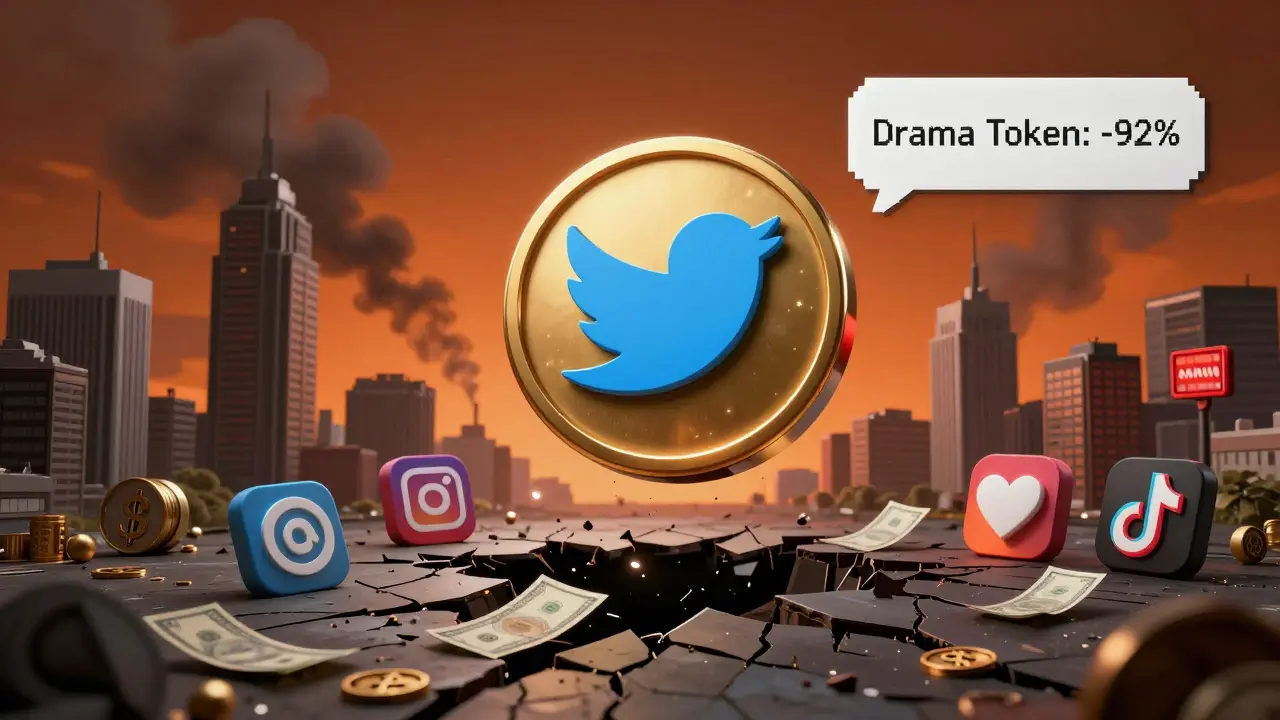
Social tokens aren’t like Bitcoin or Ethereum. You’re not betting on a network. You’re betting on a person. A single tweet, a scandal, a bad day - any of these can tank your investment overnight. Take the "Drama Token" case from July 2025. One creator got caught in a public feud. Within 72 hours, the token lost 92% of its value. No technical glitch. No hack. Just a heated argument on Twitter. That’s the reality. The token’s value was tied entirely to the creator’s reputation, not to any real utility. And when that reputation cracked, so did the price.Even big names aren’t safe. The "Kim Kardashian Effect" isn’t a myth - it’s a warning. A 2025 study found that 63% of celebrity-backed social tokens crashed within 90 days of launch. Why? Because fans bought in for the name, not the token. Once the initial buzz faded and the creator stopped posting, the token had nowhere to go. No demand. No reason to hold. Just empty wallets.
Liquidity Is a Myth
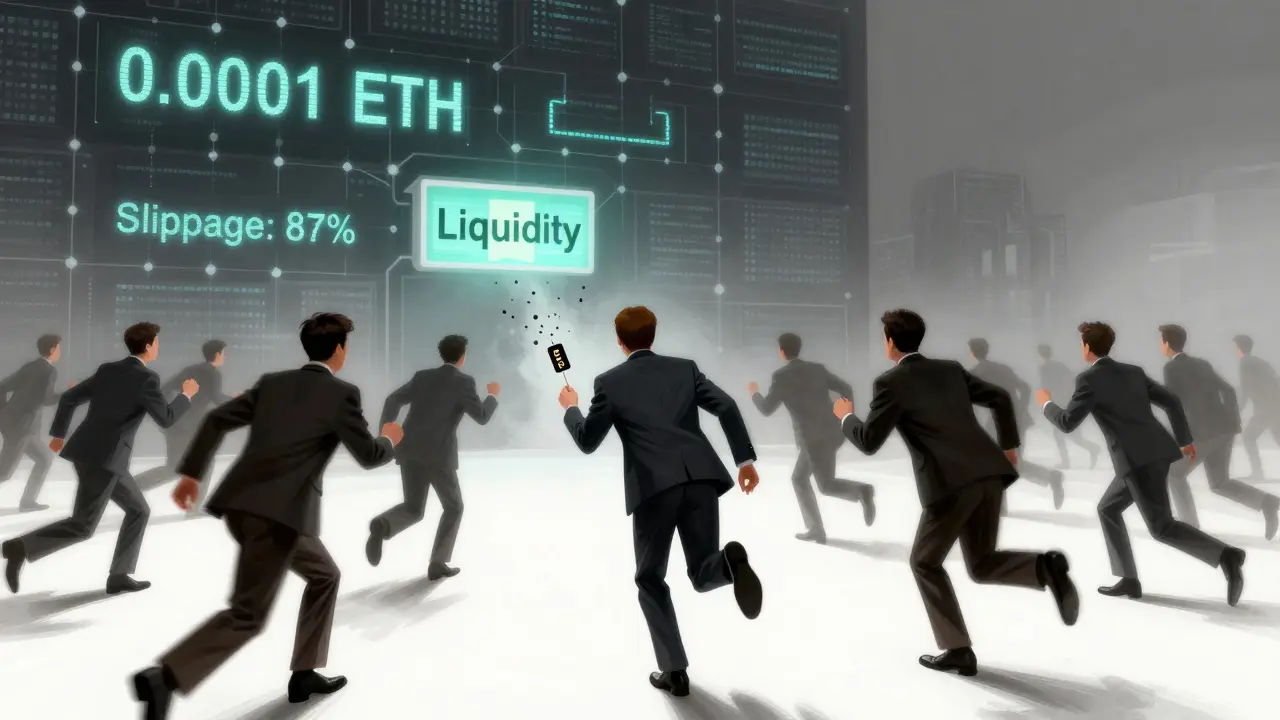
Most people assume they can sell anytime. They can’t. In Q3 2025, 61% of social tokens had less than $500,000 in total liquidity across all major decentralized exchanges. That’s not enough to handle even a modest wave of selling. When 100 people try to cash out at once, the price doesn’t just dip - it plummets. Slippage isn’t a technical term here. It’s a financial disaster.Compare that to Bitcoin, which trades over $28 billion daily. A social token? On average, $187,000. That’s 152 times less. This isn’t just illiquid - it’s dangerously thin. If you’re holding a token with low volume, you’re not an investor. You’re the last person in line. And when the crowd runs, you’re stuck.
Concentrated Ownership = Controlled Collapse
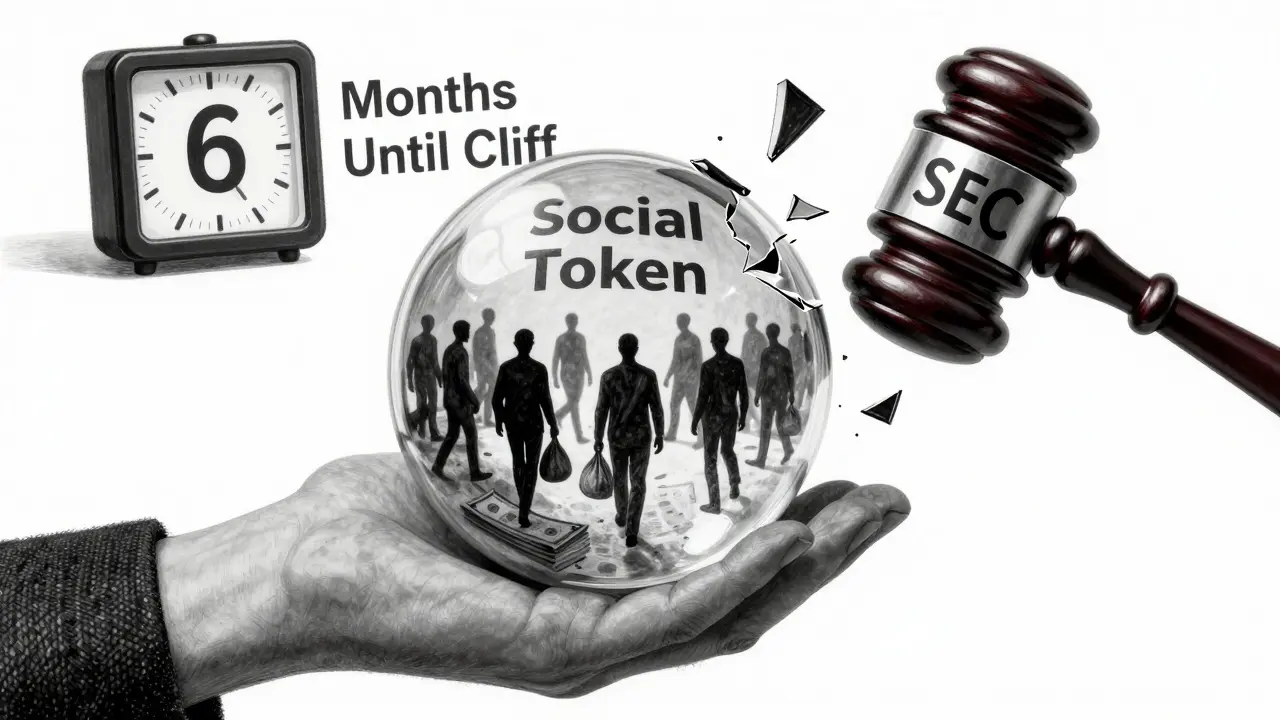
Here’s the dirty secret: the top 10 holders control between 58% and 73% of most social tokens. That means a handful of people - often the creator, early investors, or insiders - can dump their entire holdings and crash the market. And they often do.TokenUnlocks.io found that 42% of social token projects have cliff periods under six months. That means team members and early backers can sell everything after just half a year. No lock-up. No patience. Just a countdown to their exit. And guess who gets crushed when that happens? Retail investors who bought in hoping for long-term growth.
Even worse, 28% of projects have no cliff at all. No waiting period. No rules. Just a green light to cash out the moment the token launches. That’s not a community. That’s a pump-and-dump waiting to happen.
Regulators Are Coming - And They’re Not Friendly
The SEC has opened 142 active investigations into social token projects as of Q3 2025. That’s 38% of all crypto investigations. Why? Because most social tokens look like unregistered securities. They promise returns based on the creator’s efforts - exactly what the SEC defines as a security.In August 2025, the SEC approved Rule 19c-4, which requires social tokens with "substantial creator influence" to register as securities - unless they can prove they’re decentralized. Only 12% of existing tokens meet that standard. That means the vast majority are already in legal danger. If your token gets flagged, it could be delisted. Frozen. Or worse - you could be forced to return profits.
The UK and EU aren’t far behind. The UK’s FCA now requires creators to hold 12 months of operational reserves - a rule that forced 38% of small tokens off exchanges. The EU’s MiCA rules now classify many social tokens as asset-referenced tokens, subjecting them to strict capital requirements. Most creators can’t afford that. So they shut down. And your tokens? They become worthless.
Most Projects Just Die
The average social token lasts 34 months before vanishing from exchanges. DeFi tokens? 58 months. That’s not a typo. Social tokens have less than half the lifespan. Why? Because they rely on constant creator energy. No content. No engagement. No updates. And suddenly, the whole project is dead.Reddit’s r/CryptoCurrency community documented 2,847 social token failures between January and September 2025. The most common reason? "Abandoned projects." Creators stopped posting. Stopped responding. Stopped caring. And the token? It followed. There’s no backup plan. No treasury. No community-run governance. Just silence.
On Trustpilot, social token platforms average 2.1 out of 5 stars. Users complain about "extreme volatility unrelated to fundamentals" and "inability to exit without huge slippage." One case from August 2025 involved an artist’s token that lost 97% of its value in 48 hours - after he signed with a major record label. The token had no purpose outside his personal brand. Once he left, it meant nothing.
The Scams Are Everywhere
The Crypto Scam Database recorded 317 social token-specific scams in 2025 alone. The average loss? $3,850 - nearly double the $2,100 average for other crypto scams. These aren’t random hacks. They’re targeted. Fake Discord admins. Impersonated creators. Locked wallets with "emergency" withdrawal fees. And they’re getting smarter.One common scam? A creator launches a token, promotes it heavily on Instagram and TikTok, and then disappears after raising $500,000. The token’s contract has no burn mechanism. No utility. No roadmap. Just a wallet address and a promise. Then - poof. The team vanishes. The Discord goes dark. The website becomes a 404 error. And you’re left holding a digital ghost.
Even "Successful" Tokens Are Rare
There are exceptions. The "Patreon Token" maintained 85% of its value during the 2025 market crash because it wasn’t just a speculation tool - it gave holders real access to exclusive content, early releases, and voting rights within the platform. It had utility. It wasn’t just a name.But those are the 1% - not the rule. The rest? They’re gambling chips with no table. No rules. No safety net.
What Should You Do?
If you’re still thinking about investing, here’s the hard truth: social tokens are not an asset class. They’re a gamble wrapped in community branding. Fidelity’s Digital Assets Team recommends allocating no more than 1-3% of your total crypto portfolio to social tokens - and even then, never put more than 0.25% into a single token.Do your homework. Check:
- How much liquidity is actually on the DEX? (Use GeckoTerminal)
- Who holds the top 10 wallets? (Use Etherscan or SolanaFM)
- Is there a vesting schedule? Is there a cliff? (Check TokenUnlocks.io)
- Is the creator active? Are they posting daily? Are they engaging?
- Does the token have real utility - or just hype?
If the answer to any of those is "I don’t know," walk away. The market doesn’t reward curiosity. It rewards discipline. And right now, the risks far outweigh the rewards.
Are social tokens a good investment?
For almost everyone, no. Social tokens are high-risk, low-reward bets tied to volatile creator reputations. Most collapse within months. Only a tiny fraction survive long-term - and even those rarely deliver outsized returns. They’re not investments. They’re speculative bets with no safety net.
Can social tokens be regulated as securities?
Yes - and many already are. The SEC has opened 142 investigations into social tokens as of Q3 2025, primarily because they meet the definition of securities: investors expect profits based on the efforts of a central figure (the creator). Rule 19c-4, approved in August 2025, requires most social tokens to register or prove decentralization - a standard only 12% meet.
Why do social tokens crash so fast?
Because their value isn’t based on technology, adoption, or revenue - it’s based on a single person’s popularity. One controversial tweet, a dropped project, or a failed livestream can trigger panic selling. With low liquidity and concentrated ownership, even small sell-offs cause massive price drops. The 2025 "Drama Token" collapse - 92% in 72 hours - is a textbook example.
How much of my portfolio should I put in social tokens?
Fidelity’s Digital Assets Team recommends no more than 1-3% of your total crypto portfolio, with individual positions capped at 0.25-0.75%. Anything higher is reckless. Social tokens are not stable assets - they’re high-volatility, reputation-dependent bets. Treat them like lottery tickets, not stocks.
Are there any safe social tokens?
There are no "safe" social tokens - only less dangerous ones. Tokens with real utility - like access to exclusive content, voting rights, or revenue sharing - and strong, long-term creator engagement have a better chance. The Patreon Token is one example. But even these are risky. The safest approach? Avoid them entirely unless you’re a professional investor with deep due diligence resources.