
Iran doesn’t ban cryptocurrency outright - but it doesn’t let you use it freely either. If you’re trying to understand how crypto works in Iran today, you’re not looking at a simple yes-or-no answer. You’re looking at a system built on control, surveillance, and survival. The government doesn’t want you to trade Bitcoin like you would in the U.S. or Europe. It wants to know every transaction, who you’re trading with, and how much you’re holding. And if you try to bypass that? You’re playing a high-stakes game with no rules on your side.
How Iran’s Crypto Rules Work (And Why They’re So Strange)
In 2025, Iran’s Central Bank of Iran (CBI) became the only legal authority that can license crypto platforms, miners, and even individual traders. That means if you’re mining Bitcoin, you’re not allowed to sell it on Binance or Coinbase. You have to sell it directly to the government. And if you’re trading crypto, you can’t use your bank account unless it’s approved by the CBI. All payments must go through state-controlled gateways. No exceptions.
This isn’t about stopping crypto. It’s about owning it. The government wants to monitor every coin that moves through Iran’s borders. They’ve built a system where every transaction is recorded, every wallet is tracked, and every exchange is forced to hand over user data. TRM Labs calls it “unprecedented state surveillance.” In most countries, regulators watch for crime. In Iran, they watch everything.
The Stablecoin Cap: $10,000 and Counting
One of the most shocking rules came in September 2025: Iranians can’t hold more than $10,000 in stablecoins like Tether (USDT) or DAI. And they can’t buy more than $5,000 per year. Why? Because Iranians use stablecoins to protect their savings from the rial’s collapse. When inflation hits 50% a year, Bitcoin isn’t the only thing people turn to - stablecoins are.
But the government doesn’t want people using crypto as a hedge. So they slapped on a cap. If you’ve been holding $15,000 in USDT since last year? You had one month to reduce it. Miss the deadline? Your wallet could be frozen. And if you try to move money out through a foreign exchange? You’re risking legal trouble.
After Tether froze 42 Iranian-linked addresses in July 2025 - over half tied to Iran’s biggest exchange, Nobitex - users scrambled. Many switched to DAI, a decentralized stablecoin built on the Polygon network. Why? Because DAI doesn’t answer to Tether’s corporate office. It’s harder to block. But even that’s not safe forever. The CBI has said it’s working on tools to track DAI transactions too.
Bitcoin Mining? Only If the Government Gets the Coins
Iran has one of the world’s largest Bitcoin mining operations. Why? Cheap electricity. But in 2019, the government changed the rules: every miner must sell their Bitcoin directly to the Central Bank. No private sales. No exchanges. Just hand over your coins, get paid in rials - at a rate the government sets.
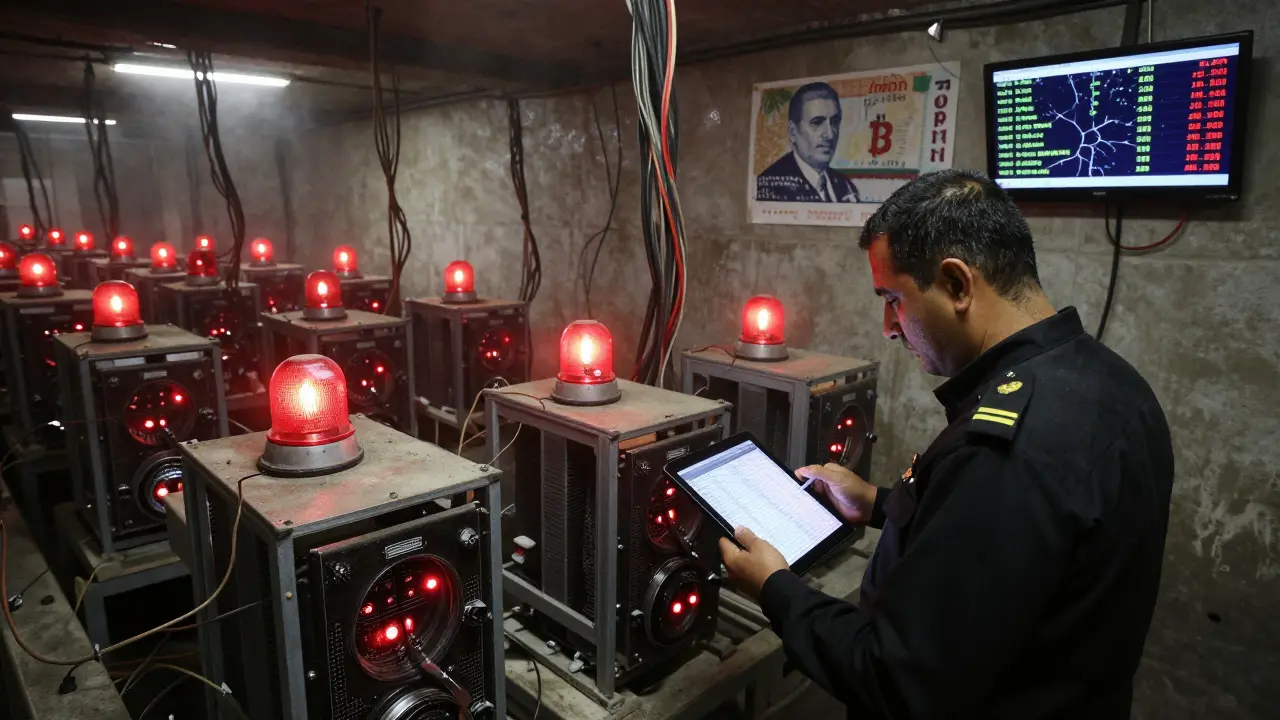
Most miners refused. Why sell at a fixed price when the market price is 3x higher? So they went underground. Illegal mining farms popped up in basements, warehouses, and even apartment buildings. Then, in December 2024, rolling blackouts hit major cities. The government traced the power drain - and found hundreds of unlicensed rigs running 24/7. Since then, enforcement has ramped up. Fines are steep. Equipment is seized. And if you’re caught? You might not just lose your rigs - you could face jail time.
Advertising Crypto Is Now Illegal
In February 2025, Iran banned all crypto advertising. That means no YouTube videos explaining how to buy Bitcoin. No Instagram posts about crypto wallets. No ads on Telegram channels. Even mentioning “crypto” in a public post can get you flagged.
The goal? Silence the conversation. If people don’t talk about it, they’re less likely to try it. But it hasn’t worked. Reddit threads in r/Iran and r/cryptocurrency are full of users sharing workarounds: using VPNs to access foreign exchanges, swapping USDT for DAI, and trading peer-to-peer through encrypted apps. The government can ban ads, but it can’t ban curiosity.
The National Digital Currency: Rial Currency
While foreign crypto is tightly controlled, Iran is pushing its own digital currency: Rial Currency. It’s not Bitcoin. It’s not Ethereum. It’s just an electronic version of the rial - fully controlled by the Central Bank. You can’t mine it. You can’t trade it on open markets. You can only use it for government-approved payments.
The CBI plans to roll it out for retail use by mid-2026. That means paying for groceries, fuel, or even your phone bill with a government-issued digital coin. Sounds convenient? Maybe. But here’s the catch: every purchase you make with Rial Currency is logged, tracked, and stored. There’s no anonymity. No privacy. Just a digital trail the state can follow anytime.

What Happens If You Try to Bypass the Rules?
Many Iranians use VPNs to access international exchanges like Binance or Kraken. Some use peer-to-peer platforms like LocalBitcoins. Others trade directly through Telegram bots. But here’s what most don’t realize: the government doesn’t just block these platforms - they monitor them.
Chainalysis reports that 60% of crypto trading in Iran still happens through unofficial channels. But that doesn’t mean it’s safe. The CBI has access to transaction data from licensed exchanges. If you send money from Nobitex to a foreign wallet, they see it. If you withdraw rials to a bank account linked to crypto, they trace it. And if you’re caught using crypto to avoid sanctions? You could be targeted under U.S. or UN sanctions - even if you’re just trying to buy food.
One Reddit user in October 2025 said: “The new system adds 3-5% fees but prevents arbitrary account freezes that happened before.” Another said: “The $10,000 limit makes hedging against inflation impossible.” Both are right. The system is designed to be frustrating - not because it’s broken, but because it’s working exactly as intended.
Taxing Crypto: The New Frontier
In August 2025, Iran introduced its first capital gains tax on cryptocurrency profits. That’s right - if you bought Bitcoin at $30,000 and sold it at $50,000, you owe taxes on the $20,000 gain. The Ministry of Economic Affairs and Finance plans to link crypto tax reporting to existing income systems by Q2 2026.
This isn’t just about revenue. It’s about legitimacy. By taxing crypto, the government is saying: “We recognize this as real income. And we control it.” It’s a quiet way of saying: “You can trade, but only on our terms.”
What’s Next? The Future of Crypto in Iran
Iran’s crypto market is shrinking - but not because people stopped using it. Daily trading volume dropped 11% in the first half of 2025. Why? Because the rules keep changing. One month, you can trade USDT. The next, it’s frozen. One week, mining is legal if you sell to the state. The next, your electricity is cut off.
But here’s the real story: Iranians still trade. They still mine. They still hold crypto. They’ve just gotten smarter. They use DAI instead of USDT. They trade on decentralized platforms. They avoid exchanges that report to the government. They’ve turned crypto from a financial tool into a survival tactic.
Will Iran’s system last? Maybe. But it’s built on a fragile foundation: control, fear, and the assumption that people will give up their freedom to avoid punishment. So far, that’s not working. People are adapting. And as long as the rial keeps falling, crypto will keep moving - even if it has to move in the shadows.
Is cryptocurrency illegal in Iran?
No, cryptocurrency is not illegal in Iran - but it’s heavily restricted. You can own and trade crypto, but only through government-approved platforms. All transactions must go through the Central Bank of Iran, and miners must sell their coins directly to the state. Using foreign exchanges or unlicensed services can lead to penalties.
Can I buy Bitcoin in Iran?
Yes, but with major restrictions. You can buy Bitcoin only through government-licensed exchanges like Nobitex. You must complete full identity verification, and all payments must go through CBI-approved channels. Mining Bitcoin is allowed only if you sell your coins directly to the Central Bank at their set price - which is often below market value.
Are stablecoins like USDT and DAI allowed in Iran?
Yes, but with strict limits. Individuals and businesses can hold a maximum of $10,000 in stablecoins at any time and buy no more than $5,000 per year. Tether (USDT) has been heavily restricted since July 2025, when Tether Inc. froze 42 Iranian-linked addresses. Many users have switched to DAI, which is harder for centralized entities to block - though the government is working to track it too.
Can I use a VPN to access foreign crypto exchanges in Iran?
Technically, yes - many Iranians do. But it’s risky. The government monitors traffic and can identify users accessing banned platforms. If you’re caught using a foreign exchange to bypass local rules, you could face fines, account freezes, or even legal action - especially if funds are linked to sanctioned entities.
Is there a tax on crypto profits in Iran?
Yes. Since August 2025, Iran has imposed a capital gains tax on cryptocurrency profits. If you sell Bitcoin or other crypto for a profit, you must report it to the Ministry of Economic Affairs and Finance. The tax system is being integrated with existing financial reporting by mid-2026, meaning crypto earnings will be tracked alongside wages and business income.
Why does Iran allow crypto if it’s so restricted?
Iran allows crypto because it’s a tool for survival. International sanctions have cut off access to global banking. Crypto lets Iranians trade for food, medicine, and essentials without using the U.S. dollar or SWIFT. The government doesn’t want people to have freedom - it wants control. By regulating every step, they can monitor transactions, tax profits, and prevent crypto from undermining the rial - while still letting people use it to get by.