
The Hidden Crisis in Digital Trust
Imagine walking into a town hall meeting where one person walks in fifty times wearing different costumes and votes for their own agenda. That isn't just unfair; it breaks the entire system. In the world of blockchain technologya distributed ledger system that records transactions across multiple computers, this exact scenario happens every day through something called a Sybil attack. As we navigate late 2025, understanding this vulnerability is critical because it strikes at the heart of what makes decentralized networks work: trust.
You might have heard that blockchain is unbreakable. But here's the reality check: while the cryptography protecting data is robust, the logic governing who gets to participate has a massive loophole. A single bad actor can create thousands of fake identities to gain control over a network. This isn't theoretical anymore. With the rise of DAOs (Decentralized Autonomous Organizations) managing billions in value, attackers don't need to hack code-they just need to hack your identity system.
What Exactly Is a Sybil Attack?
To understand the risk, you have to look back. The term comes from a book called "Sybil" by Flora Rheta Schreiber, about a woman diagnosed with dissociative identity disorder. Microsoft researcher John R. Douceur picked this name in 2002 because the attack works similarly. In computer science, one malicious entity pretends to be many distinct participants.
In a peer-to-peer network like Bitcoin or Ethereum, the system assumes that each node represents a unique participant. If you can trick the network into believing that fifty fake nodes are actually fifty honest neighbors, you can sway decisions. When an attacker controls a majority of these fake nodes, they can effectively censor transactions, double-spend money, or change the software rules of the network itself.
| Characteristic | Description |
|---|---|
| Goal | Gaining disproportionate influence over consensus or voting |
| Method | Creating numerous pseudonymous identities |
| Target | Permissionless, open networks |
| Impact | Network partitioning, censorship, or governance theft |
Why Open Networks Are So Vulnerable
The beauty of Decentralized Autonomous Organizationsorganizations represented by contracts running on a blockchain is that anyone can join. You don't need to prove you are a human; you just need a wallet. While this inclusivity drove early innovation, it creates a perfect playground for Sybil attacks.
Unlike traditional internet services where login emails act as gatekeepers, public blockchains rely on cryptographic keys. Generating a key pair costs nothing-literally zero dollars. In 2023, researchers found that 78% of potential vulnerabilities in proof-of-stake blockchains involved Sybil vectors. Simply put, if there is no cost to entry, there is no cost to spam.
This issue became painfully obvious during governance votes in 2024. For example, in the Snapshot governance vote for Yearn Finance proposal #134, analysis later revealed that nearly half of the participating addresses were created within a 24-hour window specifically to manipulate the outcome. The network trusted these "nodes" because they followed the protocol rules, even though they were all owned by one person.
The Damage: From Voting to Validator Power
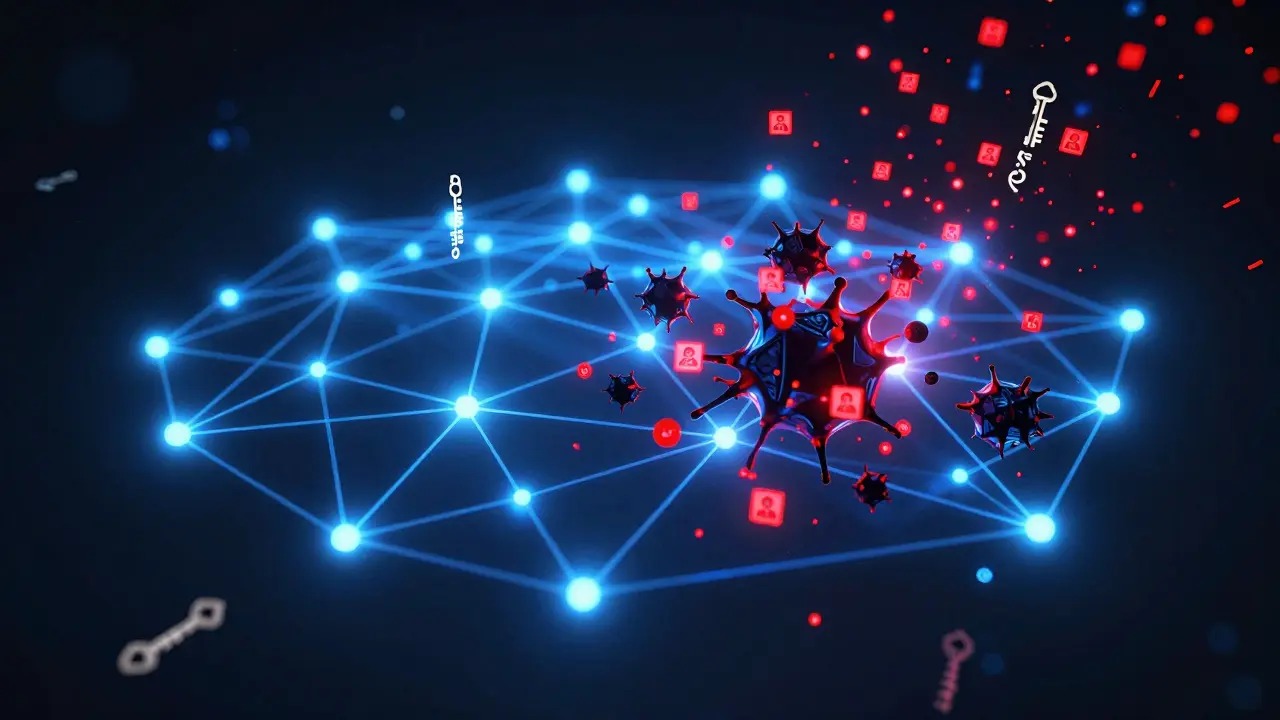
Sybil attacks aren't just about annoying spam; they threaten financial stability. There are two main ways these attacks play out. First is the Direct Attack, where the malicious nodes communicate directly with honest ones to force false consensus. Second is the Indirect Attack, where the attacker silently leverages reputation systems to isolate segments of the network.
Consider the mechanics of Proof of Stake (PoS). In systems like Ethereum, validators run nodes to secure the network. If an attacker deploys 500 nodes simultaneously staking small amounts of ETH, they appear to be 500 different stakeholders. This inflates their voting power in DAO proposals. Without checks, a single individual could theoretically steer a multi-million dollar treasury toward their own wallet.
Data from Q1 2024 showed that DAO participants suspected Sybil attacks in 67% of their governance processes. One community reported failing a treasury proposal because attackers generated 1,842 fake accounts in minutes, overwhelming the legitimate votes. This manipulation erodes confidence in the very decentralization these communities celebrate.
Defending Against Identity Manipulation
So, how do we fix a system where everyone is welcome but only humans should decide? We haven't found a silver bullet yet, but we have layered defenses. Different networks handle this differently based on their underlying technology.
| Method | Mechanism | Pros | Cons |
|---|---|---|---|
| Proof of Work | Requires physical hardware and electricity | High barrier to entry | Energy intensive, expensive scaling |
| Proof of Stake | Requires economic collateral (e.g., ETH) | Economically binding | Favorable to wealthy actors |
| Identity Schemes | Verification via external signals (Gitcoin) | Privacy-preserving | Complex, requires user effort |
Proof of Work (PoW) networks like Bitcoin make attacking expensive because you need actual mining power. Controlling just 10% of Bitcoin's hash rate costs millions monthly. It's hard to spin up thousands of cheap miners. However, this approach isn't practical for fast-moving governance.
Economic Commitments in Proof of Stake require locking up capital. On Ethereum, a validator needs to stake 32 ETH (roughly $100k depending on market conditions). This price tag acts as a deterrent. However, bots can still be automated scripts running on multiple devices if the stake threshold is low enough relative to the attack reward.
The most promising development in recent months is Gitcoin Passporta project for measuring the uniqueness of users in crypto communities. Instead of demanding government ID, it aggregates proofs like Twitter connections, email domain, and IP reputation. In a quadratic funding round, this scoring system dropped suspicious accounts from 68% down to 12%. It proves that verifying uniqueness is possible without invading privacy entirely.
The AI Factor: Synthetic Identities
If you think creating fake wallets is scary, imagine what AI adds to the mix. We are entering an arms race. By mid-2024, studies indicated that standard verification tools failed to detect 38% of AI-generated social media profiles used in simulated attacks.
This is a terrifying shift. Previously, a bot had to mimic a human behavior. Now, AI agents can generate realistic social graphs, complete with "history" and interactions. They pass basic CAPTCHA tests because the test was written yesterday by humans. The Electronic Frontier Foundation has already raised red flags about how deep social surveillance goes when trying to filter these bots out.
However, there is hope in standardization. The World Wide Web Consortium released version 2.0 of the Decentralized Identifier (DID) spec earlier this year. This creates a universal language for identity that allows blockchains to verify a user's humanity without revealing personal data. If adopted widely, this could reduce successful attacks in major DAOs to less than 5% by 2027, according to industry analysts.
Building Resilient Systems
We cannot rely on a single method to stop Sybil attacks. The future lies in hybrid models. Dr. Emin Gün Sirer of Ava Labs argues well-designed Proof of Stake systems offer natural resistance through economics. But experts like Dr. Ari Juels warn that governance remains the weak link.
For community leaders, the advice is simple: implement multi-factor identity verification. Don't trust a single signature. Combine wallet age, IP analysis, and social connection checks. For developers, design smart contracts that slow down governance execution so large sudden spikes in voter count trigger alarms.
The good news? We are learning. In the Gitcoin forum last April, users celebrated reduced Sybil rates thanks to better verification. It shows that when a community cares enough to build better tools, the system adapts. The challenge remains balancing open access-which is the soul of crypto-with safety, which is its survival mechanism.
What is the primary goal of a Sybil attack?
The primary goal is to gain disproportionate control over a decentralized network by masquerading as multiple unique participants, allowing the attacker to manipulate voting outcomes, disrupt consensus, or censor other users.
Can a Sybil attack succeed against Bitcoin?
It is highly unlikely due to Proof of Work security. To launch a successful attack, an adversary would need to control 51% of the total computing power, which currently costs hundreds of millions of dollars in hardware and energy, making it economically unfeasible.
How does Gitcoin Passport help prevent Sybil attacks?
Gitcoin Passport collects various forms of identity proof (like social media links or verified domains) to assign a score to a user. A higher score grants more weight in votes, preventing low-effort bot accounts from dominating governance results.
Why are DAOs particularly vulnerable to this threat?
Many DAOs distribute voting power equally among token holders. Since creating new wallets is free, an attacker can generate thousands of wallets to outvote the genuine human population without needing significant capital.
Are Sybil attacks a solved problem in 2026?
No. While mitigation strategies like social graph analysis and decentralized identity protocols (DIDs) are improving, no solution perfectly balances security with the permissionless nature of open blockchains. It remains an active area of research.