
Imagine throwing a handful of sand into the ocean and asking if you can catch it. That’s roughly what buying Ribbit crypto feels like right now. It’s not one single token; it’s a collection of frog-themed meme coins scattered across different blockchains, mostly riding the coattails of Pepe and Dogecoin. If you’ve seen "RIBBIT" trending on social media or popping up in your wallet as a mysterious zero-value asset, you’re probably wondering: Is this the next big thing, or just another digital joke?
The short answer? It’s mostly a joke with some serious liquidity risks. There isn’t one official "Ribbit Company." Instead, you have at least three distinct tokens sharing the name: an Ethereum-based fair launch, a Solana-based educational token called RBT, and a smaller version on Coinbase’s Base network. This article breaks down exactly what each one is, why they exist, and whether you should touch them with a ten-foot pole.
Key Takeaways
- No Single Authority: There is no unified whitepaper or foundation for all Ribbit coins. Each variant operates independently.
- Ethereum Version (RIBBIT): Marketed as a "fair launch" with no pre-mine, but currently has extremely low trading volume and market cap (under $150k).
- Solana Version (RBT): Claims to be the first frog coin on Solana, tied to the Rubic swap aggregator, but remains a micro-cap asset.
- Base Version: A tiny meme coin on Coinbase’s Layer 2, largely ignored by major exchanges.
- High Risk: All variants are explicitly labeled as entertainment assets with no intrinsic value. Liquidity is thin, meaning selling large amounts could crash the price instantly.
The Confusion: Three Different Ribbits
Before you buy anything, you need to know which Ribbit you’re looking at. The name collision is confusing because these tokens don’t talk to each other. They aren’t forks of the same codebase; they are separate projects that happened to pick the same catchy name.
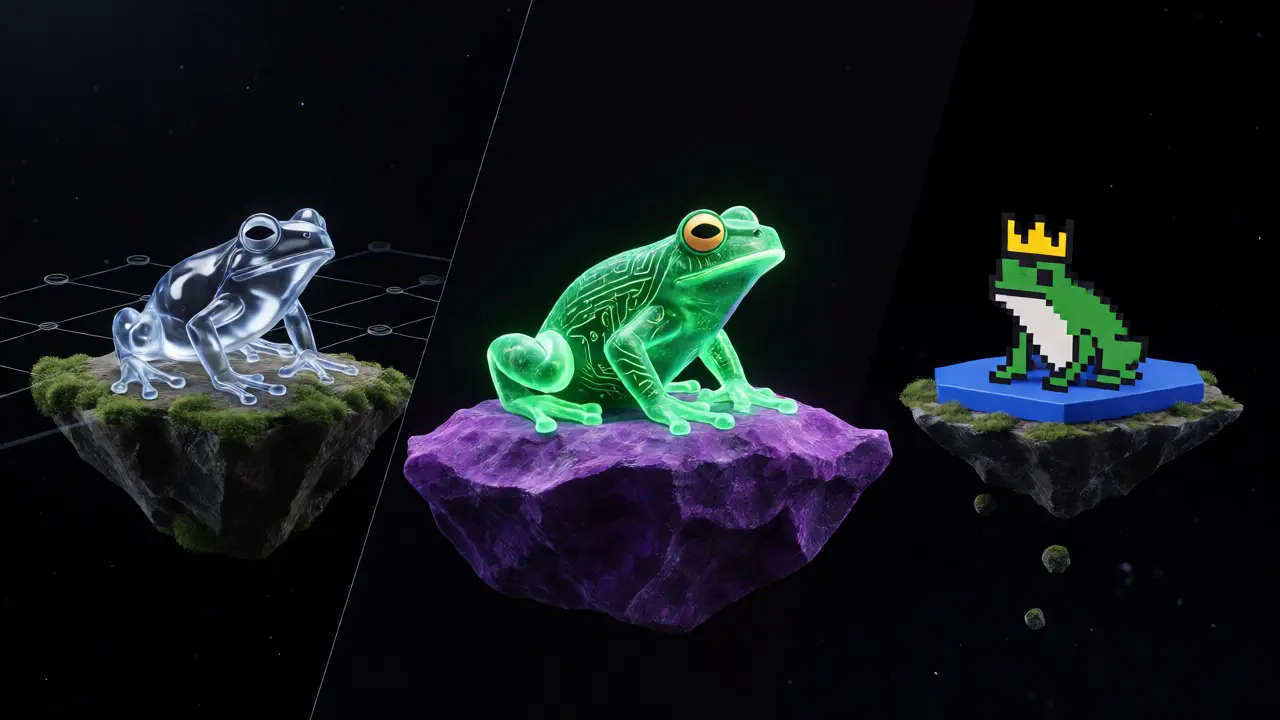
First, there’s Ribbit Meme (often just RIBBIT), typically found on Ethereum or EVM-compatible chains. Its main pitch is transparency. The developers claim they didn’t keep any tokens for themselves before listing. They sent 93.1% of the supply straight into a liquidity pool and burned the LP tokens, meaning the team can’t pull the rug by withdrawing that liquidity. The remaining 6.9% sits in a multi-signature wallet for future listings. It sounds great on paper, but in practice, it’s a ghost town. As of mid-2026, its market cap hovers around $117,000, and daily trading volume is often less than the cost of a decent dinner.
Then there’s RIBBIT (RBT) on the Solana blockchain. This one tries harder to justify its existence. It markets itself as an educational tool for the Solana ecosystem and integrates with Rubic, a cross-chain swap aggregator. The idea is that holding RBT might help facilitate swaps or reward users within that specific platform. It launched in late 2023, capitalizing on the hype cycle when Solana memes were exploding. Even here, though, the numbers are small. Market caps fluctuate between $200,000 and $800,000 depending on the day, which is peanuts compared to giants like PEPE or BONK.
Finally, we have the Base Ribbit token on Coinbase’s Layer 2 network. This one appeared back in November 2022, making it older than the Solana version. It’s described playfully as the "crowned prince of the meme coin pond," but don’t let the royal title fool you. With a total supply of 1 billion tokens and a market cap around $19,000 as of late 2025, it’s barely visible on the radar. It lacks the integration features of the Solana version and the transparent launch claims of the Ethereum version. It’s pure speculation on the Base chain.
| Feature | Ethereum RIBBIT | Solana RBT | Base RIBBIT |
|---|---|---|---|
| Primary Chain | Ethereum / EVM | Solana | Base (Coinbase L2) |
| Launch Date | Undocumented (Fair Launch) | Late 2023 | Nov 2022 |
| Main Narrative | Fair launch, no taxes | Education, Rubic integration | Meme collectible |
| Approx. Market Cap (2026) | $117k - $246k | $219k - $800k | $19k |
| Utility | None (Entertainment) | Swap rewards (Rubic) | None (Entertainment) |
| Major Exchange Support | Low (DEXs mainly) | Low (DEXs mainly) | Very Low |
Is There Any Real Utility?
Let’s be honest: most people buying meme coins aren’t checking GitHub repositories for smart contract audits. They’re chasing vibes. But does Ribbit offer anything beyond the frog emoji?
The Ethereum version explicitly states it has "no intrinsic value." Coinbase, which tracks the price but doesn’t allow direct trading of this specific token, bluntly calls it "completely useless and for entertainment purposes only." This is actually a helpful disclaimer. It means you shouldn’t expect dividends, governance votes, or staking yields. You are buying a ticket to a speculative casino where the house edge is hidden in the spread.
The Solana RBT token tries to bridge the gap between meme and utility. By partnering with Rubic, it aims to make cross-chain swaps smoother. Theoretically, using RBT within the Rubic ecosystem could lower fees or provide rewards. However, adoption metrics are hard to verify. We see price charts, but we don’t see clear data on how many active wallets are actually using RBT for swaps versus just holding it to flip it. Without transparent usage stats, the "utility" remains largely theoretical.
The Base version offers nothing special. It exists because Base is growing, and every new chain needs its own local memes. It’s a bet on the Base ecosystem’s growth rather than the token’s specific technology.
Market Performance and Liquidity Risks
If you look at the charts, Ribbit looks volatile. That’s standard for memecoins. But the real danger isn’t volatility; it’s liquidity. Look at the 24-hour trading volumes. For the Ethereum RIBBIT, volume often drops below $300 USD. For the Base version, it’s even lower. What does this mean for you?
It means slippage. If you try to sell $1,000 worth of RIBBIT in a pool that only has $500 of daily volume, you will tank the price. You might get 50% less than the quoted price just to exit. This is the classic pump-and-dump trap. Whales can buy cheap during quiet periods, hype it up on Twitter, and then dump their bags on retail buyers who chase the green candles. Because the market cap is so small (often under $300k), it takes very little money to move the price significantly.
Furthermore, none of these tokens are listed on top-tier centralized exchanges like Binance or Coinbase (for direct trading). You’re stuck using Decentralized Exchanges (DEXs) like Uniswap for Ethereum, Raydium for Solana, or Aerodrome for Base. This adds friction. You need to manage gas fees, understand slippage settings, and connect Web3 wallets correctly. If you’re a beginner, this operational complexity is a risk factor in itself.
How to Buy Ribbit (If You Must)
Since you won’t find a simple "Buy Ribbit" button on Robinhood or Coinbase Prime, here is the practical path to acquiring these tokens. Note that you must choose the correct chain.
- Choose Your Chain: Decide if you want Ethereum (RIBBIT), Solana (RBT), or Base (RIBBIT). This determines which wallet and exchange you use.
- Set Up a Wallet: Use MetaMask for Ethereum/Base or Phantom/Solflare for Solana. Never store significant amounts on an exchange if you plan to hold long-term, especially with obscure tokens.
- Fund Your Wallet: Buy ETH, SOL, or USDC/USDT on a major exchange and withdraw it to your Web3 wallet address.
- Connect to a DEX: Go to Uniswap (Ethereum), Raydium/Jupiter (Solana), or Aerodrome (Base). Connect your wallet.
- Find the Correct Contract Address: This is critical. Copy the contract address from CoinGecko or CoinMarketCap for the specific Ribbit variant you want. Do not search by name alone, or you might buy a scam copycat.
- Swap: Set your slippage tolerance higher than usual (e.g., 1-5%) due to low liquidity. Confirm the transaction.
The Verdict: Should You Invest?
Are you looking for a safe investment? Then Ribbit is not it. Are you looking for a lottery ticket with a 99% chance of losing your money and a 1% chance of a 10x return? Maybe.
The fundamental issue with Ribbit is the lack of a dominant narrative. PEPE has global recognition. DOGE has Elon Musk. BONK has community momentum. Ribbit is fragmented. Having three different tokens with the same name dilutes the brand power. When someone searches for "Ribbit," do they mean the Solana one or the Ethereum one? This confusion hurts marketing efforts.
Additionally, the absence of a formal whitepaper or audited roadmap signals that these are community-driven experiments, not professional ventures. While "fair launches" sound democratic, they often lack the funding needed for sustained marketing campaigns. Without continuous hype, these tokens tend to fade into obscurity, joining the graveyard of thousands of dead meme coins.
If you still want to dip your toe in, treat it as entertainment budget. Only invest what you are willing to lose completely. Watch the volume closely-if daily volume stays under $1,000, think twice about entering. And always double-check the contract address. In the world of micro-cap memes, being wrong by one character costs you everything.
Is Ribbit crypto a scam?
Not necessarily a scam in the traditional sense, but highly risky. The Ethereum version uses a "fair launch" model where liquidity was locked/burned, reducing rug-pull risks. However, the lack of utility, low liquidity, and multiple competing tokens with the same name make it prone to pump-and-dump schemes. Always verify the contract address to avoid fake copies.
Where can I buy Ribbit (RIBBIT)?
You generally cannot buy Ribbit on major centralized exchanges like Coinbase or Binance directly. You must use Decentralized Exchanges (DEXs). For the Ethereum version, use Uniswap. For the Solana version (RBT), use Raydium or Jupiter. For the Base version, use Aerodrome or similar Base-native DEXs.
Does Ribbit have a whitepaper?
No, there is no comprehensive technical whitepaper for the main Ribbit variants. Information is limited to exchange listings, social media posts, and brief descriptions on platforms like Coinbase or CoinGecko. The Solana version mentions integration with Rubic, but detailed technical documentation is sparse.
Why are there so many Ribbit coins?
The crypto market is fragmented across many blockchains (Ethereum, Solana, Base, etc.). Developers on each chain often create their own versions of popular meme themes. Since "Ribbit" is a catchy, frog-related term associated with internet culture, multiple independent teams launched tokens with this name on different networks without coordinating.
Is Ribbit connected to Ribbit Wallet?
No. Ribbit Wallet is a separate non-custodial mobile app built on Supra’s layer-1 network. It supports various chains like Bitcoin, Ethereum, and Polygon. While it shares the name, it is not the issuer or official wallet for the Ribbit meme coins discussed in this article.