
Imagine earning a steady 4% return on your cryptocurrency investments, only to wake up one morning and find that 10% of your capital has vanished. This isn't a hack or a market crash-it’s slashing, the hidden tax on cryptocurrency staking. For anyone running a validator node or delegating tokens in a Proof-of-Stake (PoS) network, understanding how slashing works is no longer optional; it is the difference between building wealth and losing it.
When you stake crypto, you are essentially putting up collateral to secure the network. In return, you earn rewards. But if you fail to perform your duties-whether by going offline for too long or, worse, trying to cheat the system-the protocol punishes you. These penalties, known as slashing events, directly impact your net returns. In this guide, we break down exactly how slashing happens, which networks carry the highest risk, and what you can do to protect your portfolio in 2026.
What Is Slashing and Why Does It Exist?
To understand why your returns might take a hit, you first need to understand the mechanism itself. Slashing is a penalty imposed on validators in Proof-of-Stake blockchains who act dishonestly or negligently. Think of it as a security deposit at a rental property. If you damage the place, the landlord keeps part of your deposit. In blockchain terms, if a validator breaks the rules, the network confiscates part of their staked tokens.
This concept originated with early PoS experiments like Peercoin in 2012 but became mainstream when Ethereum transitioned to Proof-of-Stake in September 2022. The primary goal is economic alignment. By forcing validators to have "skin in the game," the network ensures that it costs more to attack the chain than to protect it. However, for the individual staker, this means that every hour your node is offline carries a financial cost.
The impact on your returns is immediate. If you are earning an Annual Percentage Yield (APY) of 5%, but you get slashed by 2% due to downtime, your effective annual return drops significantly. Repeated minor slashes can wipe out years of accumulated rewards. According to data from KPMG's analysis of staking assets, poor validator quality can reduce net staking returns by 1.5 to 3.5 percentage points annually just through these penalties.
How Much Can You Lose? Penalty Breakdown by Network
Not all chains slash equally. The severity of the penalty depends entirely on the specific protocol's design. Some networks prefer light taps on the wrist, while others bring the hammer down. Here is how the major players compare:
| Network | Downtime Penalty | Critical Violation (e.g., Double-Signing) | Risk Profile |
|---|---|---|---|
| Ethereum | ~1% per epoch (if correlated) | Up to 100% of stake | High Severity / High Security |
| Cosmos Hub | 0.1% - 5% | 5% - 10% | Moderate Severity |
| Solana | Minimal / None for simple downtime | 100% for critical bugs | Unique Hybrid Model |
| Avalanche | 0.5% - 3% | Varies by subnetwork | Balanced Approach |
Ethereum stands out for its harshness. While minor infractions might result in small deductions, a "double-sign" event-where a validator signs two different blocks at the same height-is treated as an existential threat. The penalty can reach 100% of the staked amount. Furthermore, Ethereum uses "correlated slashing." If multiple validators fail at the same time, the penalty scales exponentially, potentially reaching 60% of the stake for coordinated failures. This makes infrastructure reliability non-negotiable.
In contrast, Cosmos-based networks like Osmosis tend to be gentler. Downtime penalties usually hover between 0.1% and 5%. This lower barrier allows smaller operators to participate without fearing total ruin from a single power outage. However, this comes with a trade-off: some analysts argue that lighter penalties make these networks slightly more vulnerable to certain types of attacks, though they offer higher APYs (often 8-12%) to compensate for the perceived risk.

The Real Cost: How Slashing Destroys Compound Interest
Most people look at the gross APY when choosing where to stake. They see "5% APY" and assume that is what they will earn. But slashing introduces a variable expense that turns gross yield into net loss. Let’s look at a realistic scenario.
Suppose you stake 32 ETH on Ethereum. The current price is $3,000, so your investment is $96,000. You expect a 4% annual return, which is roughly $3,840. Now, imagine your internet provider has a prolonged outage, or your server crashes, and you miss enough attestations to trigger a slash. Even a modest 1% slash costs you $960 in principal. That single event wipes out nearly three months of potential earnings.
The damage compounds over time. Because the slashed amount is removed from your total stake, you earn rewards on a smaller base moving forward. A Reddit user in the r/ethstaker community documented an incident where a software bug caused a 7.2 ETH loss (approximately $12,700). For that user, it took over a year of perfect uptime just to recover the lost principal, let alone generate profit. This is the silent killer of staking returns: not the market dropping, but your own operational failures eating away at your capital.
Common Triggers: Why Validators Get Slashed
Slashing doesn't happen randomly. It is triggered by specific technical failures. Understanding these triggers is the first step in prevention. There are three main categories of offenses:
- Downtime: This is the most common cause. If your validator node fails to sign blocks or attest to transactions for a set period, the network marks you as offline. On Ethereum, you need to maintain roughly 99% uptime. Frequent short downtimes accumulate into significant penalties.
- Double-Signing: This is the cardinal sin of PoS. It occurs when a validator signs two conflicting blocks at the same height in the blockchain. This suggests malicious intent or severe software corruption. Networks treat this as a direct attack, often resulting in the maximum possible penalty.
- Invalid Block Proposals: If a validator proposes a block that contains invalid transactions or incorrect state roots, the network rejects it. Repeated errors here signal incompetence or malice, leading to slashing.
Data from forum analyses shows that inadequate infrastructure accounts for 42% of slashing complaints, followed by software misconfiguration at 31%. Most of these are preventable with proper setup.
Mitigation Strategies: Protecting Your Staking Returns
You don't have to accept slashing as a unavoidable cost of doing business. Professional validators use several strategies to minimize risk and protect their returns. If you are self-hosting, consider these steps:
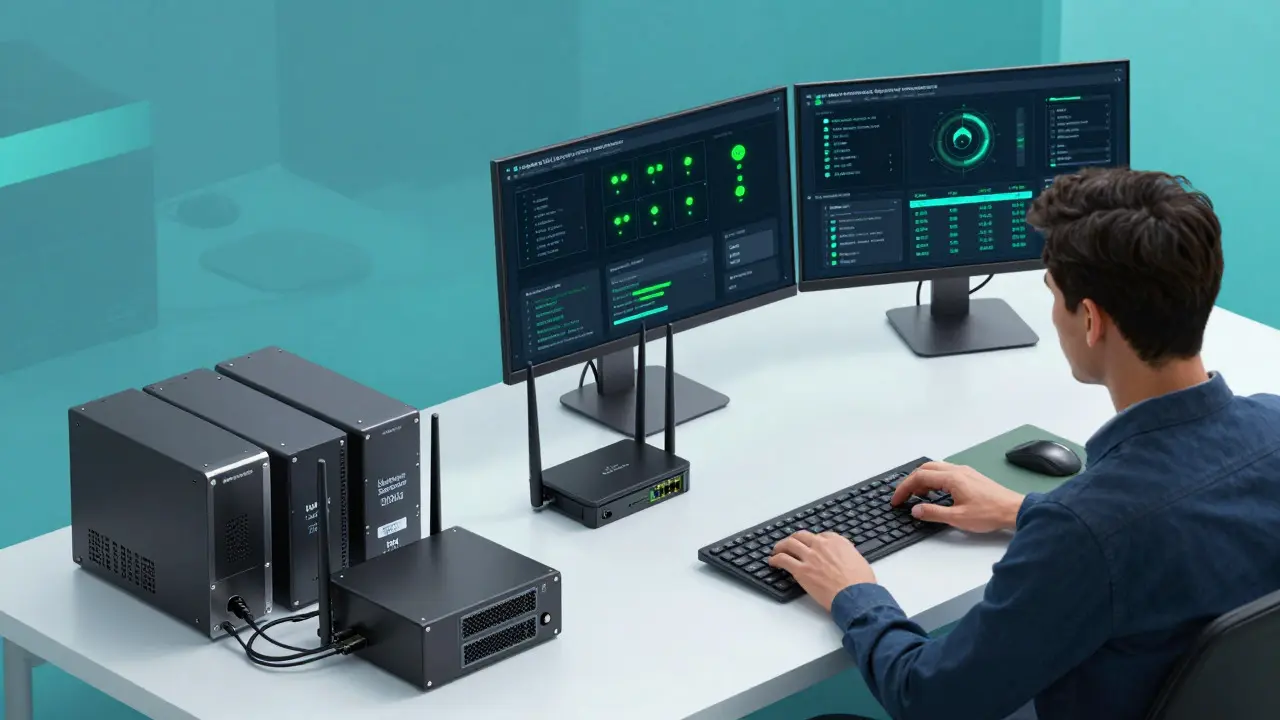
- Redundant Infrastructure: Never rely on a single point of failure. Use redundant power supplies (UPS), dual internet connections (fiber + cellular backup), and ideally, a secondary machine. Enterprise-grade setups often cost between $15,000 and $50,000 annually, but for retail stakers, a basic backup plan can be achieved for much less.
- Real-Time Monitoring: Set up alerts using tools like Prometheus and Grafana. You need to know within minutes if your node goes offline. Studies show that real-time monitoring reduces slashing risk by 76% because it allows for rapid intervention before penalties accumulate.
- Hardware Security Modules (HSM): Using HSMs for key management increases slashing resistance by 83%. These dedicated devices protect your private keys from being stolen or corrupted, which is a common cause of double-signing incidents.
- Geographic Distribution: If you run multiple validators, host them in different data centers. This prevents a local power grid failure from taking down all your nodes simultaneously.
If managing this complexity sounds overwhelming, delegation is a viable alternative. Institutional staking providers like Lido or Coinbase handle the infrastructure for you. Trustpilot reviews indicate that institutional services have minimal slashing incidents, with positive reviews citing "reliability" in 83% of cases. However, you must weigh this against the fees they charge, which also eat into your returns.
The Future of Slashing: Trends for 2026 and Beyond
The landscape of staking is evolving. As we move through 2026, we are seeing a shift toward more balanced penalty structures. For example, Ethereum’s upcoming upgrades aim to fine-tune these mechanisms. The proposed changes include reducing minimum slashing penalties for minor infractions from 1% to 0.5%, while increasing penalties for coordinated attacks. This aims to punish malice without crushing honest mistakes.
Additionally, the market for slashing insurance is growing. Companies like Nexus Mutual now offer coverage that pays out if a validator is slashed due to specific technical failures. While premiums range from 0.5% to 2.5% of your staked value, this can be a worthwhile hedge for large positions. However, read the fine print: many policies exclude 78% of common scenarios, such as user error or force majeure events.
Experts predict that as infrastructure improves, overall slashing rates will decline. Delphi Digital forecasts that annual slashing incidence could drop from the current 0.8-1.2% to 0.3-0.5% by the end of the decade. This would effectively increase net staking returns across the board, making passive income from crypto more stable and predictable.
Can I appeal a slashing penalty?
Generally, no. Slashing is an automated, code-enforced action. Once the protocol determines a violation has occurred, the penalty is executed immediately. There is no central authority to appeal to, which underscores the importance of robust infrastructure and monitoring.
Is staking safer on Ethereum or Cosmos?
It depends on your definition of "safe." Ethereum has stricter penalties, meaning a mistake costs more, but its high barriers to entry ensure that most validators are professional and reliable. Cosmos has lighter penalties, which might seem safer for your wallet, but the lower stakes can sometimes lead to less rigorous validation practices. For most users, delegated staking on either network is relatively safe.
How much does it cost to run a slashing-proof validator?
For a retail operator, setting up a highly redundant system with backups and monitoring can cost between $500 and $2,000 initially, plus monthly hosting fees. Enterprise-grade setups used by institutions can cost upwards of $15,000 annually. The key is redundancy: having backup internet, power, and hardware.
Does slashing affect my reputation score?
Yes. Many staking platforms and delegators track validator performance. A history of slashing events can damage your reputation, making it harder to attract delegators in the future. This reputational damage can indirectly reduce your returns by lowering your total active stake.
What is the difference between slashing and deactivation?
Deactivation is a temporary state where a validator is removed from the active set due to downtime or low balance, but no funds are lost. Slashing involves the actual confiscation of tokens. Deactivation is a warning; slashing is the punishment.