You’ve probably heard about individual AI coins on Solana. You might even have a few in your wallet. But managing ten different tokens, tracking their charts, and worrying about which one will pump or dump is exhausting. That’s exactly why OSOL AI Index exists. Instead of picking winners, you buy one token that holds them all. It’s marketed as the "S&P 500 of Solana AI," and it aims to simplify your life by bundling exposure to roughly 100 artificial intelligence projects into a single click.
If you are wondering what OSOL actually is, how it works, and whether it’s worth your attention, you’re in the right place. We’ll break down the mechanics, the tokenomics, and the risks involved with this specific type of crypto product.
What Exactly Is the OSOL AI Index?
At its core, OSOL is a cryptocurrency token built on the Solana blockchain that functions as an on-chain index fund. Think of it like an Exchange-Traded Fund (ETF) from the traditional stock market, but for digital assets. In the stock world, you can buy an S&P 500 ETF to own a tiny piece of Apple, Microsoft, Amazon, and hundreds of other companies without buying each stock individually. OSOL tries to do the same thing for the AI sector on Solana.
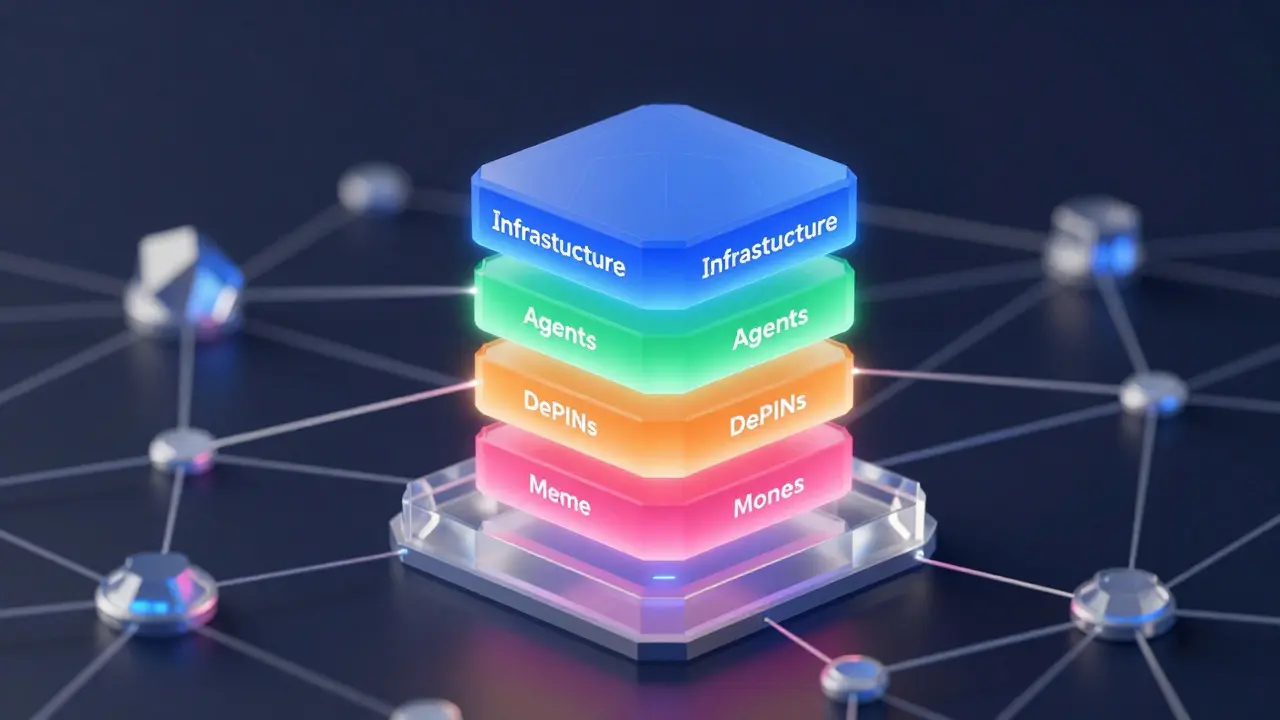
Instead of betting on one AI project-like a specific chatbot protocol or a decentralized physical infrastructure network (DePIN)-you hold OSOL. Each token represents a proportional share of a basket containing approximately 100 AI-related projects. This basket includes:
- AI Infrastructure: The foundational tech powering AI models on-chain.
- AI Agents: Autonomous software bots that perform tasks.
- AI DePINs: Projects connecting physical hardware resources to AI workloads.
- AI Meme Tokens: Viral community-driven tokens with AI branding.
The goal is diversification. If one project in the basket fails, the impact on your overall holding is minimized because you still own shares of the other 99 projects. It’s designed for investors who want exposure to the booming AI narrative on Solana but don’t have the time or expertise to research every new launch.
How Does the Index Work? (The Mechanics)
You might be asking, "Who decides what goes into the basket?" According to public documentation, OSOL tracks a rules-based index. The selection criteria generally focus on metrics like market capitalization, liquidity, and ecosystem impact. This means larger, more liquid projects likely carry more weight in the index than smaller, newer ones.
Here is how the process typically flows for a holder:
- Selection: The index committee or algorithm identifies the top ~100 AI projects on Solana based on predefined metrics.
- Weighting: These projects are weighted, often by market cap, so the index reflects the broader health of the sector rather than just hype around micro-caps.
- Token Representation: When you buy OSOL, you aren't buying the underlying tokens directly in your wallet. You are buying a receipt that proves you own a slice of that managed basket.
- Rebalancing: Periodically, the index may be rebalanced to remove underperformers or add new trending AI projects, keeping the fund relevant.
This structure removes the headache of gas fees for multiple transactions and the security risk of interacting with dozens of different smart contracts. However, it does introduce a layer of trust: you are relying on the team behind OSOL to manage the index correctly.
Tokenomics: Supply and Distribution
Understanding the supply dynamics is crucial before investing. Unlike some meme coins that inflate endlessly, OSOL has a fixed maximum supply.
| Attribute | Value |
|---|---|
| Maximum Supply | 1,000,000,000 OSOL |
| Circulating Supply | ~999,997,733 OSOL (Approximately 99.99%) |
| Blockchain | Solana (SPL Token) |
| Type | Index Fund / ETF-style Token |
As of mid-2026, nearly the entire supply is already in circulation. This suggests there is little inflationary pressure from new minting. However, keep in mind that unlike fully decentralized protocols, index funds often have team allocations or treasury reserves that might vest over time. While public snippets don't detail specific vesting schedules, the fact that the circulating supply is so close to the max implies most tokens are already tradable.
Price Performance and Volatility
Let’s talk numbers. Crypto prices change fast, and OSOL is no exception. Because it is a small-cap asset (with a market cap fluctuating between $2 million and $8 million depending on the day), it experiences significant volatility.
In January 2025, OSOL saw a massive intraday surge of 135%, jumping from roughly $0.026 to $0.084 within 24 hours. This kind of movement is typical for speculative assets in the crypto space. By mid-2026, the price had settled into a lower range, trading between $0.001 and $0.008 across various exchanges like Coinbase, Binance, and Crypto.com.
Why the discrepancy in prices you see online? Data aggregators sometimes lag or pull from different liquidity pools. For example, CoinPaprika might show a slightly different price than TradingView due to timestamp differences or exchange-specific liquidity depths. Always check multiple sources before making a trade. The key takeaway is that while OSOL offers diversification *within* the AI sector, it is still subject to the broader volatility of the crypto market. It is not a stablecoin; it is a high-risk, high-reward instrument.
Pros and Cons of Investing in OSOL
Is OSOL right for you? It depends on your investment style. Here is a balanced look at the advantages and drawbacks.
The Good:
- Simplicity: One token gives you access to 100+ projects. No need to manage 100 separate wallets or track 100 different contract addresses.
- Diversification: Reduces the risk of total loss if a single AI project turns out to be a scam or fails technically.
- Exposure to Trends: Captures value from the hottest sub-sectors, including AI agents and DePINs, which are hard to navigate individually.
- Solana Speed: Being on Solana means low transaction fees and fast settlement times compared to Ethereum-based indices.
The Bad:
- Centralization Risk: Someone has to manage the index. If the team makes poor decisions or disappears, the fund suffers. It is less decentralized than holding raw SOL.
- Data Inconsistencies: As seen in market data, tracking accurate market caps and volumes for small-cap tokens can be messy across platforms.
- No Yield Generation: Unless specified, simply holding OSOL doesn’t automatically generate staking rewards from the underlying assets unless the fund redistributes them (which requires checking their latest docs).
- Volatility: Diversification helps, but if the entire AI sector crashes, OSOL will drop too.
How to Buy OSOL AI Index
Since OSOL is an SPL token on Solana, the process is similar to buying any other Solana-based asset. Here is a general guide:
- Get a Wallet: Download a Solana-compatible wallet like Phantom, Solflare, or Backpack. Secure your seed phrase offline.
- Fund Your Wallet: Buy SOL on a major exchange (like Coinbase or Binance) and send it to your wallet address, or use a fiat-to-crypto ramp inside the wallet.
- Find the Exchange: OSOL is listed on several platforms. Check CoinGecko or CoinMarketCap for the current list of active markets. Exchanges like Coinbase, Crypto.com, and various DEXs (Decentralized Exchanges) on Solana may support it.
- Swap for OSOL: If using a DEX like Raydium or Jupiter, paste the official OSOL contract address (verify this on osol.ai to avoid scams) and swap your SOL for OSOL.
- Verify the Token: Always double-check the contract address. Fake tokens with similar names are common in crypto.
OSOL vs. Other AI Crypto Investments
How does OSOL compare to just buying a popular AI coin like Render (RNDR) or Fetch.ai (FET)?
Buying RNDR or FET is a concentrated bet. You believe specifically in their technology and team. If they succeed, you win big. If they fail, you lose everything. OSOL is a broad bet. You believe the *sector* of AI on Solana will grow, regardless of which specific company wins. It’s the difference between betting on a single horse in a race versus betting on the winner of the entire track.
Furthermore, OSOL is unique because it focuses exclusively on Solana. Most AI crypto indexes are multi-chain or Ethereum-focused. If you think Solana is the home of the next generation of AI apps, OSOL is a targeted way to play that thesis.
Final Thoughts on OSOL
OSOL AI Index fills a real niche for crypto investors who want exposure to AI without the operational headache of managing a complex portfolio. It leverages Solana’s speed and low costs to offer a streamlined experience. However, remember that "index fund" in crypto doesn’t mean "safe." It still carries market risk, smart contract risk, and team dependency.
Do your own research. Check the latest whitepaper on their official site, monitor the on-chain activity, and never invest more than you can afford to lose. The AI narrative is strong, but the path is volatile.
Is OSOL AI Index a good investment?
Whether OSOL is a "good" investment depends on your risk tolerance. It is suitable for investors who want diversified exposure to the Solana AI sector without managing multiple tokens. However, it is a small-cap asset with high volatility. It is not a guaranteed safe haven.
What blockchain is OSOL on?
OSOL is built on the Solana blockchain. It is an SPL token, meaning it uses Solana's high-speed, low-cost infrastructure.
Does OSOL pay dividends?
Public information does not explicitly state that OSOL pays automatic dividends. Like many index tokens, its value appreciation comes from the increase in the market cap of the underlying assets. Check their latest documentation for any yield redistribution mechanisms.
How many projects are in the OSOL index?
The OSOL index tracks approximately the top 100 artificial intelligence-related projects on Solana, including infrastructure, agents, DePINs, and meme tokens.
Where can I buy OSOL?
OSOL is listed on several exchanges including Coinbase, Crypto.com, and Binance, as well as Solana-based decentralized exchanges (DEXs). Always verify the current listing status on CoinGecko or CoinMarketCap before trading.