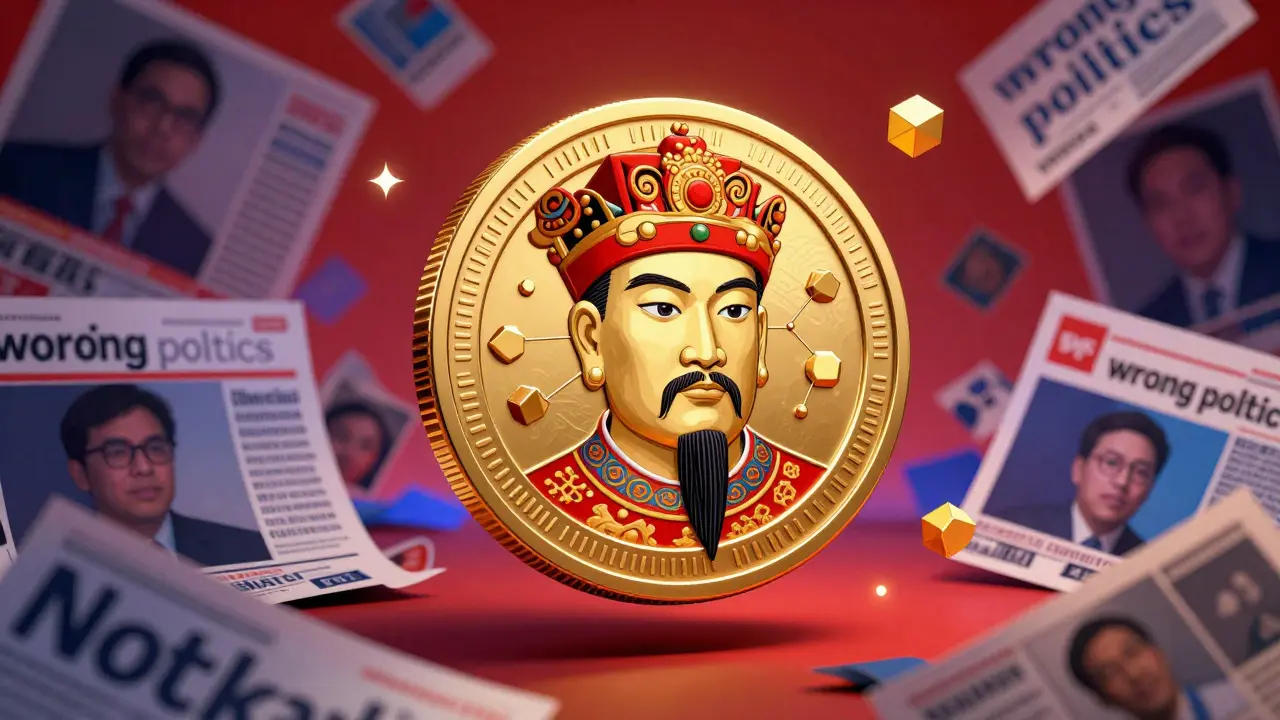
Imagine a cryptocurrency that doesn't promise to revolutionize banking or fix supply chains, but instead exists solely to mock political decisions. That’s JinPeng, known by its ticker JIN. It’s not just another dog-themed joke; it’s a tokenized piece of political satire, primarily associated with the Solana ecosystem and sometimes linked to Binance Smart Chain. If you’ve stumbled upon this tiny asset while scrolling through obscure market caps, you’re probably wondering if it has any substance or if it’s just noise in the blockchain void.
The Core Identity: Satire Over Utility
JinPeng is a small-cap, politics-themed meme cryptocurrency designed to satirize harmful political decisions. Unlike Bitcoin, which aims to be digital gold, or Ethereum, which seeks to be a world computer, JinPeng’s primary job is entertainment and commentary. The project explicitly states its goal is to highlight "wrong politics that put people’s lives and interests at risk." Several descriptions within the crypto community identify the token as a meme representation of China’s president, using humor to critique governance actions.
This narrative-driven approach places JinPeng in a niche category of "political memes." While most memecoins rely on cute animals or viral internet trends, JinPeng leans into controversial real-world figures. This makes it distinct but also potentially volatile, as its value is tied to community sentiment regarding specific political events rather than broad adoption metrics. As of late August 2026, the token trades at micro prices, hovering around $0.00001-$0.00002 USD. Its market capitalization sits between roughly $14,000 and $16,000, ranking it near the 7,800th position globally on major aggregators like CoinGecko.
Blockchain Confusion: Solana vs. BSC
One of the first things you’ll notice when researching JinPeng is a glaring inconsistency in its technical foundation. Data sources are split on where this token actually lives. On one hand, platforms like Bitget and CoinCarp label it as a Solana meme token, providing contract addresses that follow the SPL token standard. These listings emphasize fast transactions and low fees typical of the Solana network. On the other hand, CoinPaprika describes JinPeng as operating on the Binance Smart Chain (BSC), framing it as a utility token for DeFi payments and staking.
Why does this matter? Because your wallet setup depends on it. If you try to buy JIN on a Solana DEX like Raydium, you need a Solana-compatible wallet like Phantom. If it’s truly on BSC, you’d need MetaMask. This discrepancy likely stems from either a multi-chain deployment that wasn’t fully communicated or simple data errors in third-party trackers. Given that most recent trading activity points to Solana venues, users should verify the contract address before transferring funds. There is no public whitepaper or official team page to clarify this ambiguity, leaving investors to rely on exchange-specific listings.
Tokenomics and Supply Mechanics
JinPeng’s tokenomics are straightforward, though slightly inconsistent across different data providers. Most sources agree on a total and circulating supply of approximately 852 million to 854 million JIN. For instance, Coinbase lists a circulating supply of 854,316,386 JIN, noting that 100% of the supply is already in circulation. Other trackers like CoinStats report 852,656,519 JIN. This means there are no new tokens being minted regularly, and inflation isn’t a concern here. However, the lack of a locked liquidity pool or clear vesting schedules for early buyers adds to the risk profile.
| Metric | Value / Range | Source Context |
|---|---|---|
| Price | $0.00001 - $0.00002 | CoinGecko, CoinStats |
| Market Cap | $14,000 - $16,000 | Micro-cap classification |
| Total Supply | ~854 Million JIN | Coinbase, Bitget |
| All-Time High | $0.001435 (Oct 2024) | CoinGecko KR Profile |
| All-Time Low | $0.00002013 (June 2025) | CoinGecko KR Profile |
| Primary Exchange | Raydium (Solana) | CoinGecko Volume Data |
The price history tells a story of extreme volatility. JinPeng hit an all-time high of $0.001435 in October 2024, only to crash to an all-time low of $0.00002013 by June 2025. That’s a drop of over 98%. By August 2026, it had stabilized slightly above the lows but remains far below its peak. This pattern is classic for micro-cap meme coins: a speculative pump followed by a long bleed-out as hype fades.
Liquidity and Trading Venues
If you’re looking to trade JinPeng, don’t expect deep order books. Liquidity is extremely thin. On Raydium, the main decentralized exchange for Solana tokens, daily volume often dips below $10. Some snapshots show volumes as low as $9.94 USD per day. Centralized exchanges like LBank and Bitget list the token, but their volume is similarly negligible compared to major assets. In July 2025, Crypto.com recorded a spike of $127,336 in daily volume, but that was an anomaly. For most days, buying or selling significant amounts of JIN could move the price dramatically due to slippage.
There is no formal audit of the smart contract mentioned in any major aggregator. No security firms have published reviews, and the code repository isn’t prominently linked. This means you are trusting the anonymous developers who launched the token in 2021. Without a public team or legal entity behind it, JinPeng operates in the wild west of crypto anonymity.
Utility Claims vs. Reality
CoinPaprika claims JinPeng has utility for staking and governance, allowing holders to influence project direction. However, no active dApps, lending protocols, or yield farms integrate JIN in a meaningful way. You won’t find it used for paying gas fees or accessing exclusive content on major platforms. The "governance" aspect seems theoretical; without a transparent voting mechanism or active proposals, holding JIN mostly grants you exposure to its price action and the social status of owning a quirky meme.
The token’s value proposition is entirely cultural. It appeals to those who want to participate in political satire via blockchain. If the community believes the meme is funny or timely, the price might rise. If political attention shifts elsewhere, the token risks becoming dormant. It’s a bet on relevance, not technology.
Risks and Red Flags
Investing in JinPeng carries high risk. First, the team is anonymous. You don’t know who created it or if they still manage the liquidity pools. Second, the chain confusion (Solana vs. BSC) suggests poor documentation management. Third, the lack of audits means smart contract vulnerabilities haven’t been independently verified. Finally, the political nature of the meme can limit its audience. What’s funny to one group might be offensive or irrelevant to another, fragmenting the community quickly.
For beginners, JinPeng is a cautionary tale. It shows how easily a token can launch, gain traction, and then struggle for survival once the initial hype dies down. It’s not a blue-chip investment; it’s a speculative toy.
Is JinPeng (JIN) on Solana or Binance Smart Chain?
Data is conflicting. Recent trading activity and contract addresses point to Solana (SPL token), while some older descriptions mention Binance Smart Chain. Always verify the contract address on the exchange you plan to use.
Who created JinPeng?
The team is anonymous. No individual founders or legal entities are publicly named in major crypto databases.
Does JinPeng have a whitepaper?
No formal whitepaper link is available on major aggregators like CoinGecko or CoinMarketCap. Information is limited to short descriptive blurbs.
Where can I buy JIN?
You can typically find JIN on Raydium (a Solana DEX), LBank, and Bitget. Volume is very low, so check liquidity before trading.
Is JinPeng a good investment?
It is highly speculative. With a market cap under $20k and no clear utility, it’s best viewed as a high-risk meme play rather than a solid investment.