Have you ever seen a Telegram bot or a mobile app promising free cryptocurrency just for keeping it open? You might have stumbled upon Ice Open Network, often referred to by its ticker symbol ICE. It’s one of those projects that sounds too good to be true: earn crypto on your phone without buying expensive hardware. But what is it really? Is it a scam, a gimmick, or a legitimate blockchain project?
To understand ICE, you first need to know where it comes from. It isn’t built from scratch. Instead, it is a fork of the Telegram Open Network (TON) blockchain. If you’ve heard of Toncoin, you’re already halfway there. Ice Open Network takes that underlying technology and adds its own twist, focusing heavily on making Web3 accessible to people who don’t know how to code or afford high-end GPUs.
The Core Technology: How Does Ice Open Network Work?
At its heart, Ice Open Network is a Layer-1 blockchain. That means it’s a foundational network where decentralized applications (dApps) can run, similar to Ethereum or Solana. However, it borrows heavily from the architecture of TON. This includes the use of the TON Virtual Machine (TVM), which handles the execution of smart contracts.
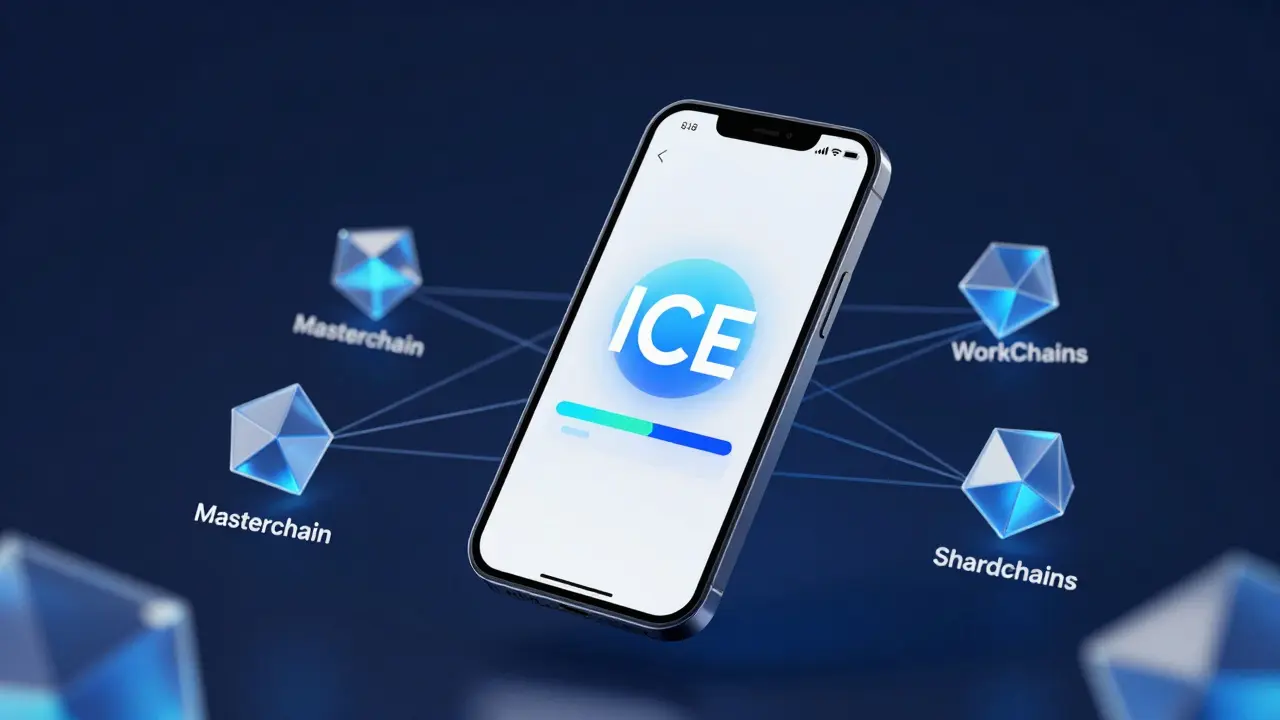
The real magic-or at least the claimed advantage-lies in its three-layer structure designed to solve the "blockchain trilemma" of scalability, security, and decentralization:
- Masterchain: This is the top layer. It ensures the overall security of the network and manages validators. Think of it as the central nervous system checking everything is okay.
- Workchains: These are secondary chains that handle specific tasks or applications. They operate under the rules set by the Masterchain but process their own data.
- Shardchains: These are subdivisions of workchains. They allow for parallel processing. While traditional blockchains like Bitcoin process transactions one after another, shardchains let multiple transactions happen at the same time. Theoretically, this allows the network to handle millions of transactions per second (TPS).
This sharding approach is why proponents claim Ice Open Network can scale better than older networks. When Ethereum gets congested, fees skyrocket. The goal here is to keep fees low and speed high by splitting the workload across many shards.
The Hype Around Mobile Mining
If you’re reading this because you saw an ad for "mining" on your phone, this section is crucial. Ice Open Network launched a mobile mining program in July 2023. By early 2025, they claimed over 9 million users had joined. This is massive adoption for a niche crypto project.
Here’s how it works in practice: You download an official app, register, and essentially keep the app running or interact with it daily. In return, you earn ICE tokens. Unlike Bitcoin mining, which requires powerful ASIC machines that consume huge amounts of electricity, this "mobile mining" is lightweight. It doesn’t drain your battery significantly or heat up your device.
But wait-is it real mining? Not in the traditional Proof-of-Work sense. Your phone isn’t solving complex mathematical puzzles to secure the network. Instead, this is more accurately described as a user acquisition tool or a loyalty reward system. The network uses a Proof-of-Stake (PoS) consensus mechanism combined with Byzantine Fault Tolerant (BFT) protocols for its operations. Your participation helps build the community and distribute tokens, rather than securing the chain through computational power.
This distinction matters. Traditional miners argue this isn’t "real" mining because it doesn’t contribute to network security in the same way. However, for the average user, it lowers the barrier to entry dramatically. You don’t need $5,000 worth of hardware; you just need a smartphone.
Gasless Transactions: Removing the Barrier to Entry
One of the biggest complaints about using cryptocurrencies is "gas fees." On Ethereum, sending a simple token transfer can cost anywhere from $5 to $50 during busy periods. For a $10 purchase, that fee makes no sense. Ice Open Network addresses this with a feature called ION Connect.
ION Connect enables gasless transactions. This means users can interact with decentralized applications on the network without needing to hold any cryptocurrency to pay for the transaction fees. The network or the application developer covers these costs.
Why does this matter? Imagine trying to convince your non-crypto-savvy friends to use a decentralized social media app. If they first have to buy ETH, convert it to the right token, and worry about paying gas fees every time they post, they’ll quit immediately. With gasless transactions, the experience feels like using Instagram or Twitter. You just log in and go. This is critical for bridging the gap between Web2 (the current internet) and Web3 (the decentralized web).
Ecosystem Components: More Than Just a Coin
The ICE token is the fuel, but the engine consists of several interconnected tools. Understanding these helps you see the bigger picture of what the project aims to build.
| Component | Function | User Benefit |
|---|---|---|
| ICE Token | Native utility token | Used for governance, staking, and ecosystem incentives |
| ION ID | Digital identity management | Secure, self-sovereign identity without relying on big tech companies |
| ION Vault | Decentralized data storage | Store files securely without fear of censorship or server downtime |
| ION Liberty | Uncensorable content access | Bypass geo-blocks and censorship to access information freely |
These components suggest a vision beyond just speculation. They aim to create a suite of tools for privacy and freedom. For example, ION Liberty could be valuable in regions with strict internet censorship. However, as of May 2026, the practical usage of these tools by the general public is still growing. Most users are still focused on the mining aspect.
Tokenomics: Supply and Circulation
When evaluating any crypto project, you must look at the numbers. How many coins exist? How many are available now? Scarcity drives value, but inflation can dilute it.
As of mid-2026, the total supply of ICE tokens is capped at approximately 21.15 billion. This number is reminiscent of Bitcoin’s 21 million cap, though scaled differently due to the nature of mobile distribution. Currently, the circulating supply stands at around 6.6 billion tokens. This means roughly 31% of all tokens are in circulation, with the rest likely allocated for future rewards, development funds, or team vesting.
The large circulating supply means the price per individual token will likely remain low compared to assets like Bitcoin or Ethereum. Don’t be fooled by a low price tag thinking it’s "cheap." Value is determined by market capitalization (price multiplied by circulating supply), not just the unit price. Always check the market cap to understand the true size of the investment required to move the price.

Risks and Criticisms: What Could Go Wrong?
No investment is risk-free, and Ice Open Network has its fair share of skeptics. Here are the main concerns you should weigh before getting involved.
1. Theoretical vs. Real Performance: The project claims to handle millions of transactions per second. While the sharding architecture supports this theoretically, real-world tests often tell a different story. Many blockchains promise high TPS but struggle when actual load hits the network. Until you see sustained, organic traffic handling these volumes, treat these numbers with caution.
2. Sustainability of Mobile Mining: Critics question whether giving away tokens for minimal effort creates long-term value. If millions of users are earning tokens without contributing significant security or compute power, does the token have intrinsic value? Or is it just a speculative asset driven by hype? Once the easy rewards dry up, will users stay engaged?
3. Competition: The Layer-1 space is crowded. Ethereum has a massive developer base. Solana offers high speed. Cardano focuses on academic rigor. Ice Open Network competes against these giants plus other forks. Its unique selling point is mobile accessibility, but if major players like Meta or Apple integrate crypto wallets natively into their OS, the niche advantage of a standalone mobile mining app could diminish.
4. Regulatory Uncertainty: As governments worldwide tighten regulations on cryptocurrencies, projects that resemble securities or unregistered exchanges face risks. The ease of access via mobile apps also attracts scrutiny from financial regulators concerned about consumer protection.
How to Get Started Safely
If you’re curious about Ice Open Network, here is a practical path forward. Remember, never invest money you cannot afford to lose.
- Download Official Apps Only: Phishing scams are rampant in crypto. Only download the Ice Open Network app from official sources listed on their verified website or GitHub repository. Never click links from random DMs on Telegram or Discord.
- Start with Mobile Mining: Since the entry barrier is low, try the mobile mining program. It costs nothing but time. Use this period to learn about the interface and the community without financial risk.
- Research the Team: Look into who is behind the project. Are they doxxed (publicly known)? Do they have a track record in blockchain development? Anonymous teams carry higher risk.
- Use a Secure Wallet: If you decide to trade ICE tokens, move them out of exchange wallets into a private wallet that supports the TON/ICE ecosystem. Hardware wallets offer the best security for larger amounts.
- Monitor Market Cap, Not Price: Keep an eye on the total market capitalization and trading volume. Low liquidity can make it hard to sell your tokens if you want to exit quickly.
Is Ice Open Network Worth It?
Ice Open Network represents a bold attempt to democratize blockchain access. By leveraging the proven TON architecture and adding features like gasless transactions and mobile mining, it targets a demographic that traditional crypto ignored: the everyday smartphone user.
For developers, the cross-chain compatibility and TVM support offer a familiar environment to build dApps. For users, the ability to earn tokens without upfront capital is undeniably attractive. However, the skepticism surrounding the sustainability of free token distribution and the intense competition in the Layer-1 space are valid concerns.
It is not a get-rich-quick scheme. The tokens earned through mobile mining may have modest value initially. The real potential lies in whether the ecosystem-ION ID, Vault, and Liberty-gains genuine utility and adoption. If people start using these tools for privacy and communication, the demand for ICE could grow organically. If it remains just a mining game, the value may stagnate once the novelty wears off.
Approach it with curiosity, but keep your expectations grounded. In crypto, innovation is exciting, but patience and due diligence are your best defenses.
Is Ice Open Network (ICE) a scam?
There is no evidence that Ice Open Network is a outright scam. It is a legitimate blockchain project with a functioning mainnet, active development, and a transparent whitepaper. However, like all cryptocurrencies, it carries investment risks. Be wary of third-party websites or Telegram groups claiming to offer "guaranteed returns" or asking for your private keys. Always verify official channels.
Can I mine ICE on my iPhone or Android?
Yes, the mobile mining program is designed for both iOS and Android devices. You do not need root access or special hardware. Simply download the official app, create an account, and follow the instructions to start earning. Note that this is not traditional Proof-of-Work mining; it is a user engagement reward system.
What is the difference between TON and ICE?
TON (Toncoin) is the native token of the original Telegram Open Network. ICE is the native token of Ice Open Network, which is a fork of TON. While they share similar underlying technology (like the TVM and sharding), they are separate blockchains with different tokens, communities, and ecosystems. Holding TON does not automatically give you ICE.
Are transactions on Ice Open Network really free?
The network supports "gasless" transactions through its ION Connect protocol. This means end-users do not need to pay fees to interact with certain dApps. However, someone (usually the developer or the network) still pays the underlying cost. For basic transfers or interactions within supported apps, the experience is effectively free for the user.
Where can I buy ICE tokens?
ICE tokens are traded on various cryptocurrency exchanges. Availability depends on your region and the specific exchange listings. Always check reputable tracking sites like CoinMarketCap or CoinGecko for the most up-to-date list of supported exchanges. Never trade on unofficial peer-to-peer platforms without proper escrow services.
Does mobile mining damage my phone battery?
No, the mobile mining process is optimized to be lightweight. It does not perform heavy computational tasks that would overheat your device or drain your battery rapidly. It primarily runs in the background with minimal resource usage, unlike traditional crypto mining apps.