Trading crypto on Ethereum mainnet feels like paying a luxury tax. You want to swap tokens, but the gas fees eat up your profits before the trade even settles. That is exactly why Velodrome Finance has become the go-to spot for traders who refuse to overpay. It is not just another decentralized exchange; it is the liquidity backbone of the Optimism Layer 2 network. Launched in June 2022, Velodrome combines the best parts of Curve, Convex, and Uniswap into one streamlined protocol. If you are looking for deep liquidity, near-zero transaction costs, and a governance model that actually rewards you for participating, this review breaks down how Velodrome works, whether it is safe, and if it fits your trading strategy.
What Is Velodrome Finance?
At its core, Velodrome Finance is a decentralized automated market maker (AMM) built specifically for the Optimism blockchain. Unlike traditional exchanges that use order books, Velodrome relies on liquidity pools. This means your trades happen instantly against a pool of funds provided by other users, rather than waiting for a buyer or seller to match your price. Because it runs on Optimism, a Layer 2 scaling solution for Ethereum, transactions settle fast and cost pennies instead of dollars.
The platform acts as the primary liquidity hub for the entire Optimism ecosystem. When new projects launch on Optimism, they often start by adding their tokens to Velodrome to ensure people can trade them easily. As of mid-2024, the protocol held over $300 million in Total Value Locked (TVL) with daily trading volumes regularly exceeding $50 million. This scale matters because deeper pools mean less slippage when you make large trades.
How the Fee Structure Works
Costs are where Velodrome shines compared to centralized exchanges or older DEXs. The protocol charges a flat transaction fee of 0.04% per trade. To put that in perspective, if you swap $1,000 worth of assets, you pay only $0.40 in protocol fees. On top of that, the gas fees on the Optimism network are typically under $0.10 per swap. Compare that to Ethereum mainnet swaps that can cost $5 to $20 during busy periods, and the savings are obvious.
Here is how that 0.04% fee gets split:
- 50% (0.02%) goes directly to Liquidity Providers (LPs) who supply the assets in the pool.
- 50% (0.02%) goes to holders of veVELO, the governance token obtained by locking VELO.
This distribution model creates a sustainable economy. Liquidity providers earn real yield from trading volume, not just inflationary token emissions. Meanwhile, long-term token holders get paid in actual fees, aligning their interests with the health of the protocol.
The ve(3,3) Governance Model Explained
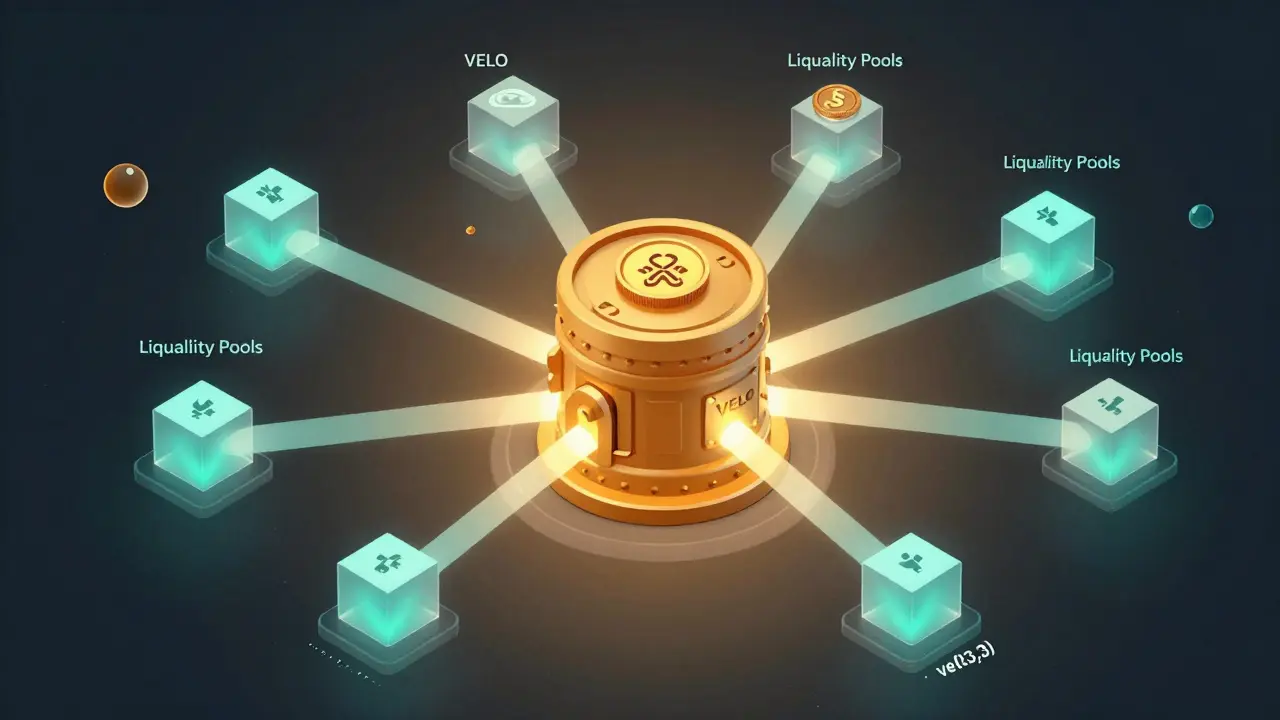
Velodrome uses a unique mechanism called the ve(3,3) model. This is a combination of "vote-escrowed" tokens and a specific emission structure designed to balance liquidity mining with fee generation. Here is how you participate:
- Lock Your Tokens: You take your native VELO token and lock it in the contract for a period ranging from 1 week to 4 years.
- Earn veVELO: The longer you lock, the more veVELO you receive. A 4-year lock gives you the maximum voting power and fee share.
- Vote for Pools: Use your veVELO to vote for specific liquidity pools you want to see grow. You can vote for pools containing stablecoins, volatile assets, or new project tokens.
- Collect Rewards: Pools that receive the most votes get higher emissions of VELO tokens. As a voter, you also collect 100% of the fees and bribes generated by the pools you supported.
This system allows protocols to bribe voters to direct liquidity to their specific pools. For example, a new DeFi project might offer extra incentives to veVELO holders who vote for their liquidity pair. This creates a competitive market for liquidity, ensuring that capital flows to where it is most needed and rewarded.
| Feature | Velodrome Finance | Uniswap (Mainnet) | Centralized Exchanges (CEX) |
|---|---|---|---|
| Network | Optimism (Layer 2) | Ethereum (Layer 1) | Proprietary Servers |
| Avg. Swap Cost | < $0.10 + 0.04% fee | $5 - $20 + 0.30% fee | $0 - $1 + 0.10% fee |
| Custody | Non-custodial (You hold keys) | Non-custodial (You hold keys) | Custodial (Exchange holds keys) |
| Governance | ve(3,3) Token Locking | DAO Voting | Corporate Decisions |
| Liquidity Source | Community LPs + Protocol Owned | Community LPs | Market Makers |
Security and Risks You Need to Know
While Velodrome is open-source and audited, no DeFi protocol is immune to risk. Understanding these vulnerabilities helps you protect your capital.
Smart Contract Risk: Like all AMMs, Velodrome relies on smart contracts. While the code has been audited by reputable firms, bugs can still exist. Always verify contract addresses yourself before interacting.
Voting Manipulation: The ve(3,3) model has a documented weakness. Large stakeholders or whale protocols can use their massive voting power to skew incentives. They might prevent fee collection from certain pools or direct all emissions to pools that benefit them disproportionately, potentially hurting smaller participants. This centralization of voting power is a known issue in many ve-token models.
Phishing Scams: Be extremely careful with links. There is a known fraudulent website (governance-velo[.]finance) that mimics the legitimate site (velodrome.finance). Scammers use fake governance pages to trick users into connecting wallets and draining funds. Always double-check the URL and never click links from unsolicited DMs.

How to Start Trading on Velodrome
Getting started is straightforward if you already have some Ethereum. Here is the step-by-step process:
- Bridge ETH to Optimism: You need ETH on the Optimism network to pay for gas. Use the official Optimism Bridge or cross-chain bridges like Stargate Finance or Bungee Exchange.
- Connect Your Wallet: Go to velodrome.finance and connect a compatible wallet like MetaMask, Rabby, or Coinbase Wallet.
- Select Your Pool: Navigate to the "Swap" tab. Choose the asset you want to sell and the asset you want to buy. Velodrome’s router will automatically find the best path across its stable and variable pools.
- Execute the Trade: Review the quote, confirm the low slippage tolerance, and approve the transaction. The swap should complete in seconds.
If you want to provide liquidity, go to the "Pools" section, select a pair, deposit your assets, and you will start earning trading fees immediately. Remember that providing liquidity carries impermanent loss risk, especially in volatile pairs.
Is Velodrome Right for You?
Velodrome is an excellent choice if you prioritize low fees and active participation in the Optimism ecosystem. It is ideal for:
- Active Traders: Who want to minimize slippage and gas costs on frequent swaps.
- Yield Farmers: Who understand the mechanics of ve-tokens and want to maximize returns through strategic voting and bribes.
- DeFi Developers: Building on Optimism who need reliable, deep liquidity for their tokens.
However, it may not be suitable for beginners who are uncomfortable with bridging assets or managing wallet connections. The complexity of the ve(3,3) governance model also requires a learning curve. If you prefer a simple "buy and forget" experience, a centralized exchange might still be easier, though you lose control of your assets.
As Optimism continues to grow, Velodrome’s position as the primary liquidity layer strengthens. Its community-owned model and sustainable fee distribution make it a resilient player in the DeFi space. Just remember to do your own research, verify URLs, and never invest more than you can afford to lose.
Is Velodrome Finance safe to use?
Velodrome is generally considered safe due to its open-source code, multiple security audits, and established track record since 2022. However, like all DeFi platforms, it carries smart contract risks. Users must also be vigilant against phishing scams, particularly fake governance sites. Always interact only through the official domain velodrome.finance.
What is the difference between VELO and veVELO?
VELO is the tradable native token of the protocol. veVELO is a non-transferable voting power token that you receive by locking VELO for a set period (up to 4 years). veVELO grants you governance rights and a share of protocol fees, while VELO can be bought, sold, and traded freely.
How much does it cost to swap on Velodrome?
The protocol fee is a flat 0.04% per trade. Gas fees on the Optimism network are typically less than $0.10. So, for a $1,000 trade, your total cost would be approximately $0.50, which is significantly cheaper than Ethereum mainnet alternatives.
Can I use Velodrome without holding VELO tokens?
Yes. You can use Velodrome purely as a trader to swap assets without ever buying or locking VELO. Holding VELO is only necessary if you want to participate in governance, vote for liquidity pools, or earn additional fee shares through the ve(3,3) model.
What happens if I unlock my VELO tokens early?
If you unlock your VELO tokens before your lock-up period ends, you lose all associated veVELO voting power and fee shares immediately. You cannot partially unlock; it is an all-or-nothing action. Therefore, choose your lock duration carefully based on your long-term commitment to the protocol.
Why is Velodrome better than Uniswap on Optimism?
Velodrome is optimized specifically for the Optimism ecosystem, offering lower fees (0.04% vs Uniswap's 0.30% standard tier) and a more sophisticated incentive model via ve(3,3). It also benefits from being the first-mover on Optimism, resulting in deeper liquidity for many native OP tokens compared to newer entrants.