
When it comes to running a crypto business, most countries make it hard. Either the rules are vague, or they’re so strict that innovation dies before it starts. But Switzerland has done something different. It didn’t ban crypto. It didn’t ignore it. It built a clear, practical framework that lets businesses operate legally - and even thrive.
Since 2016, Switzerland has been quietly shaping one of the world’s most predictable environments for blockchain companies. Not because it’s part of the EU, but because it chose to stay independent. While the EU rolled out MiCA - a sweeping, one-size-fits-all rulebook - Switzerland stayed flexible. It focused on outcomes, not labels. If a token acts like a security? Regulate it like one. If it’s a utility token? Treat it differently. This substance-over-form approach is what makes Swiss regulation stand out.
How the Swiss Licensing System Works
You can’t just open a crypto exchange in Switzerland and start trading. But you also don’t need to jump through 20 hoops to get started. The Swiss Financial Market Supervisory Authority (FINMA) offers four clear licensing paths:
- Fintech license - The most common entry point. Lets companies accept crypto deposits up to CHF 100 million, as long as they don’t invest the funds or pay interest. No banking license needed. As of end of 2024, only five firms held this license - but they’re the backbone of Switzerland’s crypto startup scene.
- Exchange license - Required if you operate a platform where users trade crypto for fiat or other digital assets. Must comply with full AML/KYC rules and keep detailed records.
- Investment fund license - For tokenized funds or crypto-based investment vehicles. Heavily regulated, with strict reporting and custody rules.
- Banking license - Only for firms that take deposits, lend money, or offer interest-bearing crypto accounts. Extremely rare. Only two crypto-native banks exist in Switzerland today.
Most startups begin with the fintech license. It’s not a loophole - it’s a bridge. It lets companies prove their model before taking on the heavier obligations of a full banking license. And because FINMA publishes clear guidelines, businesses know exactly what’s expected.
Anti-Money Laundering: The Non-Negotiable
Switzerland doesn’t just say “be compliant.” It enforces compliance like no other country. The Anti-Money Laundering Act (AMLA) applies to every crypto firm, whether it’s a small DeFi startup or a major exchange.
Here’s what you must do:
- Verify every customer’s identity - including beneficial owners behind shell companies.
- Monitor all transactions for unusual patterns. If something looks off, you report it - not to a vague agency, but directly to the Money Laundering Reporting Office Switzerland (MROS).
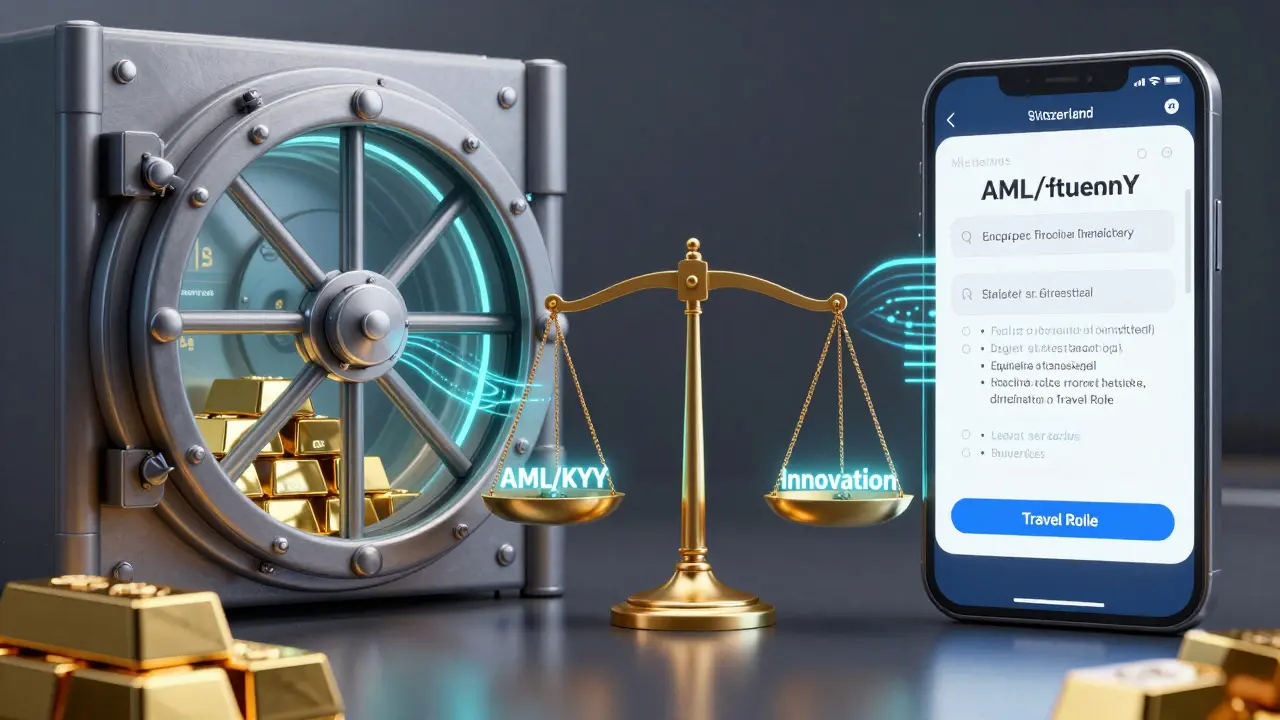
- Follow the Travel Rule. Not the weak version. Switzerland’s version requires full originator and beneficiary data to be transmitted with every crypto transfer above CHF 1,000. Even peer-to-peer transactions between wallets must carry this info if routed through a Swiss service provider.
There’s no gray area. If you skip KYC, you’re out. No warnings. No second chances. FINMA doesn’t negotiate. And that’s why companies trust it. You know where you stand.
Why Stablecoins Are a Gray Zone - And How Firms Navigate It
Stablecoins are the wild card. Switzerland doesn’t have a specific law for them. Instead, FINMA looks at how they work. If a stablecoin is backed by cash and redeemable on demand? It’s treated like a deposit. If it’s backed by a basket of assets and promises price stability? It might be classified as a collective investment scheme.
Some issuers try to avoid licensing by using bank guarantees. They say: “Our stablecoin is backed by a Swiss bank, so we’re not a financial institution.” But FINMA has warned: this doesn’t work. The bank takes on risk. The issuer still has to comply with AML rules. And if the stablecoin fails? The bank might get dragged into the fallout.
As of 2025, no stablecoin has been fully approved under a dedicated Swiss regime. But dozens are operating under FINMA’s existing token rules - with full transparency. That’s the Swiss way: don’t wait for perfect laws. Apply the best existing rules, and document everything.
Tax Advantages: No Blockchain Tax, No Digital Service Tax
Here’s where Switzerland really shines. Most countries are rushing to tax crypto. France added a 30% flat tax on crypto gains. Germany treats crypto as private money but taxes every trade. The UK has complex reporting rules.
Switzerland? Nothing special. No digital service tax. No crypto-specific capital gains tax. No VAT on crypto-to-crypto trades. Corporate income tax rates vary by canton - but many offer 10-12% for tech firms. Zurich, Zug, and Geneva have tailored tax packages for blockchain companies.
Plus, crypto assets held by companies are treated as business assets - not personal property. That means you can deduct losses, depreciate hardware, and write off development costs like any other tech investment.
There’s no “crypto tax loophole.” There’s just normal business tax law - applied fairly. And that’s more valuable than any special break.
Real Companies, Real Presence
You don’t have to take our word for it. Look at who’s already there.
- Ethereum - The Ethereum Foundation is legally registered in Zug. Not because it’s a “crypto haven,” but because Zug offers legal certainty, skilled engineers, and a quiet place to build.
- Solana - Its legal entity and compliance team are based in Switzerland. Why? Because it needs to serve EU customers, and Switzerland’s framework aligns closely with MiCA.
- Tezos - Headquartered in Geneva. Its treasury is managed under Swiss corporate law, with full transparency.
These aren’t tax havens. They’re operational hubs. Companies choose Switzerland because they can hire top engineers, work with Swiss banks, and know their legal risks won’t change next month.

What About the EU’s MiCA? Doesn’t That Make Switzerland Obsolete?
No. It makes Switzerland smarter.
Switzerland isn’t part of the EU. So it doesn’t have to follow MiCA. But if you’re a Swiss company selling services to EU customers? You still have to comply with MiCA. That’s not a burden - it’s a strategic advantage.
Many Swiss firms now operate under a dual model: Swiss law for local operations, MiCA for EU-facing services. This gives them flexibility. They can test new products under Swiss rules, then scale them into the EU with minimal rework.
Compare that to a company based in Germany or France. Once MiCA kicks in, they’re locked in. No room to experiment. Switzerland lets them move faster.
What’s Changing in 2026?
Switzerland is preparing for the Basel Committee’s new global rules on cryptoasset exposures - effective January 2026. These rules will force Swiss banks to treat crypto as high-risk assets. That means:
- Higher capital reserves for banks holding crypto
- Stricter limits on how much crypto a bank can lend
- More scrutiny on custody providers
This isn’t a crackdown. It’s alignment. Switzerland is keeping pace with global standards - not leading them blindly, but adapting with control. That’s why Swiss banks are still open to working with crypto firms. They know the rules. They’ve trained their staff. They’ve built systems.
Other countries are still arguing about whether crypto is money or a commodity. Switzerland already built the infrastructure to handle both.
Who Should Use This Framework?
Not everyone. If you’re a one-person team with a Discord channel and no compliance budget? Switzerland isn’t for you.
But if you’re:
- Building a DeFi protocol that needs legal custody
- Launching a tokenized asset or stablecoin
- Running a crypto exchange or wallet service
- Wanting to attract institutional investors
Then Switzerland offers something no other country can match: predictability. Legal clarity. Tax neutrality. And a track record of working with the biggest names in crypto.
You don’t need to be Swiss. You don’t even need to live there. But if you want to build a crypto business that lasts - not just survives - this is the framework to use.
Can a foreign company register a crypto business in Switzerland without a local partner?
Yes. Foreign companies can register a Swiss AG (stock corporation) or GmbH (limited liability company) without needing a Swiss citizen as a shareholder or director. But they must appoint a local registered agent and maintain a physical office address in Switzerland. All applications go through FINMA, and compliance with AML/KYC rules is mandatory from day one.
Is there a minimum capital requirement to get a fintech license in Switzerland?
There’s no fixed minimum capital, but FINMA requires sufficient funds to cover operational costs for at least 12 months. Most applicants show proof of CHF 50,000-100,000 in liquid assets. The focus isn’t on how much you have - it’s on whether you can sustain operations without relying on customer deposits.
Do I need to pay taxes on crypto profits if my company is registered in Switzerland?
Corporate crypto profits are taxed as business income at the cantonal level, typically between 10% and 12%. There is no separate crypto tax, no capital gains tax on business-held assets, and no VAT on crypto-to-crypto exchanges. Personal gains by employees or shareholders are taxed separately under individual income rules - but not as a crypto-specific category.
Can I use a Swiss crypto license to serve customers in the U.S. or Asia?
Yes - but only if you comply with local laws in those jurisdictions. A Swiss license gives you legal standing in Switzerland and access to EU markets under MiCA. But if you target the U.S., you still need to register with FinCEN, follow state-level rules (like NYDFS), and possibly obtain a BitLicense. The Swiss license doesn’t override foreign regulations.
How long does it take to get licensed by FINMA?
The process usually takes 6 to 12 months. Fintech applications are the fastest - around 6-8 months if documents are complete. Exchange and banking licenses can take over a year due to deeper scrutiny. FINMA does not offer expedited processing. Delays usually come from incomplete documentation or unclear business models - not from bureaucracy.