
There is a lot of noise online about South Korea taxing cryptocurrency at rates between 5-45%. If you are holding assets on a Korean exchange or planning to trade in the region, those numbers can look terrifying. But here is the catch: that wide range isn't a single flat rate applied to everyone. It is a combination of different tax categories, thresholds, and local surcharges that create a complex picture. Getting this wrong could cost you thousands, but understanding the structure means you might pay nothing at all.
As of July 2026, the landscape has shifted significantly. After years of political tug-of-war, the government confirmed that the new cryptocurrency tax regime will finally kick off in January 2027. This delay was a massive win for retail investors who were worried about premature regulation stifling innovation. However, it also means the clock is ticking. You have roughly six months to organize your records before the National Tax Service (NTS) starts enforcing these rules strictly.
The 50 Million Won Shield: Why Most People Pay Zero
The most critical thing to understand is the exemption threshold. South Korea does not tax every single profit you make from selling Bitcoin or Ethereum. Instead, they use a high-water mark approach. You only owe Capital Gains Tax (CGT) if your total annual profits from crypto trading exceed 50 million Korean Won (approximately $35,900 USD).
If your net gains are below this number, your tax bill is zero. This protects small-time investors and casual traders from being bogged down by administrative red tape. The calculation is straightforward: take your total selling price and subtract your acquisition cost. If the result is under 50 million KRW, you keep the money. If it’s over, the excess amount is taxed.
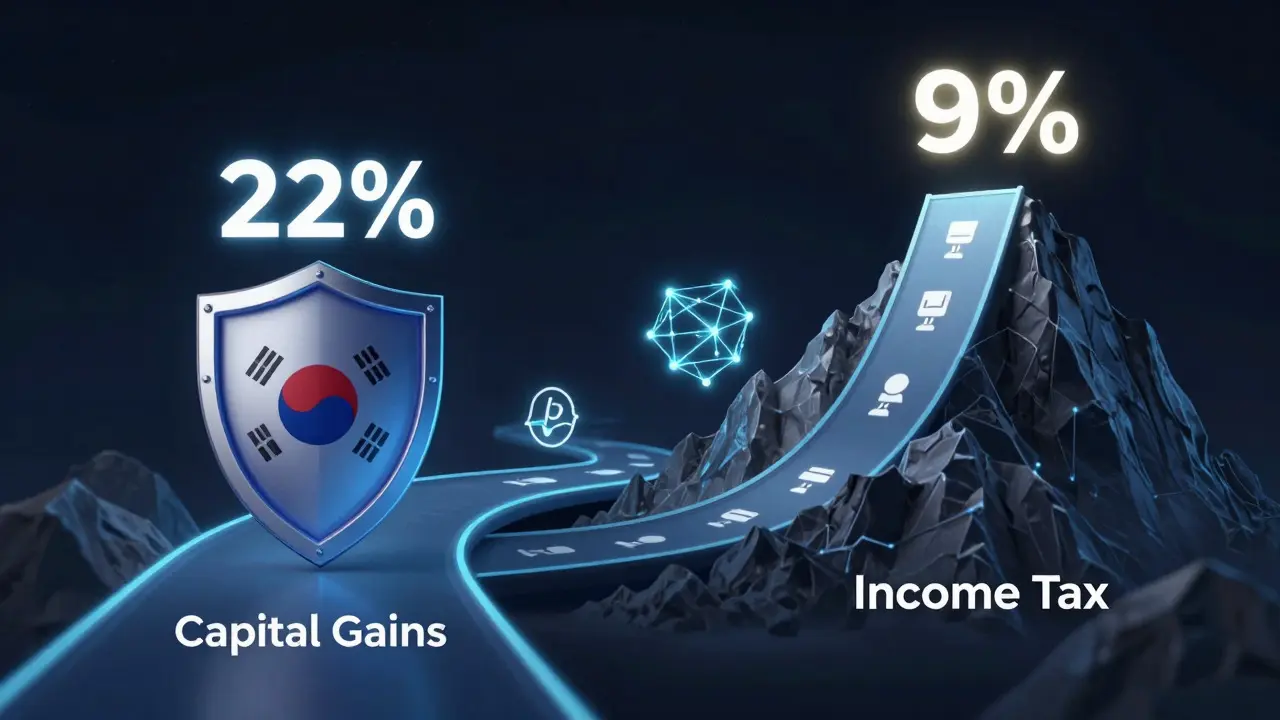
Here is where the confusion often starts. The base rate for capital gains is 20%. However, when you add the local inhabitant tax, the effective rate jumps to 22%. So, if you made 100 million KRW in profit, you don’t pay 22% on the whole amount. You pay 22% only on the 50 million KRW that exceeds the threshold. This progressive-style application keeps the burden manageable for mid-tier traders while targeting high-volume speculators.
Income vs. Gains: Where the 45% Figure Comes From
So where does the scary "up to 45%" (or even higher) figure come from? That applies when your crypto isn't just an investment-it's income. If you earn cryptocurrency through mining, staking, airdrops, or getting paid for freelance work in Bitcoin, the NTS classifies this as "other income."
This category is taxed differently than capital gains. It falls under the standard individual income tax brackets, which are progressive. Depending on your total household income, the rate can range from a low of 6.6% up to a staggering 49.5% when including local taxes. For a high-earner who receives a large airdrop or gets paid a salary in crypto, that top marginal rate bites hard. This distinction is crucial. Trading profits are one bucket; earned crypto is another. Mixing them up in your head can lead to significant miscalculations during tax season.
| Tax Type | Source of Crypto | Threshold/Exemption | Effective Rate Range |
|---|---|---|---|
| Capital Gains Tax (CGT) | Selling/trading assets for profit | First 50M KRW exempt | 22% on excess gains |
| Income Tax | Mining, Staking, Airdrops, Salary | No specific crypto exemption | 6.6% - 49.5% (progressive) |
| Value Added Tax (VAT) | Crypto transactions | N/A | 0% (Not applicable) |
The 2027 Implementation and Political Context
The timeline for this tax law has been anything but smooth. Originally slated for 2022, then pushed to 2025, the final agreement came in December 2024 between the ruling People Power Party (PPP) and the opposition Democratic Party of Korea (DPK). They settled on a January 2027 start date. This compromise was designed to give the industry time to adapt without driving capital offshore permanently.
Why the delay? Industry advocates argued that implementing the tax too early would crush liquidity and push users to unregulated offshore platforms. By waiting until 2027, the government allows exchanges and tax software providers to build better tracking tools. For you, this means the next six months are a grace period. Use it wisely. The National Tax Service has already issued clarifications in mid-2025 regarding foreign corporations paying residents in crypto, signaling that they are preparing their enforcement machinery now.
Tracking Your Trades: The Real Challenge
Paying the tax is only half the battle. Proving what you owe is the harder part. Because blockchain transactions are transparent and immutable, the NTS expects detailed records. You need to track every buy, sell, swap, and transfer. This includes crypto-to-crypto trades, which are considered taxable events in South Korea.
For the average user, this requires exporting transaction histories from every exchange you’ve used. If you’ve been active since 2020, that data can be messy. Tax professionals estimate it takes 10-20 hours of initial setup to clean this data, plus ongoing monthly maintenance. You’ll need to know the value of each asset in Korean Won at the exact moment of the transaction. Relying on memory or rough estimates won’t cut it. The rise of DeFi lending and yield farming adds another layer of complexity, as these rewards are taxed as income, not gains, and valuing them accurately can be tricky.
What About Foreign Investors?
If you are not a Korean resident, the rules shift again. Foreign individuals and corporations face either an 11% withholding tax on the transfer price or a 22% tax on net capital gains, depending on the structure of the disposal. There is no 50 million KRW exemption for non-residents in the same way there is for citizens. This creates a disparity that some international investors find frustrating, but it reflects the country’s focus on protecting domestic retail markets while capturing revenue from external entities.
Additionally, the OECD’s Crypto-Asset Reporting Framework (CARF) is coming into play. This global initiative aims to share information between countries. South Korea’s participation means that hiding assets abroad becomes increasingly difficult. The NTS is actively closing loopholes, so assuming your overseas holdings are invisible is a risky strategy.

Practical Steps for 2026 Preparation
Since the deadline is January 2027, you have a clear window to act. Here is what you should do right now:
- Audit your history: Log into every exchange and wallet you’ve used. Download CSV files of all transactions. Don’t wait until December.
- Categorize your activity: Separate your trading profits from your staking/mining rewards. These two buckets have completely different tax treatments.
- Check the threshold: Calculate your net gains for the last year. If you’re consistently above 50 million KRW, start setting aside 22% of the excess now.
- Use specialized software: Manual spreadsheets error-prone. Invest in crypto tax software that supports Korean regulations and can calculate cost basis for crypto-to-crypto swaps.
- Consult a pro: If you have significant DeFi exposure or cross-border income, hire a tax advisor familiar with South Korean virtual asset laws. The penalty for underreporting can outweigh the fee.
The goal isn’t to avoid taxes illegally, but to ensure you aren’t overpaying due to confusion. Many retail investors assume they owe tax on every small gain, leading to unnecessary stress. Remember the 50 million KRW shield. If you’re a casual holder, you might be in the clear. If you’re a professional trader, precision is your best defense.
Future Outlook and Regulatory Trends
Looking beyond 2027, the framework is likely to stabilize. The government sees crypto as a legitimate asset class now, moving away from the "wild west" mentality of the past decade. We may see adjustments to the threshold or rates based on market volatility, but the core structure-distinguishing between gains and income-is solid.
South Korea remains a top-five global player in trading volume. Its regulatory approach influences neighboring Asian markets. As CARF implementation deepens, expect more automated reporting from exchanges directly to the NTS. This reduces the burden on individuals to self-report but increases the accuracy of government oversight. The era of flying under the radar is ending. Adaptation is no longer optional; it’s essential for staying compliant in one of Asia’s most dynamic crypto ecosystems.
When does the South Korea crypto tax officially start?
The new cryptocurrency tax regime is scheduled to begin in January 2027. This date was confirmed after political negotiations in late 2024, pushing back previous deadlines of 2022 and 2025 to allow for better industry preparation.
Do I pay tax on small crypto profits in South Korea?
No, if your total annual capital gains from trading are less than 50 million Korean Won (approx. $35,900 USD), you pay zero Capital Gains Tax. This exemption protects smaller retail investors from minor fluctuations.
Is staking income taxed the same as trading profits?
No. Staking rewards, mining income, and airdrops are classified as "other income" rather than capital gains. They are subject to progressive income tax rates ranging from 6.6% to 49.5%, regardless of the 50 million KRW exemption threshold for trading.
How is the 22% effective tax rate calculated?
The base Capital Gains Tax rate is 20%. When you add the local inhabitant tax, the total effective rate becomes 22%. This rate applies only to the portion of your gains that exceeds the 50 million KRW annual exemption threshold.
Are crypto-to-crypto trades taxable events?
Yes. In South Korea, swapping one cryptocurrency for another (e.g., Bitcoin for Ethereum) is treated as a sale. You must calculate the gain or loss based on the value in Korean Won at the time of the swap and report it accordingly.
Does VAT apply to cryptocurrency transactions?
Currently, no. Cryptocurrencies are not classified as goods or services under South Korean law, so Value-Added Tax (VAT) is not imposed on crypto transactions. Only capital gains and income taxes apply.