If you’ve heard about a RACA × Cambridge airdrop, you’re not alone. Many crypto users are asking the same thing: Is this real? How do I get in? And why does Cambridge matter? The truth is, there’s no official announcement from RACA (Radio Caca) about any partnership with Cambridge - not on their website, not on Twitter, not in their Discord. But that hasn’t stopped rumors from spreading. People are sharing screenshots, fake links, and promises of free tokens. And that’s dangerous.
What is RACA (Radio Caca)?
RACA, short for Radio Caca, is a blockchain-based ecosystem that started as a meme coin but has grown into something more. It’s built on the Binance Smart Chain and includes a decentralized exchange, NFT marketplace, and metaverse projects. Its native token, $RACA, has been around since 2021 and has seen multiple token upgrades, including a burn-and-reissue event in 2023 that reduced supply by over 90%.
Unlike many meme coins, RACA has tried to build real utility. Its ecosystem includes UST (a stablecoin), VITA (a health-focused NFT game), and Metaverse land sales. In 2024, RACA’s total value locked (TVL) peaked at $180 million, according to DeFiLlama data. But since then, activity has slowed. The project hasn’t launched any major updates since mid-2024, and its social media engagement has dropped by nearly 60% compared to its 2022 highs.
Where Did the Cambridge Airdrop Rumor Come From?
The idea of a "RACA × Cambridge airdrop" likely comes from a mix of wishful thinking and misinformation. Cambridge is a well-known name in tech and academia - home to the University of Cambridge, which has research ties to blockchain and AI. Some people assume that if a crypto project is "partnering with Cambridge," it must be legit. But there’s zero evidence of any formal collaboration.
Search any official Cambridge University website, their blockchain research group, or their tech transfer office - you won’t find RACA listed. No press release, no research paper, no joint announcement. The same goes for Cambridge Analytica, Cambridge Innovation Center, or any other Cambridge-based entity. The name is being used to make the airdrop sound more trustworthy.
Meanwhile, sites like AirdropBee.com list "RACA Airdrop 2025" as a potential opportunity. But those sites are not official. They’re aggregation platforms that list hundreds of airdrops, many of which are unverified or outright scams. They don’t verify claims - they just repost them.
How Airdrops Actually Work (and Why This One Doesn’t Add Up)
Real airdrops have clear rules. They announce:
- A specific snapshot date - when your wallet balance is checked
- Eligibility criteria - like holding a minimum amount of a token or completing specific tasks
- A claiming window - when you can actually get the tokens
- A vesting schedule - if tokens are locked for months
- Official smart contract addresses - publicly audited and verified
None of that exists for the RACA × Cambridge airdrop. No snapshot date. No wallet requirements. No contract address. No timeline. Just vague posts saying "Join now to claim your free RACA tokens!"
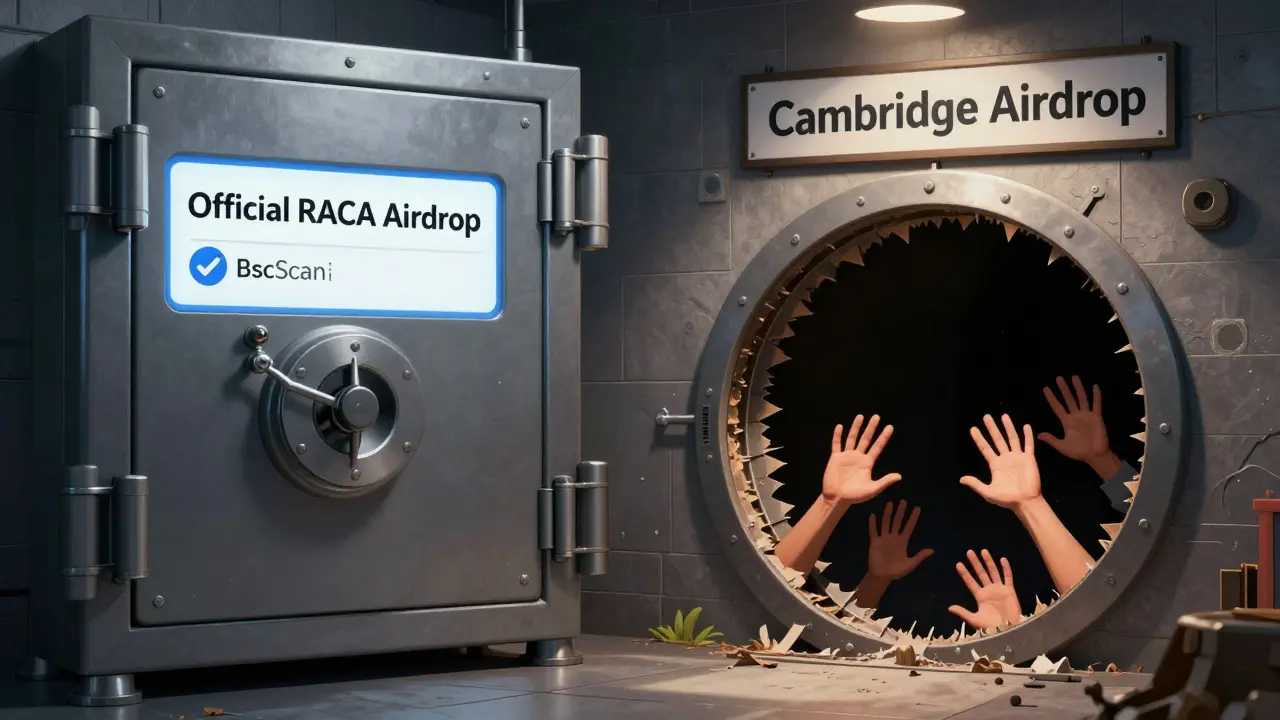
And here’s the red flag: if an airdrop asks you to connect your wallet, send crypto, or pay a gas fee to "unlock" your reward, it’s a scam. Real airdrops don’t ask for money upfront. They don’t need your private key. They don’t require you to download unknown apps.

What You Should Do Instead
If you’re serious about RACA, here’s what actually works:
- Go to radio-caca.com - the only official site. Check their blog and announcements section.
- Follow their verified Twitter account: @RadioCacaOfficial. Not fan accounts. Not impersonators.
- Join their Discord. Look for posts from verified moderators with blue checkmarks.
- Use Etherscan or BscScan to verify any contract address before interacting with it.
- Check CoinGecko or CoinMarketCap for official token info - not random blogs.
Right now, RACA’s token is trading at around $0.000018 (as of December 2025), with a market cap under $100 million. That’s down from its peak of $0.00012 in early 2022. If there was a real airdrop planned, the team would be promoting it heavily - especially since they need liquidity and community growth.
Why People Fall for Fake Airdrops
Fake airdrops work because they tap into hope. Crypto is volatile. People lost money in the 2022 crash. They’re desperate for a win. Scammers know that. They use:
- Fake logos - copied from official sites
- Stolen screenshots - pretending to show "confirmation emails"
- Bot-driven hype - fake Twitter accounts retweeting "I got 50,000 RACA!"
- Urgency - "Only 24 hours left!" - even when the "airdrop" has been live for months
In 2024, over $1.2 billion was stolen through fake airdrop scams, according to Chainalysis. Most victims were new users who didn’t know how to verify sources.
What to Watch For in 2025
Real airdrops don’t come out of nowhere. They’re usually tied to:
- Protocol upgrades
- New product launches
- Partnerships with exchanges or wallets
- Community milestones (like 100k holders)
If RACA ever does an airdrop, it’ll be announced on their own channels - not on Telegram groups or TikTok. It’ll have a clear timeline. It’ll have a verifiable contract. And it won’t ask you for anything except your wallet address.
Right now, the only safe move is to ignore the Cambridge rumor. Don’t click links. Don’t connect wallets. Don’t send any crypto. Wait for official news.
Is There Any Chance RACA Will Do an Airdrop in 2025?
Possibly. But not because of Cambridge. If RACA wants to revive interest, they might run a token distribution to long-term holders, NFT owners, or active community members. That’s standard practice. But it would be announced clearly, with documentation, and backed by their team.
For now, treat every "RACA × Cambridge" post as a red flag. Crypto moves fast, but scams move faster. Stay skeptical. Stay informed. And never trust a free token that asks you to do too much.