
The days of wild west crypto trading in Japan are officially over. If you are running an exchange or holding significant assets there, the rules have changed again. The Financial Services Agency (FSA) is Japan's primary financial regulatory body that oversees banking, securities, and insurance markets has tightened its grip on digital assets, creating one of the strictest compliance frameworks in the world. This isn't just about paperwork; it’s a fundamental shift in how digital assets are treated under Japanese law.
In September 2025, the FSA announced a major move: bringing certain digital assets under the Financial Instruments and Exchange Act (FIEA) is Japan's main securities law that governs investment products and public offerings. This means tokens with investment-like features are now treated as securities. For businesses, this brings heavy disclosure requirements. For investors, it offers stronger protection but also more red tape. Here is what you need to know about navigating this new landscape in 2026.
The Shift from Payment Services to Securities Law
To understand where we are, we have to look at where we started. Before 2017, crypto regulation in Japan was fragmented. The collapse of Mt. Gox in 2014 forced the government to act. They introduced the Payment Services Act (PSA) is Japanese legislation originally designed to regulate money transfer services, later expanded to include cryptocurrency exchanges in 2017. This act defined "crypto-assets" and required exchanges to register with the FSA. It set the baseline: you must be licensed, you must keep customer funds separate, and you must fight money laundering.
But the PSA had limits. It treated crypto mostly like a payment method, not an investment. That worked fine for Bitcoin when people used it to buy coffee. It fell apart when tokenized stocks and governance tokens became popular. The FSA realized that treating a utility token the same as a security token created loopholes. So, they moved to a dual-framework system.
Now, in 2026, the FIEA takes center stage for many assets. If your token has governance rights or looks like an investment contract, it falls under the FIEA. This change introduces insider trading bans, mandatory disclosures for issuers, and stricter market conduct rules. It aligns crypto with traditional finance. The goal? To stop fraud before it starts. The trade-off? Higher barriers to entry for startups.
Strict Compliance Requirements for Exchanges
If you operate a crypto-asset exchange service provider (CAESP) in Japan, the bar is high. The FSA doesn’t just check your box and let you go. They dig deep. Here is what the strict compliance framework demands:
- Licensing: You cannot operate without registration. The process takes 6 to 12 months. You need to prove you have the capital, the tech, and the team to run securely.
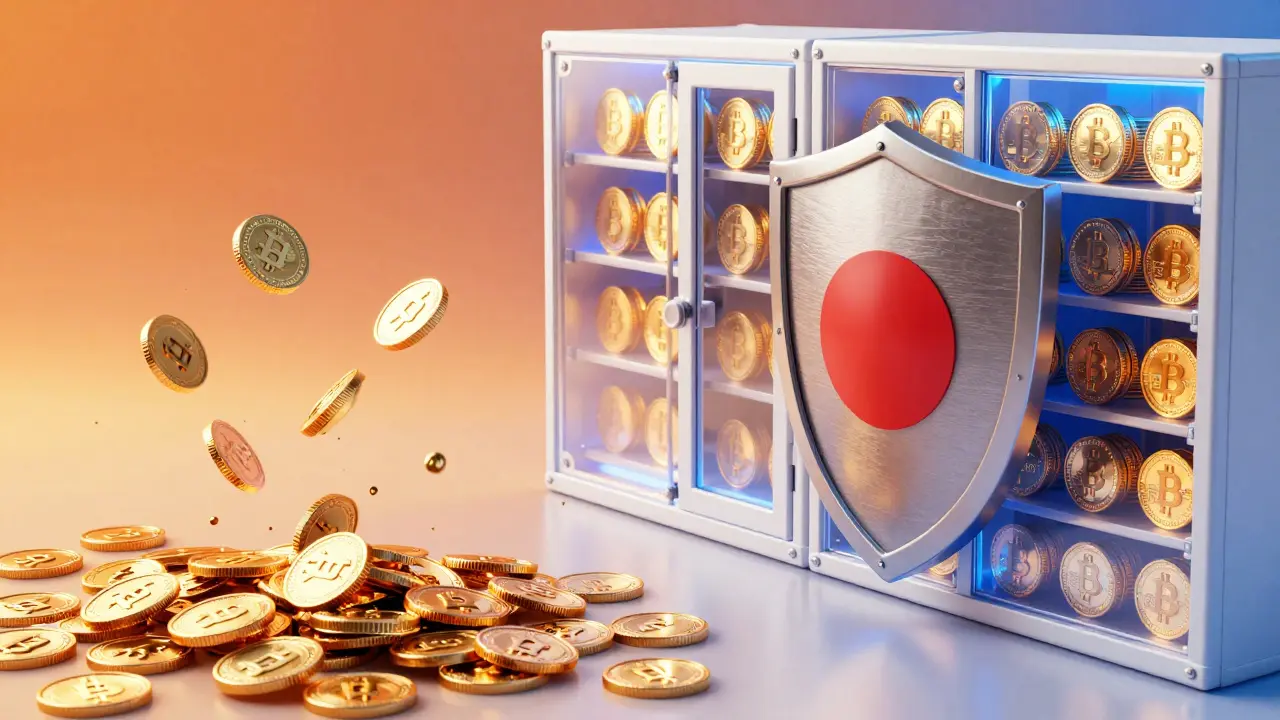
- Cold Storage Mandate: At least 95% of user assets must be kept in offline cold wallets. This rule came after past hacks showed how vulnerable hot wallets are. It’s annoying for liquidity, but it saves users’ money.
- Fund Segregation: Customer funds must be completely separated from operational capital. If your company goes bankrupt, creditors can’t touch user deposits. This is non-negotiable.
- AML/KYC Procedures: You need robust Anti-Money Laundering and Know Your Customer systems. Every transaction is tracked. Anonymous accounts are banned. You must report suspicious activity immediately.
- Physical Presence: You must maintain physical operations within Japan. Remote-only teams don’t cut it. The FSA wants to inspect your servers and meet your staff.
These rules aren’t suggestions. Violations lead to license revocation. In recent years, several exchanges lost their licenses for failing audits or poor security practices. The message is clear: play by the rules or get out.
What Changes for Investors in 2026?
You might think strict regulations only hurt businesses. But for everyday investors, the FSA’s approach brings real benefits. First, safety. With mandatory cold storage and fund segregation, your assets are safer than on most unregulated platforms. Second, clarity. The FIEA reclassification means you know exactly which tokens are securities. No more guessing games about whether a token is legal to trade.
However, there are costs. Trading fees on Japanese exchanges are often higher because compliance eats into margins. Exchanges spend 15-20% of their operational budget on legal and security checks. Those costs pass to you. Also, access to some decentralized finance (DeFi) protocols may be restricted if they don’t meet FSA standards. You won’t find shady offshore tokens here. Everything is vetted.
On the tax front, August 2025 brought good news. The FSA proposed moving crypto gains into a 20% tax bracket, down from the previous progressive rates that could hit 55%. Plus, you can carry forward losses for three years. This makes investing more predictable. It shows the FSA wants to encourage participation, not crush it.
The Rise of Self-Regulatory Organizations
The FSA doesn’t work alone. It relies on industry groups to help enforce standards. Two key players are the Japan Virtual Currency Exchange Association (JVCEA) is a self-regulatory organization representing cryptocurrency exchanges in Japan that sets internal compliance standards and the Japan Security Token Offering Association (JSTOA) is an industry group focused on regulating security tokens and blockchain-based securities offerings.
These organizations create guidelines that often exceed FSA minimums. For example, JVCEA members undergo regular third-party security audits. JSTOA helps issuers navigate FIEA disclosure rules. Working with these groups signals trustworthiness. If your exchange isn’t a member, clients might hesitate. It’s a badge of honor in a skeptical market.
DeFi and the Future of Oversight
Decentralized Finance (DeFi) poses a challenge. How do you regulate code that runs on global blockchains? The FSA isn’t ignoring it. They formed a DeFi Study Group that meets every few months. Members include regulators, developers, and academics. They’re exploring how to apply AML rules to smart contracts without stifling innovation.
Expect clearer rules on stablecoins and tokenized securities soon. The FSA wants to bring DeFi into the fold, not ban it. But “bringing into the fold” means compliance. Decentralized platforms will likely need identity verification layers or regulated gateways. Pure anonymity is fading fast.
| Feature | Payment Services Act (PSA) | Financial Instruments and Exchange Act (FIEA) |
|---|---|---|
| Applies to | Crypto-assets as payment methods | Tokens with investment/governance features |
| Licensing Body | FSA Registration | FSA Approval + Public Disclosure |
| Disclosure Requirements | Basic operational info | Detailed financial and risk reports |
| Market Conduct | Anti-fraud measures | Insider trading bans, manipulation rules |
| Investor Protection | Fund segregation, cold storage | All PSA protections + securities safeguards |
Global Impact and Lessons for Other Markets
Japan’s model is being watched closely. Regulators in Europe, Asia, and the Americas study the FSA’s approach. Why? Because it balances safety and growth. Other countries struggle with either too little regulation (leading to scams) or too much (killing innovation). Japan found a middle path.
The FSA’s proactive stance-creating study groups, updating laws quickly, engaging industry-sets a benchmark. When the formal FIEA bill passes in early 2026, it could become the global standard. Companies planning to expand internationally should look at Japan first. If you can comply here, you can comply almost anywhere.
Practical Steps for Compliance in 2026
Whether you’re a startup or an established player, here’s how to stay ahead:
- Audit Your Tokens: Classify each asset under PSA or FIEA. Consult legal experts to avoid misclassification fines.
- Upgrade Security: Ensure 95% cold storage. Implement multi-signature wallets and regular penetration testing.
- Strengthen KYC: Use biometric verification and continuous monitoring. Don’t rely on static ID checks.
- Join Industry Groups:: Become a JVCEA or JSTOA member to access best practices and networking.
- Prepare for Disclosures: Set up systems to generate detailed reports for FIEA-compliant tokens. Transparency is key.
The learning curve is steep, but the payoff is trust. In a market flooded with uncertainty, compliance is your competitive advantage.
What is the difference between PSA and FIEA regulation for crypto in Japan?
The Payment Services Act (PSA) regulates crypto as a payment method, focusing on exchange licensing and basic security. The Financial Instruments and Exchange Act (FIEA) treats certain tokens as securities, requiring detailed disclosures, insider trading bans, and stricter market conduct rules. Tokens with investment or governance features fall under FIEA.
How long does it take to get an FSA license for a crypto exchange?
The FSA registration process typically takes 6 to 12 months. It involves extensive documentation, security audits, capital verification, and interviews. Delays are common if applications lack detail or fail initial reviews.
Are all cryptocurrencies taxed at 20% in Japan now?
As of August 2025 proposals, crypto gains are subject to a flat 20% tax rate, replacing the previous progressive system that could reach 55%. This applies to most digital assets traded on registered exchanges. Losses can be carried forward for three years.
Can I use anonymous wallets on Japanese exchanges?
No. Japanese exchanges must enforce strict KYC (Know Your Customer) rules. All users must verify their identity. Anonymous or private wallets are not supported for trading or withdrawals on FSA-registered platforms.
How does the FSA regulate DeFi protocols?
The FSA is developing rules through its DeFi Study Group. While pure DeFi remains challenging to regulate, platforms offering financial services via smart contracts will likely need to implement AML/KYC measures and register as service providers. Expect clearer guidelines in late 2026.