
You’ve probably seen the headlines. People talking about earning double-digit returns on their crypto just by letting it sit in a digital vault. It sounds too good to be true, right? Well, it’s not magic, but it is complex. This process is called yield farming, and it’s one of the most popular ways people generate passive income in the decentralized finance (DeFi) world.
But here’s the catch: yield farming isn’t like putting money in a high-yield savings account at your local bank. There are no FDIC insurance guarantees, no customer service hotline, and plenty of risks if you don’t know what you’re doing. If you’re new to this, diving in blind can lead to losing more than you earn. So, how do you actually start without getting burned? Let’s break it down step-by-step, keeping things simple and safe.
What Is Yield Farming, Really?
At its core, yield farming is about lending or staking your cryptocurrency to help decentralized platforms run smoothly. Think of it like being a shareholder in a bank, but instead of shares, you hold tokens, and instead of dividends, you get rewards in crypto.
When you deposit your assets into a DeFi protocol-like Aave or Uniswap-you’re providing liquidity. Liquidity is basically the fuel that keeps these platforms moving. Without enough people depositing assets, traders couldn’t swap tokens, and borrowers couldn’t get loans. In return for helping out, the platform pays you. These payments come in three main forms:
- Transaction fees: A cut of the fees paid by users trading on the platform.
- Lending interest: Interest paid by borrowers who take out loans against your deposited assets.
- Governance tokens: Bonus tokens from the platform itself, often used to vote on future changes to the protocol.
The beauty of this system is that it’s automated. Once you set it up, the smart contracts handle the rest. But automation doesn’t mean “set it and forget it” forever. You still need to understand where your money is going.
Choosing Your Strategy: Simple vs. Complex
Not all yield farming is created equal. Some strategies are as easy as buying a bond, while others require the focus of a day trader. For beginners, I always recommend starting with the simplest option possible. Why? Because complexity usually hides risk.
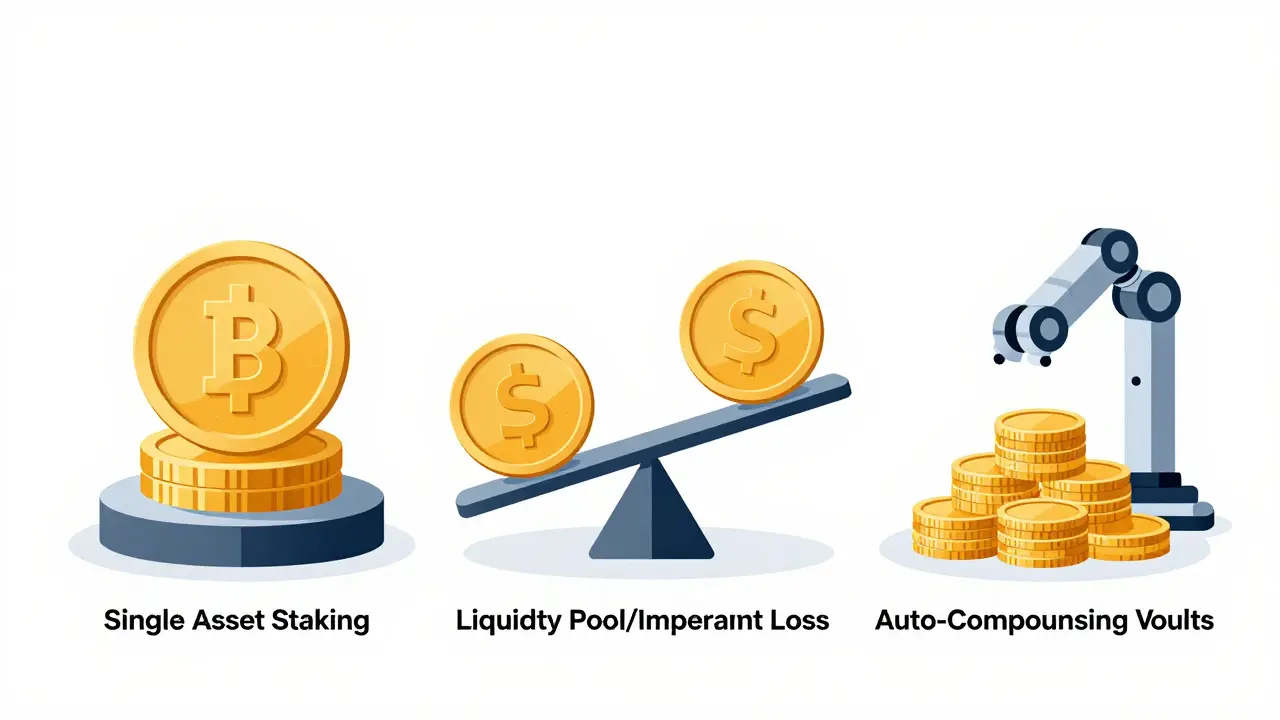
Here are the three most common strategies you’ll encounter:
- Single Asset Staking: This is the easiest entry point. You deposit one type of asset, like USDC or ETH, into a lending protocol. You earn an Annual Percentage Yield (APY) plus maybe some bonus tokens. The risk is low because you aren’t exposed to price swings between two different assets. For example, depositing USDC into Aave might give you a steady 4% APY. It’s boring, but it works.
- Liquidity Pool Provision (LP): Here, you pair two assets together, like ETH and USDC, in a 50/50 value ratio. You provide this pair to a decentralized exchange like Uniswap. You earn trading fees whenever someone swaps those tokens. The catch? If the price of ETH crashes while USDC stays stable, you end up with more ETH and less USDC than you started with. This is called impermanent loss, and we’ll talk more about that later.
- Auto-Compounding Vaults: Platforms like Yearn Finance or Beefy automate the process. They harvest your rewards, sell them for the base asset, and reinvest everything back into the pool. This compounds your gains without you lifting a finger. It’s powerful, but you’re trusting the vault’s code completely.
If you’re just starting, stick to single asset staking or blue-chip liquidity pools (pairing major coins like BTC or ETH with stablecoins). Avoid exotic token pairs until you have a solid grasp of how the market moves.
Step-by-Step: How to Set Up Your First Farm
Ready to try it? Here’s exactly what you need to do to get started. Don’t rush this part. Taking your time now saves headaches later.
1. Get a Non-Custodial Wallet
You can’t use a standard exchange like Coinbase or Binance directly for most yield farming. You need a non-custodial wallet where you control the private keys. The gold standard is MetaMask. It’s a browser extension and mobile app that connects you to the Ethereum network and other blockchains. Alternatives include Trust Wallet or Coinbase Wallet.
Install MetaMask, write down your seed phrase on paper (never digitally), and keep it safe. That seed phrase is your bank account. Lose it, and your money is gone forever.
2. Fund Your Wallet
You’ll need two types of crypto in your wallet:
- Farming Assets: The tokens you want to stake or provide liquidity with (e.g., ETH, USDC).
- Gas Tokens: Native tokens to pay for transaction fees. On Ethereum, this is ETH. On Binance Smart Chain, it’s BNB. On Polygon, it’s MATIC. Always keep extra gas tokens handy; running out mid-transaction is frustrating and costly.
Buy these on a centralized exchange and withdraw them to your MetaMask address. Double-check the network! Sending ETH to a Bitcoin address will result in total loss.
3. Choose a Reputable Protocol
Not all DeFi platforms are safe. Look for protocols with:
- Audits: Have independent security firms checked their code?
- Total Value Locked (TVL): Higher TVL usually means more trust and stability. Check sites like DefiLlama to compare.
- Community Reputation: Is there an active Discord or Telegram? Do developers respond to issues?
For beginners, stick to the giants: Aave, Uniswap, Curve, or PancakeSwap. They’ve been around longer and have stronger security track records.
4. Connect and Deposit
Go to the protocol’s website. Click “Connect Wallet” and select MetaMask. Approve the connection. Then, find the “Stake” or “Provide Liquidity” section. Enter the amount you want to deposit. Review the details carefully. Confirm the transaction in your wallet. You may need to approve the token spending limit first, which is a separate transaction.
Once confirmed, you’ll receive LP tokens or a receipt showing your position. Your earnings start accumulating immediately.
Understanding the Risks: What Could Go Wrong?
This is the part most tutorials skip, but it’s crucial. Yield farming carries real risks that can wipe out your profits-or your principal.
| Risk Type | Description | Impact Level |
|---|---|---|
| Impermanent Loss | Occurs when the price of your deposited assets changes relative to each other. You end up with fewer dollars’ worth of assets than if you had just held them. | Medium to High |
| Smart Contract Bugs | Code errors or exploits can allow hackers to drain funds from the protocol. No insurance covers this. | Critical |
| Stablecoin Depeg | If a stablecoin like USDT or DAI loses its $1 peg, your entire portfolio value drops instantly. | High |
| APY Volatility | Rewards rates can drop overnight if incentives change or liquidity dries up. | Medium |
Impermanent loss is tricky. Imagine you deposit $1,000 in ETH and $1,000 in USDC. If ETH doubles in price, the pool automatically sells some of your ETH to maintain balance. When you withdraw, you have more ETH than before, but less USDC. Mathematically, you’d have been richer if you’d just held the original amounts. This is why pairing volatile assets with stablecoins increases this risk.
Smart contract risk is the silent killer. Even audited contracts can have vulnerabilities. Remember the bZx hack? Millions were lost due to a code exploit. Never invest money you can’t afford to lose entirely. Treat every DeFi interaction as potentially risky.
Calculating Real Returns: APR vs. APY
Platforms love to advertise huge APYs. But do they tell you the whole story? Understanding the difference between APR and APY is key to managing expectations.
APR (Annual Percentage Rate) is simple interest. If you earn 10% APR, you get 10% of your initial deposit per year, assuming no reinvestment.
APY (Annual Percentage Yield) includes compounding. If rewards are reinvested automatically, your balance grows faster. For example, a 10% APR compounded monthly results in an APY of about 10.47%. Over time, this difference adds up significantly.
However, high APYs often signal higher risk. A 1,000% APY usually means the protocol is printing new tokens to attract liquidity. Those tokens may crash in value soon. Always look at the underlying asset sustainability. Is the yield coming from real trading fees, or just inflationary token emissions?

Pro Tips for Long-Term Success
Yield farming isn’t a one-time setup. It requires ongoing attention. Here’s how to stay ahead:
- Diversify: Don’t put all your eggs in one basket. Spread your capital across different protocols and chains (Ethereum, Arbitrum, Polygon) to reduce single-point failure risk.
- Monitor Regularly: Check your positions weekly. Are reward rates dropping? Is the protocol facing news of a vulnerability? Be ready to exit quickly if needed.
- Use Calculators: Tools like Yearn’s calculator or external DeFi dashboards help estimate net returns after fees and slippage.
- Start Small: Test with $100 or $500 first. Learn the interface, experience the gas fees, and understand the withdrawal process before committing larger sums.
- Stay Updated: Follow reputable DeFi analysts on Twitter or Discord. The space moves fast. What worked last month might be obsolete today.
Remember, the goal isn’t to chase the highest number. It’s to build sustainable, passive income over time. Patience beats greed every time in DeFi.
Final Thoughts on Building Passive Income
Yield farming offers incredible opportunities, but it demands respect. It’s not a get-rich-quick scheme. It’s a financial tool that, when used correctly, can enhance your portfolio. Start small, prioritize security, and never stop learning. The DeFi landscape evolves daily, so staying informed is your best defense against losses.
As you gain confidence, you can explore more advanced strategies like recursive lending or cross-chain bridging. But for now, master the basics. Provide liquidity to trusted protocols, monitor your positions, and let compound growth work for you. Your future self will thank you.
Is yield farming legal?
Yes, yield farming is generally legal in most countries, including the United States. However, tax implications vary. In the U.S., rewards earned through yield farming are considered taxable income at the time of receipt. Consult a tax professional familiar with cryptocurrency regulations to ensure compliance.
How much money do I need to start yield farming?
You can start with as little as $50-$100. However, consider gas fees on networks like Ethereum, which can exceed $10-$20 per transaction. Using Layer 2 solutions like Arbitrum or Optimized chains like Polygon reduces costs significantly, making smaller investments viable.
Can I lose all my money in yield farming?
Unfortunately, yes. Smart contract hacks, rug pulls (where developers abandon a project), or severe market crashes can lead to total loss. Always use audited platforms, diversify your holdings, and never invest more than you can afford to lose.
What is impermanent loss, and how do I avoid it?
Impermanent loss occurs when the price ratio of your deposited assets changes. To minimize it, pair stablecoins (like USDC/USDT) or assets with correlated prices (like WBTC/ETH). Avoid pairing highly volatile tokens with stablecoins unless you’re comfortable with the risk.
Are there safer alternatives to yield farming?
Yes. Single-asset staking on established platforms like Aave or Compound is lower risk than liquidity provision. Additionally, centralized exchanges offer staking services with simpler interfaces and sometimes insurance, though they lack decentralization benefits.
Which blockchain is best for yield farming in 2026?
Ethereum remains the largest ecosystem but has high fees. Layer 2s like Arbitrum and Optimism offer lower costs and growing DeFi options. Solana and Avalanche also provide high-speed, low-cost environments with competitive yields. Choose based on your risk tolerance and preferred assets.