You send a payment. You buy some digital assets. Then, suddenly, your bank account is frozen or closed with no warning. For many people in Myanmar, this isn't a hypothetical nightmare-it’s the daily reality of trying to use cryptocurrency under one of the world's strictest bans.
If you are holding Bitcoin, trading Ethereum, or simply using Tether (USDT) to save money from inflation, you are walking on thin ice. The Central Bank of Myanmar (CBM, the primary regulatory body for currency and financial institutions in Myanmar) has made it clear: they will shut down your access to traditional banking if they catch you engaging in unregulated digital currency activities. But what exactly triggers this? What are the legal consequences beyond just losing your bank account? And how does the political divide between the military government and the opposition change the rules?
The Shift from Warning to Action
For years, the stance on crypto in Myanmar was ambiguous. Back in May 2020, Notification No. 9/2020 stated that individuals engaging in digital currency transactions did so at their own risk. It sounded like a warning, but enforcement was lax. People traded, mined, and held assets without much fear of immediate retribution.
That changed drastically in 2024. On May 24, 2024, the CBM issued a public notice that escalated the situation from passive observation to active enforcement. They explicitly warned against the sale, purchase, exchange, or transfer of unregulated digital currencies. More importantly, they stated their readiness to enforce regulations by closing bank accounts and pursuing legal action. This wasn't just talk. The central bank began targeting specific behaviors, particularly those involving personal Facebook pages and web-based exchanges where users converted Kyat into cryptocurrencies like Bitcoin (BTC), Litecoin (LTC), and Ethereum (ETH).
The message was simple: if you touch crypto, you lose your bank access. For a country where cash is king but digital banking is essential for modern commerce, losing your account is devastating. It cuts you off from salaries, remittances, and basic financial services.
Legal Framework: Why Your Account Gets Closed
To understand why the penalty is so severe, you have to look at the laws backing it up. The CBM doesn't operate in a vacuum. Their authority comes from a combination of three major pieces of legislation:
- The Central Bank of Myanmar Law: Gives the CBM sole authority to issue currency. By definition, decentralized cryptocurrencies challenge this monopoly.
- The Foreign Exchange Management Law: Controls how money enters and leaves the country. Crypto is often used to bypass these controls, sending value abroad instantly.
- The Anti-Money Laundering Law: Used to criminalize transactions that lack transparency. Since crypto can be anonymous, regulators view it as a high-risk vector for laundering funds.
When the CBM closes an account, they aren't just punishing you for liking Bitcoin. They are enforcing these laws to prevent economic instability. They argue that unchecked crypto flows drain foreign reserves and destabilize the Kyat. From their perspective, closing your account is a necessary tool to maintain financial order. From your perspective, it feels like confiscation.
| Aspect | Pre-2024 (Notification No. 9/2020) | Post-May 2024 (Current Enforcement) |
|---|---|---|
| Stance | "At your own risk" | Active prohibition and punishment |
| Account Closures | Rare / Uncommon | Primary enforcement mechanism |
| Legal Action | Minimal prosecution | Pursued under Anti-Money Laundering Law |
| Targeted Assets | General digital currencies | BTC, ETH, LTC, USDT, Perfect Money |
Beyond Account Closure: Fines and Imprisonment
Losing your bank account is bad. Facing prison time is worse. The penalties for crypto activities in Myanmar extend far beyond financial sanctions. Under the current legal framework, violations can result in imprisonment, heavy fines, or both.
The CBM has specifically targeted widely recognized cryptocurrencies including Bitcoin, Litecoin, Ethereum, and even non-crypto e-money systems like Perfect Money (PM). They have shown particular interest in transactions conducted through social media platforms. If you run a Telegram group or a Facebook page facilitating P2P trades, you are a prime target. The authorities view these informal networks as hubs for illegal currency conversion and unauthorized hundi money transfers.
In practice, this means that if you are caught trading significant volumes, you might not just get a letter from your bank. You could face investigation under the Financial Institutions Law. While mass arrests haven't been reported daily, the threat creates a climate of fear. Many traders operate in silence, avoiding any digital footprint that could link their identity to their wallet addresses.
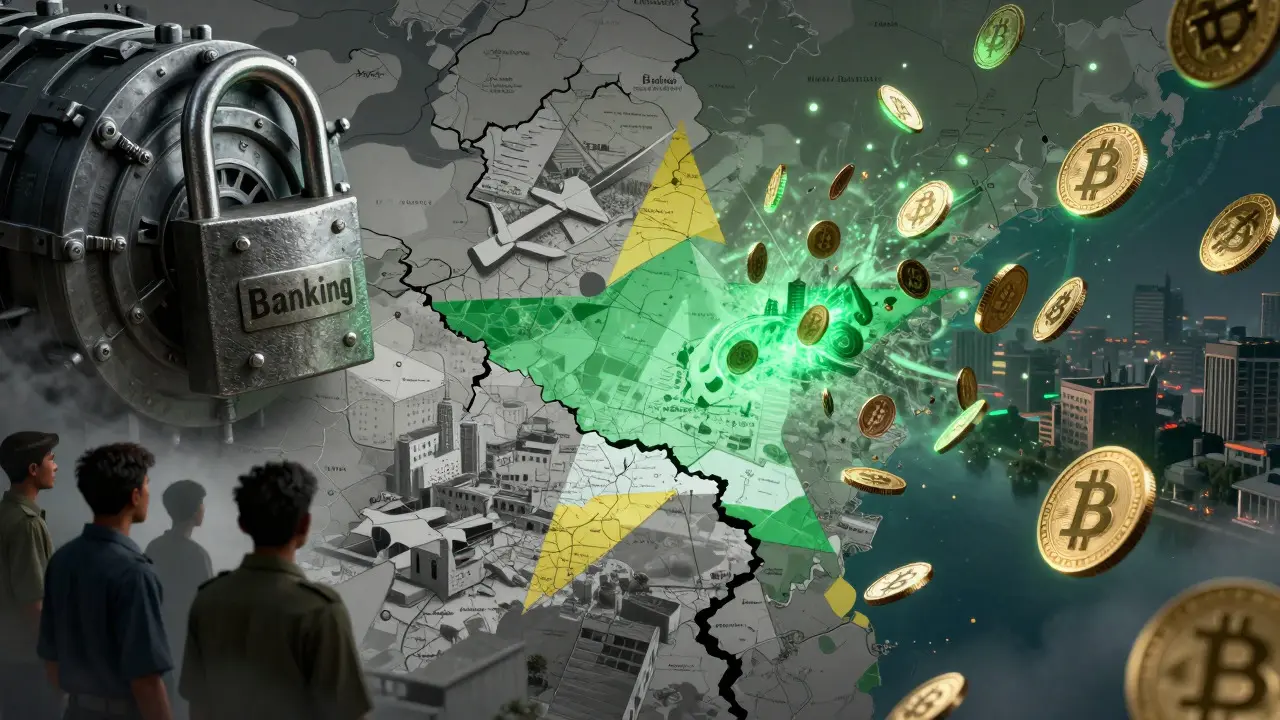
The Underground Economy: How People Still Trade
Despite the risks, demand for crypto in Myanmar hasn't disappeared; it has gone underground. The collapse of the Kyat, capital controls, and political instability following the 2021 coup have driven citizens to seek alternative stores of value. Digital assets offer a way to save wealth, send remittances, and finance resistance activities.
Between 2024 and 2025, we saw a tremendous growth in peer-to-peer (P2P) transactions carried out on platforms like Telegram and offshore exchanges. Stablecoins, especially USDT on the Tron network, have come to dominate informal international payments. Why USDT? Because it holds its value against the dollar, unlike the volatile Kyat. It becomes a digital lifeboat for people watching their savings evaporate.
This underground economy operates in direct defiance of CBM regulations. Participants accept significant risks of account closure and criminal prosecution. To mitigate detection, traders use complex methods to obscure transaction trails. However, the CBM has become smarter at tracking these flows, often freezing accounts when large, suspicious deposits appear-especially if they match known crypto payout patterns.
The Political Divide: Legal in Some Areas, Illegal in Others
One of the most confusing aspects of the crypto landscape in Myanmar is the political split. The military-led State Administration Council (SAC) enforces the strict ban through the CBM. However, the opposition National Unity Government (NUG) took a different approach.
In December 2021, the NUG declared Tether (USDT) legal tender in regions under its control. This was a strategic move to circumvent junta currency controls and support the opposition's economy. This created a bizarre dual reality: the same cryptocurrency activity could be considered legal and encouraged under opposition governance but illegal and punishable by prison under the military government's regulations.
For the average citizen, this adds another layer of risk. Depending on which area you live in and which government forces control your local bank branches, the enforcement intensity can vary. But generally, the SAC's reach through the banking system is extensive, making the CBM's threats credible nationwide.

The Irony of the Digital Kyat
While banning private cryptocurrencies, the Myanmar government is busy building its own. In June 2024, the CBM established the Central Committee for the Issuance of Central Bank Digital Currency (CBDC). Chaired by the CBM Governor and approved by the State Administration Council, this committee oversees the research and development of a "digital kyat."
This reveals the true intent behind the crackdown. The government isn't necessarily anti-digital money; it is anti-decentralized money. They want the efficiency of blockchain technology but with total state control. A CBDC allows them to track every transaction, enforce monetary policy directly, and eliminate the shadow economy. Meanwhile, private miners and traders are pushed out or forced to flee to neighboring countries like Thailand and Laos, where regulations are more favorable.
For now, the message remains clear: if it’s not the digital kyat, it’s illegal. And if you try to use it, expect your bank account to vanish.
Practical Risks for Users Today
If you are currently in Myanmar and considering crypto, here is what you need to know about the practical risks:
- Bank Monitoring: Banks are instructed to flag unusual transactions. Large, frequent transfers to unknown entities can trigger an automatic freeze.
- Social Media Exposure: Posting about crypto gains or offering exchange rates on Facebook or Telegram is dangerous. Authorities monitor these platforms for evidence of illegal trading.
- No Recourse: If your account is closed, there is little legal recourse. The burden of proof is on you to show you weren't involved in "illegal currency conversion," which is nearly impossible given the blanket ban.
- Migration Risk: Many professional miners have left the country. If you rely on mining income, staying in Myanmar puts your hardware and livelihood at risk of seizure.
The environment is hostile for retail investors. The limited financial infrastructure, where large portions of the population still rely on cash, makes the transition to crypto risky. Authorities justify strict enforcement by pointing to risks of money laundering and fraud, arguing that the potential misuse outweighs the benefits for ordinary citizens.
Is cryptocurrency completely illegal in Myanmar?
Yes, for private individuals. As of 2025, mining, trading, and exchanging cryptocurrencies like Bitcoin and Ethereum remain illegal under the Central Bank of Myanmar's regulations. The only exception is the upcoming Central Bank Digital Currency (CBDC), which is being developed by the state.
What happens if the CBM finds out I trade crypto?
The most immediate penalty is the closure of your bank account. Beyond that, you may face legal action under the Anti-Money Laundering Law and the Financial Institutions Law, which can result in fines or imprisonment.
Why do people still use USDT in Myanmar despite the ban?
People use USDT primarily to protect their savings from Kyat inflation and to bypass capital controls. It serves as a stable store of value and a tool for remittances, especially since the opposition NUG recognized it as legal tender in controlled areas.
Can I open a new bank account after being closed for crypto trading?
It is extremely difficult. Once flagged by the CBM, your name may be blacklisted across multiple financial institutions. Reopening an account often requires proving no further involvement in unregulated digital currency activities, which is hard to verify.
Is the Digital Kyat available yet?
As of mid-2026, the Central Committee for the Issuance of Central Bank Digital Currency is still overseeing research and development. The digital kyat is not yet fully launched for general public use, but the infrastructure is being built to eventually replace private crypto usage.