
You might have seen an ad for "Coin Bank Exchange" and wondered if it's the next big thing in crypto. Here is the harsh truth that saves you money: Coin Bank Exchange does not exist as a major, regulated cryptocurrency platform. Most likely, you are seeing a confusion with Coinbase, the publicly traded giant founded in 2012 by Brian Armstrong and Fred Ehrsam. Or worse, you are looking at a generic name used by smaller, unregulated apps trying to sound official. If you clicked this title hoping for a deep dive into a specific niche exchange called "Coin Bank," you need to pause. This article clarifies the identity crisis surrounding this name and reviews the actual service most people mean when they type this: Coinbase.
| Feature | Coinbase (The Real Entity) | Generic "Coin Bank" Apps |
|---|---|---|
| Regulation | SEC-registered broker-dealer (No. 177-00009) | Often unlicensed or offshore |
| Asset Storage | 98% in cold storage across 17 locations | Variable; often hot wallets only |
| Fees | Transparent spread + trading fees (0.50%+) | Hidden spreads up to 3-5% |
| Insurance | $255M crime insurance via Lloyd's of London | Rarely insured |
Why the Name Confusion Matters
Naming matters in finance. When you see "Coin Bank," your brain links it to two things: banking safety and coin trading. But in the U.S., banks and exchanges are legally separate. Institutions like Customers Bank or Evolve Bank & Trust hold fiat currency, while exchanges like Coinbase handle digital assets. There is no single entity called "Coin Bank Exchange" listed on major regulatory bodies like the SEC or CFTC. If you downloaded an app with this exact name from a third-party store, check the developer details carefully. Many scam apps use names like "Coin Bank," "Crypto Bank," or "Bit Bank" to mimic established brands. They promise high yields but lack the transparency required for serious investing.
Assuming you meant Coinbase, which serves 48.7 million verified U.S. users, let’s look at what you actually get. Coinbase isn't just an exchange; it's a gateway. It integrates directly with 94% of U.S. banking institutions via Plaid. This means moving money from your checking account to Bitcoin takes minutes, not days. For beginners, this friction reduction is worth more than saving a fraction of a percent on fees.
Security and Asset Protection
Security is where Coinbase shines compared to smaller competitors. The platform keeps 98% of customer assets in cold storage-meaning offline hardware wallets stored in geographically dispersed locations. Hot wallet limits are capped at $250 million, reducing the risk of a massive hack draining user funds instantly. They also maintain a $255 million crime insurance policy through Lloyd's of London. This doesn't cover losses from market crashes, but it protects against internal theft or certain cyber incidents.
However, security comes with friction. You will face mandatory two-factor authentication (2FA) and frequent identity checks. In August 2025, Sensor Tower data showed that 15% of users experienced monthly 2FA issues, locking them out temporarily. While annoying, this strictness is why institutional clients trust Coinbase. Their compliance framework is rated "industry-leading" by experts like Dr. David Gerard, though he notes it reduces privacy. If you value anonymity over convenience, this might feel restrictive.
The Fee Structure: Where Your Money Goes
Here is the part that confuses 68% of new users: fees. Coinbase makes money in three ways. First, there is the spread-the difference between the buy and sell price. Second, there are trading fees. Third, there are payment processing fees.
- ACH Transfers: 0% fee, but slow (1-3 business days).
- Debit Card Purchases: Fast, but expensive. Fees range from 1.49% for small amounts to 3.99% for purchases over $1,000.
- Coinbase Advanced Trade: Lower fees (starting at 0.50%) for active traders who understand order books.
If you buy $100 of Bitcoin with a debit card, you might pay nearly $4 in fees. That sounds small, but it eats into your returns quickly. Kraken charges less for card purchases (0.90-1.50%), and Binance US offers a flat 0.50% rate. So, is Coinbase too expensive? Only if you trade frequently without using the Advanced Trade interface. For one-time buyers, the convenience of instant card settlement often outweighs the higher cost.

Trading Experience and Altcoin Selection
Coinbase supports 235 cryptocurrencies as of late 2025. This is decent, but not the largest. Crypto.com lists over 300 tokens. If you are hunting for obscure altcoins, you might find yourself disappointed. However, Coinbase has been aggressive in listing popular assets. Following the SEC's February 2025 enforcement actions, they delisted 17 tokens, including XRP and ADA, to stay compliant. This regulatory caution means the assets you buy here are less likely to be suddenly deemed securities and removed from the platform.
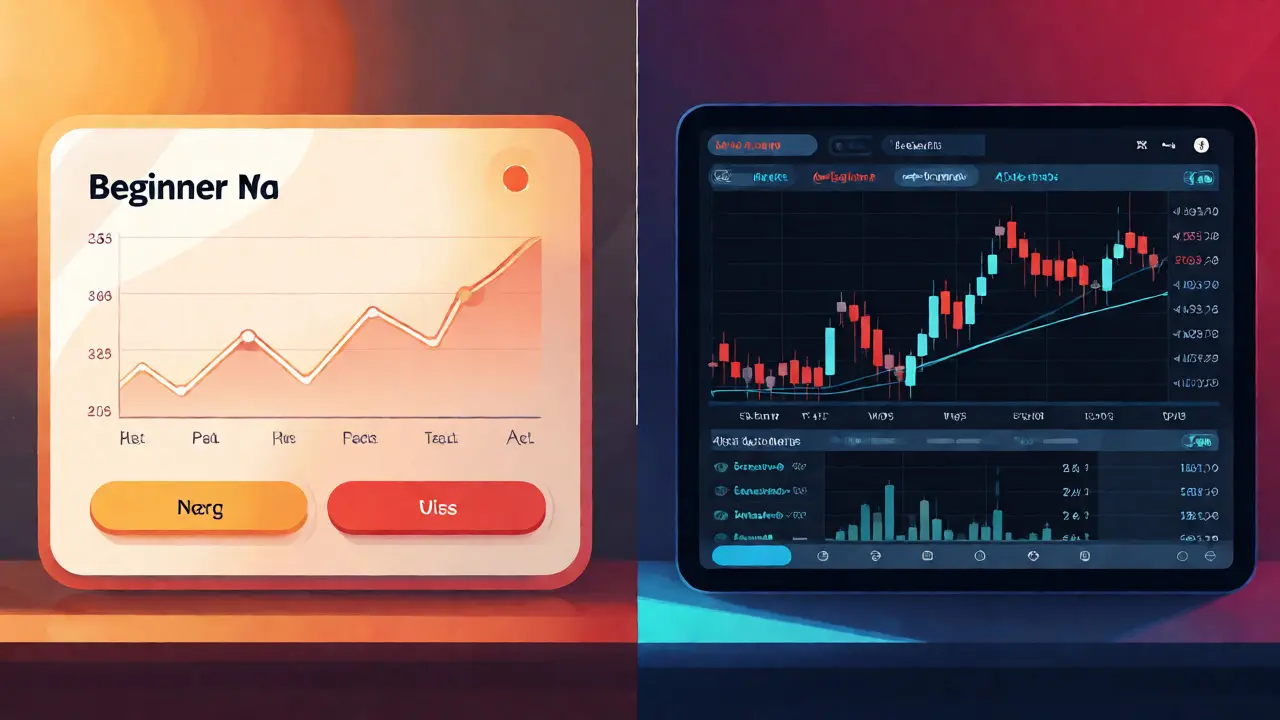
The interface is designed for simplicity. Basic users see a simple "Buy/Sell" button. Advanced users can toggle to a chart view with limit orders. The learning curve is shallow; Koinly’s 2025 study found it takes just 3.2 hours to master basic trading. But don't expect pro-level tools. API rate limits are capped at 100 transactions per second, whereas Kraken allows 2,000. High-frequency traders will hit walls here.
Staking and Earning Opportunities
One reason people stick with Coinbase is staking. You can earn interest on holdings like Ethereum (3.8% APY) and Solana (6.2% APY). This passive income helps offset inflation. But read the fine print. Coinbase deducts a significant portion of the rewards as their fee-between 25.25% and 35%. So, that shiny 6.2% APY becomes roughly 4% in your pocket. Still, for hands-off investors, it’s better than zero.
They also offer educational rewards through Coinbase Earn. You watch short videos about new cryptocurrencies and answer quizzes to earn free crypto. This gamification helped onboard millions of users who had zero prior knowledge. It’s a smart strategy: teach the user, then sell to the user.
User Reputation and Support
What do real users say? On Trustpilot, Coinbase holds a 4.1/5 rating across 38,700 reviews. Positive feedback focuses on the intuitive interface and responsive support. Their Q2 transparency report claims 92% of tickets are resolved within 24 hours. That’s fast for a financial institution.
Negative reviews, however, are vocal. A common complaint involves hidden costs inflating expenses by 22% on average due to poor fee understanding. Another pain point is withdrawal speed. During volatility, ETH withdrawals can take 17 minutes on Coinbase versus 4.2 minutes on Kraken. In April 2024, a system outage prevented 1.2 million users from trading during a 12% Bitcoin price swing. These failures remind us that centralized platforms carry operational risks.
Is It Right for You?
Choose Coinbase if you are a beginner in the U.S. who values security and ease of use over lowest possible fees. Its integration with local banks and regulatory compliance provides peace of mind. Choose alternatives like Kraken or Binance US if you are an advanced trader seeking lower fees, faster withdrawals, or more altcoin options.
If you were actually looking for a specific app named "Coin Bank Exchange," proceed with extreme caution. Verify its license status. If it lacks clear regulation and transparent reserves, keep your exposure minimal. In crypto, clarity is king. Don't let a confusing name cost you your capital.
Is Coin Bank Exchange the same as Coinbase?
Not necessarily. "Coin Bank Exchange" is often a misnomer for Coinbase, the major U.S. exchange. However, some smaller, unregulated apps may use similar names. Always verify the developer and regulatory licenses before depositing funds.
How much does Coinbase charge for buying crypto?
Fees vary by method. ACH transfers are free but slow. Debit card purchases incur fees ranging from 1.49% to 3.99%. Using Coinbase Advanced Trade can reduce trading fees to around 0.50%, plus the standard spread.
Is my money safe on Coinbase?
Coinbase stores 98% of assets in cold storage and carries $255 million in crime insurance. However, crypto investments are inherently volatile, and insurance does not cover market losses.
Can I withdraw cash from Coinbase?
Yes, you can sell crypto and withdraw USD to your linked bank account via ACH or wire transfer. Withdrawal times depend on the method chosen, with ACH taking 1-3 business days.
Does Coinbase support all cryptocurrencies?
No, Coinbase supports approximately 235 cryptocurrencies. Some tokens, especially those deemed securities by the SEC, may be delisted or unavailable in certain states like New York.