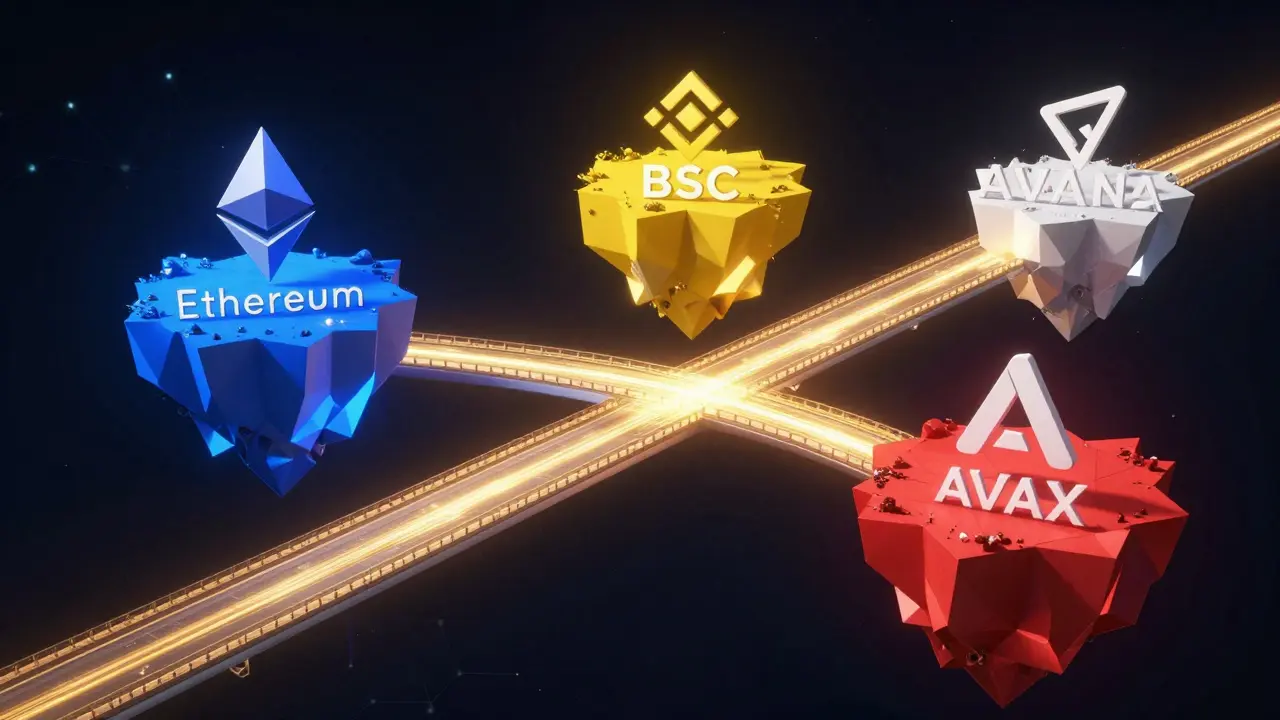
Have you ever tried to trade crypto across different blockchains and felt like you were moving through molasses? You swap tokens on Ethereum, bridge them to Binance Smart Chain, wrap them again for Polygon, and by the time you’re done, the gas fees have eaten your profits. That’s exactly the problem Unifi Protocol DAO (UNFI) was built to solve.
Launched in 2018, Unifi isn’t just another coin hoping for a quick pump. It’s an infrastructure project designed to make decentralized finance (DeFi) actually usable for everyday people and businesses. Instead of forcing you to learn five different wallets or navigate ten different bridges, Unifi creates a single, interoperable layer that connects major blockchains. If you’ve heard of UNFI but aren’t sure if it’s worth your attention, this guide breaks down what the protocol does, how its two-token system works, and why its multi-chain approach matters in 2026.
The Core Idea: Interoperability Without the Headache
Most blockchain networks are islands. Ethereum doesn’t talk directly to Tron. Avalanche doesn’t natively understand Harmony. To move value between them, you usually need a "bridge," which often involves wrapping your tokens into a synthetic version. Wrapped tokens carry risk-if the bridge gets hacked or the wrapper contract fails, your funds can be stuck or stolen.
Unifi Protocol DAO takes a different path. It uses a group of non-custodial, multi-chain smart contracts that allow true cross-chain interaction without wrapping. Think of it as a universal translator for crypto assets. Whether you’re on Ethereum, Binance Smart Chain, Avalanche, or even Tron, Unifi lets you access the same liquidity pools and trading features. This reduces friction and lowers the barrier to entry for users who don’t want to manage multiple chain-specific wallets.
How uTrade Works: The Heart of the Ecosystem
The main product you’ll interact with is uTrade. It’s a decentralized exchange (DEX) that functions as an Automated Market Maker (AMM). But unlike Uniswap or SushiSwap, which are locked to one chain, uTrade is multi-chain from the ground up.
Here’s how it works in practice:
- User-Generated Liquidity: There is no central market maker setting prices. Instead, users provide liquidity to pools called "uPairs."
- Unlimited Token Combinations: In traditional AMMs, you might only trade ETH/USDT. In uTrade, you can create pairs with almost any combination of tokens supported by the network.
- Cross-Chain Trading: Because the underlying contracts are interoperable, you can execute trades that span different blockchains seamlessly.
This structure allows for advanced strategies like DARBi (Decentralized Arbitrage), where bots automatically exploit price differences between chains to keep markets efficient. For the average user, this means tighter spreads and better execution prices when you swap tokens.
The Two-Token System: UNFI vs. UP
If you look at Unifi’s tokenomics, you’ll see two distinct tokens: UNFI and UP. Confusing them is a common mistake, so let’s clear it up.
| Feature | UNFI Token | UP Token |
|---|---|---|
| Primary Role | Governance and Staking | Liquidity Rewards and Revenue Share |
| Supply | Fixed at 10 million | Infinite (minted/burned based on demand) |
| Value Driver | Scarcity and governance power | Transaction volume and ecosystem activity |
| Use Case | Voting, staking for rewards, delegation | Earning fees from providing liquidity |
UNFI is the governance token. With a hard cap of 10 million tokens, it’s deflationary by design. Holders use UNFI to vote on protocol upgrades, delegate votes to Community Council Representatives, and stake to earn more UNFI. It’s the key to participating in the Unifi Global Governance Model.
UP stands for "Unlimited Potential." It acts as the reward mechanism for liquidity providers. When you add funds to a uTrade pool, you earn UP tokens. These tokens represent the revenue generated by the ecosystem. Since UP has no max supply, its value is tied directly to how much activity happens on Unifi. You can hold UP, or you can swap it for UNFI at dynamic market rates. This dual-token model separates speculative governance value from utility-driven earnings.
Security and Consensus: Proof-of-Stake Efficiency
Unifi operates on a Proof-of-Stake (PoS) consensus mechanism. Unlike Bitcoin’s energy-intensive Proof-of-Work, PoS secures the network by requiring validators to lock up (stake) their tokens. This makes the network highly scalable and environmentally friendly.
More importantly for security, Unifi employs a unique node staking reward system. 100% of the node rewards are shared with the community of stakers. This aligns incentives perfectly: if the network is secure and active, everyone benefits. There’s no separate mining cartel hoarding profits; the value flows back to the users securing the chain.
Additionally, the protocol offers Unifi Farms, which use "non-stake farming." In many DeFi protocols, you must lock your tokens in a contract, giving the contract control over them. Unifi Farms allow you to earn yields without transferring ownership of your assets, reducing the risk of smart contract exploits draining your principal.

Buying and Trading UNFI in 2026
As of May 2026, UNFI is widely available on major exchanges. You won’t find it on obscure platforms; it’s listed on tier-one venues like Kraken, Binance, Crypto.com, and MEXC.
Current market data shows UNFI trading around $0.037-$0.040 USD, depending on the exchange. Here’s how to get involved:
- Choose Your Platform: Kraken is great for fiat on-ramps (bank wire, ACH, credit card). MEXC offers both spot and futures trading if you want leverage.
- Spot vs. Futures: For most investors, spot trading is safer. You buy the actual token, own it, and can withdraw it to a wallet. Futures involve betting on price direction with borrowed capital, which carries higher risk.
- Execute the Trade: On Kraken, select "Buy Crypto," choose UNFI from the asset list, enter your amount in USD or EUR, and confirm. The tokens appear instantly in your account.
Once purchased, you can leave UNFI on the exchange for easy trading, or withdraw it to a self-custody wallet to participate in governance and staking. Remember, holding on an exchange means you don’t control the private keys, so for long-term holders, a hardware wallet or secure software wallet is recommended.
Why Unifi Matters for DeFi’s Future
The biggest hurdle for DeFi adoption has always been fragmentation. Users hate switching contexts. Developers hate rebuilding apps for every new chain. Unifi addresses this by building the plumbing that connects everything.
By supporting chains like Polygon, Ontology, and Harmony, Unifi ensures that liquidity isn’t trapped in silos. As the industry moves toward a multi-chain future, protocols that facilitate seamless movement between these chains will capture significant value. Unifi’s early start (2018) gives it a mature codebase and a tested governance model.
However, keep in mind that DeFi is still volatile. UNFI’s price fluctuates with broader market trends. The fixed supply of 10 million tokens provides some stability against inflation, but demand drives price. Always do your own research, understand the risks of smart contracts, and never invest more than you can afford to lose.
Is UNFI a good investment in 2026?
Whether UNFI is a good investment depends on your belief in multi-chain interoperability. UNFI offers exposure to DeFi infrastructure rather than just a meme coin or simple store-of-value asset. Its fixed supply of 10 million tokens creates scarcity, while its utility in governance and staking provides ongoing demand drivers. However, crypto markets are volatile, and UNFI has experienced significant price swings. Consider it a high-risk, high-reward play on DeFi evolution.
What is the difference between UNFI and UP tokens?
UNFI is the governance token with a fixed supply of 10 million, used for voting and staking. UP is the reward token with an infinite supply, minted to liquidity providers based on transaction volume. You earn UP by providing liquidity, and you can swap UP for UNFI. UNFI represents ownership and control; UP represents earnings and activity.
Which blockchains does Unifi Protocol support?
Unifi supports multiple EVM-compatible blockchains including Ethereum, Binance Smart Chain, Avalanche, Polygon, Tron, Harmony, Ontology, loTex, and BitTorrent. This multi-chain architecture allows users to access DeFi services across these networks through a unified interface.
How do I earn UNFI rewards?
You can earn UNFI by staking your existing UNFI tokens or by delegating your voting power to Community Council Representatives. Additionally, you can earn UP tokens by providing liquidity on uTrade and then swap those UP tokens for UNFI on the open market. The protocol shares 100% of node staking rewards with the community.
Is Unifi Protocol safe to use?
Unifi uses non-custodial smart contracts, meaning you retain control of your funds. The protocol employs Proof-of-Stake for security and offers non-stake farming options that reduce smart contract risk. However, all DeFi protocols carry inherent risks, including potential bugs in smart contracts or cross-chain bridge vulnerabilities. Always audit your transactions and consider using reputable hardware wallets for storage.