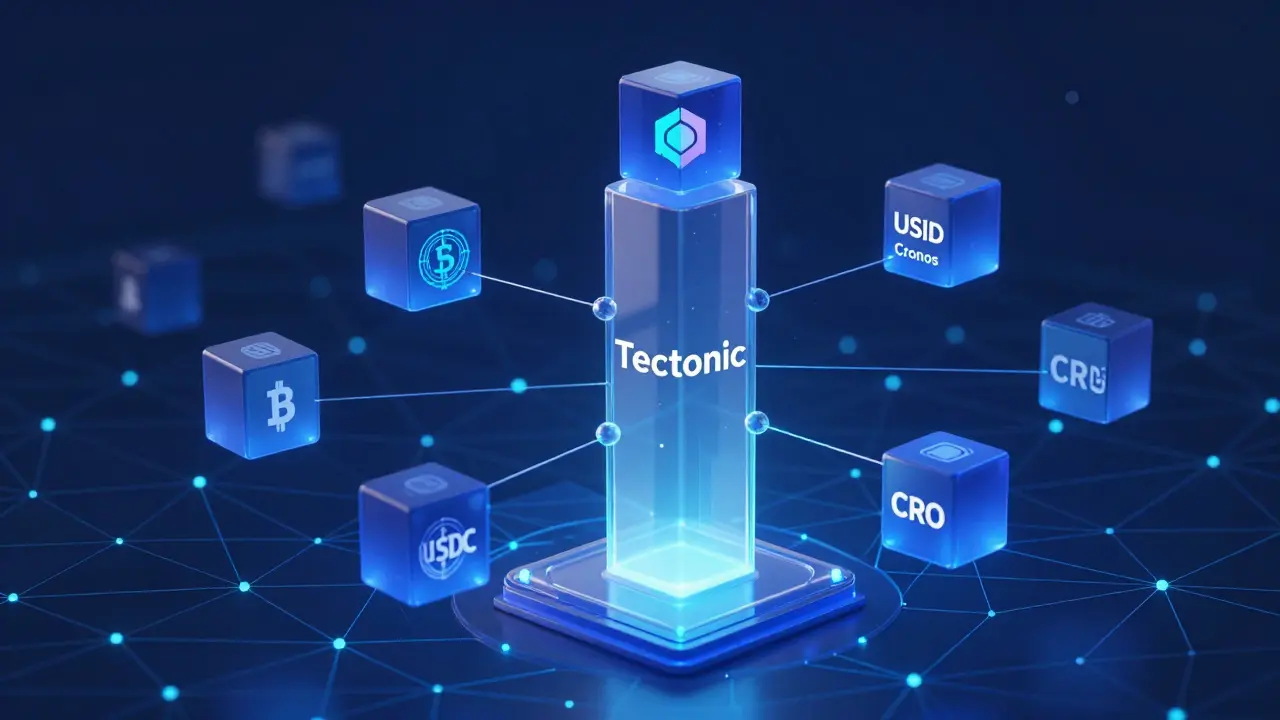
Ever looked at a crypto price chart and wondered why a coin costs less than a fraction of a penny? You’re not alone. Tectonic is a decentralized lending protocol on the Cronos blockchain that lets users lend assets for interest and borrow against their crypto holdings. Its governance token, TONIC, often confuses new investors because its price hovers in the micro-cent range while its total supply hits trillions. If you are asking "What is Tectonic (TONIC) crypto coin," you likely want to know if it’s a viable place to park your money or just another speculative gamble.
The short answer is this: Tectonic is a functional piece of financial infrastructure, but the TONIC token itself comes with heavy structural headwinds. It is not a magic bullet for getting rich quick. Instead, it is a tool for earning yield on the Cronos network, wrapped in a governance model that makes massive price appreciation statistically difficult. Let’s break down how it works, what the numbers actually mean, and whether it fits into your portfolio.
How Tectonic Actually Works
To understand Tectonic, you first need to understand the problem it solves. In traditional finance, banks take your deposits, pay you a tiny interest rate, and lend that money out at a much higher rate. They keep the difference. DeFi (Decentralized Finance) removes the bank. Tectonic acts as an automated middleman using smart contracts on the Cronos blockchain, which is an EVM-compatible chain built by Crypto.com designed for fast and low-cost transactions.
Here is the workflow:
- Lenders: You deposit crypto (like USDC, CRO, or ETH) into a pool. You earn interest paid by borrowers. The more people want to borrow that specific asset, the higher your Annual Percentage Yield (APY) goes.
- Borrowers: You lock up crypto as collateral. You can then borrow other assets against it. This allows you to access liquidity without selling your original holdings. For example, you might hold Bitcoin but need cash, so you borrow stablecoins against your BTC.
- Governance: Holders of the TONIC token vote on key parameters like interest rates, supported assets, and fee structures.
The system is non-custodial, meaning Tectonic never holds your keys. Your funds sit in smart contracts. If the code fails, the funds are at risk. If the code works, you have direct control. This mirrors earlier Ethereum giants like Compound and Aave, but Tectonic is optimized specifically for the Cronos ecosystem, where transaction fees are often under $0.01 compared to dollars on Ethereum mainnet during busy periods.
The TONIC Token: Supply Shock Explained
This is where most people get tripped up. You see TONIC trading at roughly $0.000000013 (as of mid-2026). Your brain wants to think, "If this doubles, I double my money!" But in crypto, unit price means almost nothing without context. Context comes from market capitalization and total supply.
TONIC has a maximum supply of 500 trillion tokens. That is a number so large it is hard to visualize. To put it in perspective, if every person on Earth had one TONIC, there would still be billions left over. Currently, about 247 trillion are in circulation. At current prices, the fully diluted valuation (FDV)-what the market cap would be if all tokens were released-is modest, sitting in the low millions of dollars.
Why does this matter? Because for TONIC to reach $0.01 (one cent), the market cap would need to hit $5 trillion. That is roughly twice the entire value of all cryptocurrencies combined during the peak bull runs of 2021-2022. It is mathematically implausible under current conditions. Investors who chase "penny stocks" in crypto without checking supply often suffer severe losses when they realize the ceiling is far lower than they imagined.
| Feature | Tectonic (TONIC) | Aave (AAVE) | Compound (COMP) |
|---|---|---|---|
| Blockchain | Cronos | Ethereum, Arbitrum, Optimism, etc. | Ethereum, Polygon, etc. |
| Total Supply Cap | 500 Trillion | ~16 Million | ~10 Million |
| Primary Use Case | Cronos-native lending | Cross-chain lending giant | Ethereum-centric lending |
| Transaction Cost | Very Low (<$0.01) | High (Ethereum) / Low (L2s) | High (Ethereum) / Medium (L2s) |
| Governance Power | Protocol parameters, incentives | Risk parameters, upgrades | Interest rate models, grants |
Is Tectonic Safe? Understanding the Risks
No DeFi platform is risk-free. While Tectonic has operated since late 2021 without a catastrophic, protocol-level hack draining user funds, you must understand three specific risks:
- Smart Contract Risk: All funds are held in code. If a developer makes a mistake, or if hackers find a vulnerability in the underlying Cronos infrastructure, funds could be lost. Tectonic uses audits, but audits are snapshots in time, not guarantees.
- Liquidation Risk: If you borrow against collateral, and the value of your collateral drops too fast, the protocol will automatically sell your assets to repay the loan. On volatile markets, this can happen in seconds. Always maintain a healthy loan-to-value ratio (e.g., borrow only 50% of your collateral’s value, not the max 80%).
- Concentration Risk: Tectonic’s Total Value Locked (TVL) is around $118 million. While significant for Cronos, it is small globally. A portion of this TVL is held by a few large "whale" accounts. If these whales withdraw suddenly, it can impact liquidity and yields for everyone else.
Furthermore, oracle manipulation is a threat. Oracles feed price data to the smart contracts. If an oracle reports a fake price for a volatile token, borrowers might exploit the system. Stick to blue-chip assets like USDC, USDT, CRO, and wrapped ETH/BTC to minimize this exposure.
Who Should Use Tectonic?
Tectonic isn’t for everyone. Here is how to decide if it fits your strategy:
Use Tectonic if:
- You already hold Cronos-based assets (CRO, USDC on Cronos) and want them to work harder.
- You want to avoid high Ethereum gas fees for frequent small transactions.
- You understand that yields fluctuate based on demand and are comfortable with variable APRs ranging from 2% to 20%+ depending on the asset and campaign.
Avoid Tectonic if:
- You are buying TONIC solely hoping it will hit $1 or even $0.01. The math simply doesn’t support this.
- You are uncomfortable with the concept of losing your principal due to smart contract bugs.
- You need guaranteed, fixed returns. DeFi yields are variable and can drop to near zero if no one is borrowing.
Getting Started: A Practical Checklist
If you decide to try it out, here is the safest path forward:
- Set Up a Wallet: Install MetaMask or use the Crypto.com DeFi Wallet. Ensure you are connected to the Cronos network.
- Get Gas Fees: Buy a small amount of CRO (the native token of Cronos) to pay for transaction fees. Keep this separate from your investment capital.
- Start Small: Deposit a test amount of stablecoins (like USDC) into the Tectonic lending pool. Monitor the interface for a week to understand how interest accrues.
- Check Health Factors: If you borrow, constantly monitor your "Health Factor." If it drops below 1.0, you face liquidation. Set alerts if possible.
- Don’t Over-Leverage: Resist the urge to borrow the maximum allowed amount. Volatility kills leveraged positions.
The Bottom Line
Tectonic fills a necessary role in the Cronos ecosystem. It provides liquidity for developers building apps on Cronos and offers retail users a way to earn passive income on idle assets. The protocol is mature, functional, and cost-effective.
However, the TONIC token is a different story. It is a governance instrument with a massive supply that suppresses its unit price potential. Treat it as a utility tool for participating in the protocol’s future, not as a lottery ticket. If you focus on the lending mechanics-earning yield on stablecoins or major assets-you might find genuine value. If you focus on the token price speculation, you are likely setting yourself up for disappointment.
Will TONIC reach $0.01?
It is highly unlikely. With a 500 trillion token supply, a price of $0.01 would require a $5 trillion market capitalization, which exceeds the total value of many global economies and the entire crypto market during previous peaks. More realistic milestones involve reaching $0.000001 or similar micro-gains.
Is Tectonic safe to use?
Like any DeFi protocol, it carries smart contract risk. While Tectonic has not suffered a major hack since its 2021 launch, no code is immune to vulnerabilities. Users should only deposit funds they can afford to lose and stick to well-established assets like USDC or CRO to minimize oracle and volatility risks.
What is the minimum amount to lend on Tectonic?
There is no strict minimum set by the protocol, but practical limits exist due to gas fees. Since Cronos fees are very low (often less than $0.01), you can technically start with very small amounts, though deposits under $10 may not generate meaningful interest relative to the effort.
How do I earn yield on Tectonic?
You connect your wallet, select an asset (like USDC or CRO), and click "Supply." You will receive interest-bearing tokens representing your deposit. As borrowers pay interest, your balance grows. You can withdraw your principal and accrued interest at any time.
What happens if I get liquidated?
If the value of your collateral drops significantly relative to your borrowed amount, the protocol will automatically sell your collateral to repay the loan. You will lose your position and potentially a portion of your funds as a liquidation penalty. To avoid this, keep your loan-to-value ratio low (e.g., below 50%).