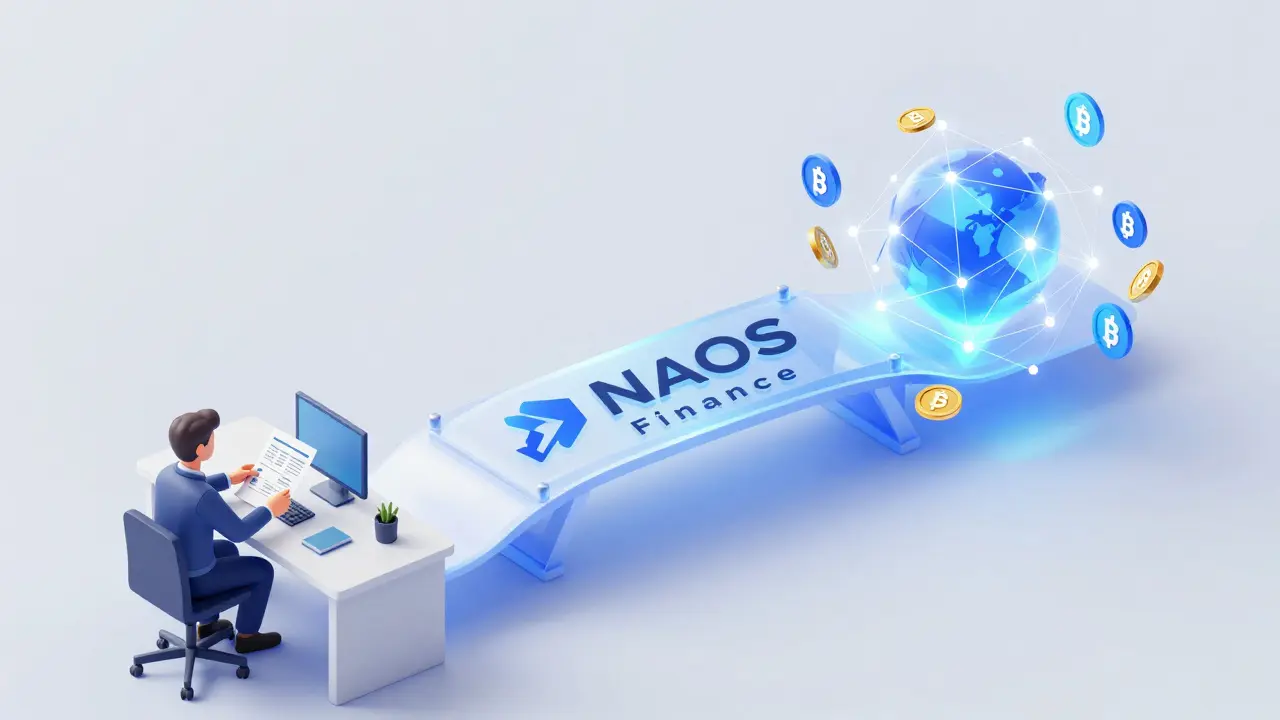
Have you ever wondered how small businesses get loans without going through a bank? Or how crypto investors can earn steady income that isn't tied to Bitcoin's wild price swings? That’s exactly what NAOS Finance is trying to solve. It’s a decentralized protocol that connects lenders in the crypto world with borrowers in the real world-specifically small and medium-sized enterprises (SMEs). The catch? They use real-world assets as collateral, not just other cryptocurrencies.
If you’ve heard the ticker symbol NAOS thrown around on social media or seen it listed on exchanges like Bitget or Coinbase, you might be asking: Is this legit? How does it actually work? And why should you care? This guide breaks down the mechanics, the risks, and the potential of this niche project in plain English.
The Core Idea: Bridging DeFi and Real-World Assets
At its heart, NAOS Finance is a blockchain-based decentralized lending protocol focused on connecting DeFi lenders with SME borrowers using real-world assets (RWA) as collateral. Think of it as a bridge. On one side, you have crypto holders sitting on stablecoins or other digital assets, looking for yield. On the other side, you have small businesses needing working capital but struggling to get traditional bank loans.
NAOS steps in the middle. Instead of requiring crypto as collateral (which is risky when prices crash), NAOS allows borrowers to pledge real-world assets. These could be invoices, receivables, or other tangible financial instruments. The protocol then tokenizes these assets into Non-Fungible Tokens (NFTs). Once tokenized, these NFTs serve as secure, on-chain collateral for crypto loans.
This model addresses a huge gap in the market. Traditional finance often ignores small players due to high overhead costs. Decentralized finance (DeFi) has plenty of liquidity but lacks connection to the real economy. NAOS aims to merge the two, offering lenders stable, recurring income streams derived from off-chain cash flows, rather than speculative trading profits.
How the NAOS Protocol Works
You don’t need to be a coder to understand the flow, but it helps to visualize the steps. Here is how the machine runs:
- Asset Origination: An SME borrower brings a real-world asset (like an unpaid invoice) to the platform. They work with approved originators who verify the asset’s value and legitimacy.
- Tokenization: The NAOS smart contracts convert this verified asset into an NFT. This NFT represents the claim on the future payment from the invoice.
- Collateral Lock: The borrower locks this NFT into the protocol as collateral.
- Crypto Borrowing: In exchange for the locked NFT, the borrower receives cryptocurrency (usually stablecoins) from the lending pool.
- Lender Yield: Crypto lenders deposit their funds into this pool. As the SME repays the loan with interest (from their real-world business operations), the lenders earn that yield.
The goal is automation. The long-term vision of the team is to fully automate this entire process-from verifying the asset to distributing the yield-without human intermediaries. This reduces costs and makes capital accessible to anyone with an internet connection and a valid real-world asset.

Tokenomics: Supply, Circulation, and Value
Every protocol needs a native token, and for this ecosystem, that’s the NAOS token. But before you buy, you need to look at the numbers. Tokenomics tell you about scarcity, inflation, and current market presence.
| Metric | Value |
|---|---|
| Total Supply | ~219.17 Million NAOS |
| Maximum Supply | 300 Million NAOS |
| Circulating Supply | ~84.2 Million NAOS |
| Market Cap Range | $79,000 - $130,000 USD |
| Price Range (Recent) | $0.00094 - $0.0016 USD |
A few things stand out here. First, only about 28% of the maximum supply is currently circulating. This means there is room for more tokens to enter the market over time, which could impact price if demand doesn’t grow proportionally. Second, the market cap is tiny. We are talking micro-cap territory. For context, major DeFi protocols have billions in market cap. NAOS sits under $150k. This indicates it is a highly speculative, early-stage asset with significant volatility risk.
Data discrepancies are common here. You might see CoinGecko report a price of $0.00094 while Coinbase shows $0.0016. Why? Low liquidity. With daily trading volumes sometimes dipping below $30 on some platforms, even small trades can swing the price. Always check multiple sources before making decisions.
Risks and Limitations You Must Know
I’m not here to sell you a dream; I’m here to give you the facts. While the concept of bridging DeFi and SME financing is sound, executing it is incredibly hard. Here are the red flags and challenges associated with NAOS Finance right now.
- Liquidity Risk: With such low trading volume, getting in and out of a position can be painful. If you try to sell a large amount of NAOS, you might crash the price yourself because there aren’t enough buyers waiting.
- Credit and Legal Risk: Remember those real-world assets? If an SME defaults on their loan, recovering the value isn’t as simple as liquidating Bitcoin. It involves legal proceedings in the real world. Does the protocol have the legal framework to seize and sell an invoice in another country? That’s a complex hurdle.
- Smart Contract Security: Like all DeFi projects, NAOS relies on code. If there’s a bug in the tokenization or lending contracts, funds could be drained. Always check if independent audits have been performed (though specific audit reports weren’t detailed in recent public snapshots).
- Adoption Hurdles: The social footprint is small. Only about 25 unique individuals were actively discussing the asset on tracked social platforms recently. Without a growing community and user base, the network effect remains weak.

Who Is NAOS Finance For?
Not every crypto project fits every investor. NAOS seems tailored for two specific groups:
1. Yield Seekers Tired of Volatility: If you’re bored with farming yields that depend entirely on Bitcoin pumping, NAOS offers exposure to real-world economic activity. The interest comes from businesses paying back loans, which is theoretically less correlated to crypto market crashes.
2. Believers in the RWA Narrative: Real-World Asset tokenization is a massive trend in blockchain. Institutional giants are exploring it. Early supporters of NAOS are betting that this specific protocol will succeed in automating SME lending better than competitors.
It is not for casual traders looking for quick flips based on hype, nor for risk-averse investors who cannot afford to lose their principal investment. The micro-cap status means it’s a high-risk, high-reward play.
Future Outlook: Can It Scale?
The team’s roadmap focuses on full automation. Imagine a future where an SME uploads an invoice, AI verifies it, an NFT is minted instantly, and a loan is issued in seconds-all without a human touching it. That’s the end goal. If they pull that off, the efficiency gains would be massive, potentially disrupting traditional factoring companies.
However, scaling requires trust. They need partnerships with real-world originators and legal entities to handle disputes. Currently, the data suggests limited mainstream recognition. The path forward involves proving that the model works at scale, attracting institutional liquidity, and ensuring regulatory compliance across different jurisdictions.
For now, NAOS Finance remains a niche experiment in a crowded field. It’s worth watching if you believe in the convergence of traditional finance and blockchain, but proceed with caution and do your own due diligence.
Is NAOS Finance a scam?
There is no evidence suggesting NAOS Finance is a scam. It operates as a legitimate DeFi protocol with a clear utility: bridging real-world assets to crypto lending. However, being legitimate doesn't mean it's safe. It is a high-risk, micro-cap investment with low liquidity and unproven long-term viability. Always verify smart contract audits and official documentation before investing.
Where can I buy NAOS tokens?
You can find NAOS tokens on several exchanges. Bitget explicitly lists a "Buy NAOS" option. Other platforms like Coinbase, Kraken, and Crypto.com track the price and may offer trading pairs, though availability varies by region and time. Always check the latest listings on CoinGecko or CoinMarketCap for the most up-to-date exchange options.
What are Real-World Assets (RWA) in crypto?
Real-World Assets (RWA) are physical or traditional financial assets-like real estate, invoices, bonds, or commodities-that are digitized and represented on a blockchain. In the case of NAOS, these assets are tokenized into NFTs to serve as collateral for crypto loans, bringing off-chain value into the decentralized finance ecosystem.
How does NAOS generate yield for lenders?
Lenders provide crypto capital (often stablecoins) to NAOS lending pools. Small and medium-sized enterprises (SMEs) borrow this capital by pledging real-world assets as collateral. When the SMEs repay their loans with interest, that interest is passed on to the lenders. This creates a yield source based on real economic activity rather than speculative crypto trading.
What happens if an SME defaults on a loan?
If an SME defaults, the protocol holds the tokenized real-world asset (the NFT) as collateral. The recovery process involves legal and operational steps to liquidate or enforce the underlying real-world asset (e.g., collecting the unpaid invoice). This introduces legal and jurisdictional risks that pure crypto-collateralized loans do not face.