Most people think DLT and blockchain are the same thing. They’re not. Blockchain is just one way to build a distributed ledger - and not always the best one. If you’ve only heard of DLT through crypto headlines, you’re missing the bigger picture. DLT is the foundation. Blockchain is a specific tool on that foundation. And the real power of DLT shows up when you stop trying to force crypto into every use case and start asking: What kind of trust do we actually need?
What DLT Really Is (And What It Isn’t)
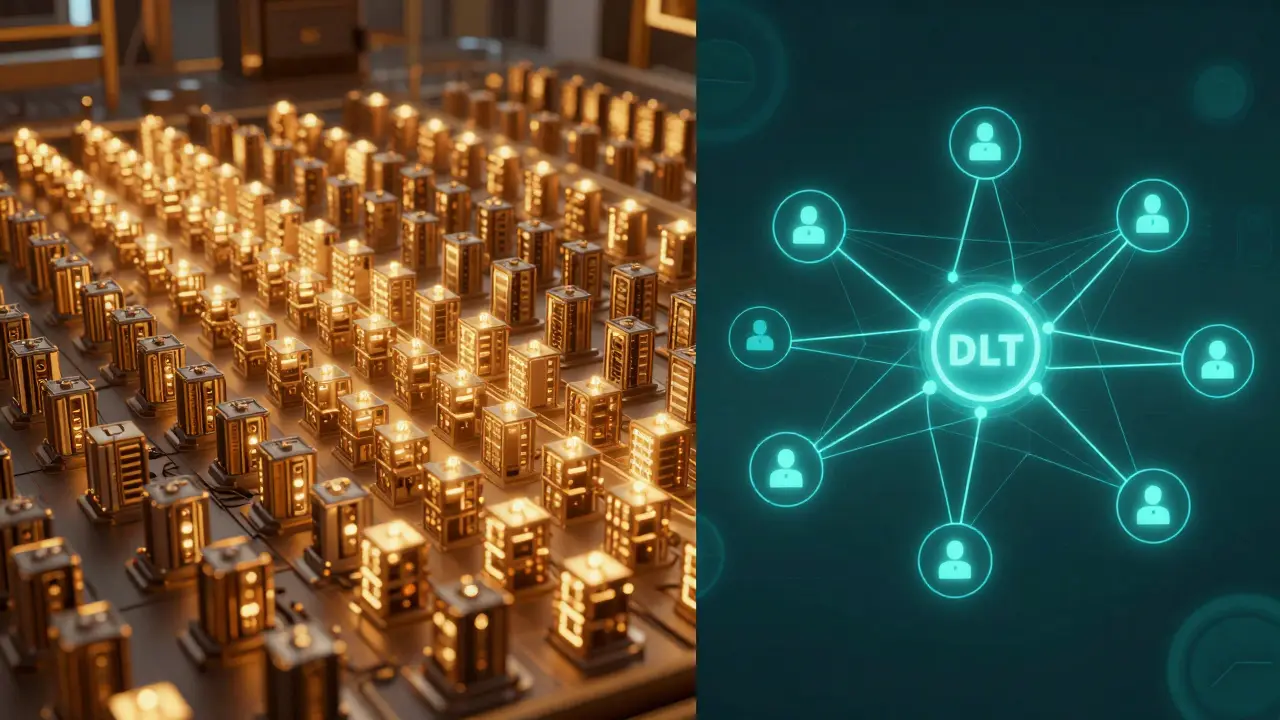
Think of DLT as a shared digital notebook. Not one copy kept by a bank or a government. Not a single server in a data center. But hundreds - maybe thousands - of identical copies, each updated at the same time, across computers in different cities, countries, even companies. When someone adds a new entry, everyone’s notebook changes together. No single person controls it. No middleman approves it. It just works because the network agrees.
This isn’t science fiction. It’s how BitTorrent worked back in 2001 - sharing files without a central server. The same idea now powers supply chains, land registries, and hospital records. The key? It’s decentralized. It’s synchronized. And it’s designed so that once something is written, it’s nearly impossible to erase or secretly change it.
That’s where most people get confused. They hear “immutable record” and think: blockchain. But blockchain is just one flavor of DLT. Think of it like this: all Post-its are sticky notes, but not all sticky notes are Post-its. Same with DLT and blockchain. Blockchain requires blocks to be chained together in a strict, linear order. It often needs mining, tokens, and proof-of-work. DLT doesn’t. DLT can use different structures - trees, graphs, directed acyclic graphs - whatever fits the job.
Why Blockchain Isn’t Always the Answer
Blockchain got famous because of Bitcoin. But Bitcoin’s design came with trade-offs. It’s slow. It uses massive amounts of electricity. It needs a native token to keep people honest. And it forces every transaction into a fixed sequence. That works for digital cash. It doesn’t work for tracking 10,000 shipments per hour across a global supply chain.
Take BBVA, the Spanish bank. They didn’t use blockchain to move money. They used a private DLT system - no tokens, no mining - to automate letters of credit in international trade. Instead of waiting days for paperwork to bounce between banks, lawyers, and shipping companies, they built a network where everyone sees the same document in real time. Changes are approved by consensus among authorized parties. No central authority. No delays. No lost invoices.
That’s the difference. Blockchain was built for distrust. DLT can be built for efficiency. You don’t always need to prove you’re not cheating. Sometimes you just need everyone to see the same thing - fast, reliably, securely.
How DLT Works Without Blockchain
DLT doesn’t need blocks. It doesn’t need chains. It doesn’t even need a cryptocurrency. Here’s how it actually works:
- Peer-to-peer architecture: Every participant runs a node. No central server. No single point of failure.
- Consensus without mining: Instead of solving math puzzles, nodes vote. Or they use practical Byzantine fault tolerance. Or they rely on reputation. It’s faster. It’s greener.
- Flexible data structure: Records can be linked in any pattern - not just a straight line. This lets you handle complex relationships, like a product’s journey from factory to store, with multiple stakeholders involved.
- Controlled transparency: You can make the ledger public, private, or permissioned. Hospitals can use DLT to share patient data only with authorized staff. Governments can track land titles without exposing personal details to the public.
- No token required: Tokens are optional. Most enterprise DLT systems don’t use them at all. They rely on legal agreements and identity verification instead.
LCX, a regulated tech provider in Liechtenstein, built a DLT system for asset tokenization - but they didn’t use proof-of-work. They used a permissioned network with identity verification. The result? Faster settlements, lower costs, and full regulatory compliance. No mining. No energy waste. Just trust built into the system design.
Real-World Uses That Have Nothing to Do With Crypto
DLT is already changing industries - quietly, without headlines.
In the U.K., the Combined Online Information System uses a DLT-based network to manage health records across multiple hospitals. Doctors see updated patient histories instantly. No more faxed forms. No more lost files. And because every change is logged and verified, there’s no risk of accidental or malicious tampering.
Supply chains? Walmart uses DLT to track food from farm to shelf. If there’s a contamination alert, they can trace the affected batch in seconds - not days. That saves lives. It also saves millions in recalls.
Even voting systems are testing DLT. Estonia has been experimenting with it for years. Voters get a digital ID. Their vote is recorded on a private ledger. It’s verifiable, tamper-resistant, and doesn’t require blockchain-style mining. The system doesn’t need a token. It needs identity, access control, and auditability - all things DLT delivers better than traditional databases.
These aren’t experiments. They’re live systems. Running now. Solving real problems.
Why DLT Is the Future - Not Just Blockchain
The hype around blockchain made people think decentralization meant chaos. But DLT shows the opposite. True decentralization means control without chaos. It means structure without centralization.
DLT lets you choose:
- How many participants need access
- How fast updates must happen
- How much transparency is needed
- How much security is worth
Blockchain locks you into one set of answers. DLT lets you design your own.
That’s why companies like R3, Hyperledger, and the Ethereum Enterprise Alliance are building enterprise DLT platforms - not blockchain clones. They’re building systems for banks, insurers, logistics firms - organizations that need reliability, speed, and compliance. Not mining rewards.
The future isn’t more blockchains. It’s more tailored DLT systems - each built for a specific need. One for land titles. One for pharmaceutical tracking. One for digital identity. One for carbon credits. Each optimized. Each efficient. Each free from the baggage of crypto.

How to Know If Your Project Needs DLT
Not every problem needs a distributed ledger. Here’s when it makes sense:
- You have multiple parties who don’t fully trust each other
- Records are shared across organizations
- Changes to data need to be tracked and verified
- Centralized systems are slow, expensive, or prone to errors
- You need an audit trail that can’t be erased
If you’re just storing customer emails or product inventory in one database? Stick with SQL. DLT won’t help.
If you’re coordinating invoices between 12 suppliers, 5 logistics firms, and 3 banks? DLT might be the missing piece.
Ask yourself: Is the problem about trust, or just data storage? If it’s trust - and multiple parties are involved - DLT is worth exploring. If it’s just about saving space? Don’t overcomplicate it.
The Bottom Line
DLT isn’t about replacing banks or killing intermediaries. It’s about making systems work better - faster, safer, and with less friction. Blockchain got the spotlight. But DLT is the quiet revolution.
You don’t need a token. You don’t need mining. You don’t need to explain it to your grandma using Bitcoin analogies. You just need the right tool for the job. And sometimes, that tool isn’t a blockchain. It’s something simpler. Something more flexible. Something built for real-world use - not hype.
DLT is the foundation. Blockchain is one brick. The rest of the building? That’s up to you.
Is DLT the same as blockchain?
No. Blockchain is one type of DLT, but not all DLT is blockchain. DLT is the broader category - any system that stores data across multiple nodes with consensus. Blockchain adds a specific structure: blocks chained together in order, often using proof-of-work and tokens. DLT can use trees, graphs, or other structures without those requirements.
Does DLT require cryptocurrency?
No. Cryptocurrency is optional. Many enterprise DLT systems - like those used by banks or governments - don’t use tokens at all. They rely on identity verification, legal contracts, and permissioned access instead. Tokens are only needed if you want to incentivize participation or create a native asset - which most business applications don’t need.
Can DLT be private or restricted?
Yes. Unlike public blockchains, DLT systems can be permissioned. Only authorized participants can view or add data. Hospitals, supply chains, and government agencies use private DLT networks to share sensitive information securely without exposing it to the public. Privacy is built into the design - not an afterthought.
How is DLT more efficient than blockchain?
DLT avoids the energy-heavy consensus methods like proof-of-work. Instead, it uses faster, lighter methods like practical Byzantine fault tolerance or voting among known participants. This means lower costs, faster transaction times, and less environmental impact. It’s more scalable for high-volume use cases like logistics or healthcare.
What industries are using DLT today?
Finance (BBVA, R3), healthcare (U.K.’s Combined Online Information System), supply chain (Walmart, Maersk), government (Estonia’s digital ID), and energy (carbon credit tracking). These systems focus on trust, traceability, and efficiency - not speculation or mining.
Should I use DLT for my startup?
Only if you have multiple untrusted parties sharing data that needs to be immutable and auditable. If you’re building a simple app with one database and one team, DLT adds unnecessary complexity. But if you’re coordinating between suppliers, regulators, and customers - and trust is the bottleneck - then yes. Start with a pilot. Don’t build a blockchain. Build the right DLT for your problem.
Is DLT secure?
Yes - if designed well. DLT uses cryptography to prevent tampering, and because data is replicated across many nodes, it’s extremely hard to alter records without detection. But security depends on the implementation. A poorly designed permissioned network can still be hacked. The technology helps, but it’s not magic. Good access controls and identity management are still essential.
What’s the biggest mistake people make with DLT?
Assuming blockchain = DLT. People try to force blockchain’s limitations - like slow speeds, high energy use, and token dependency - into every project. That’s like using a hammer to screw in a lightbulb. The right tool matters. Choose DLT based on your needs, not the hype.