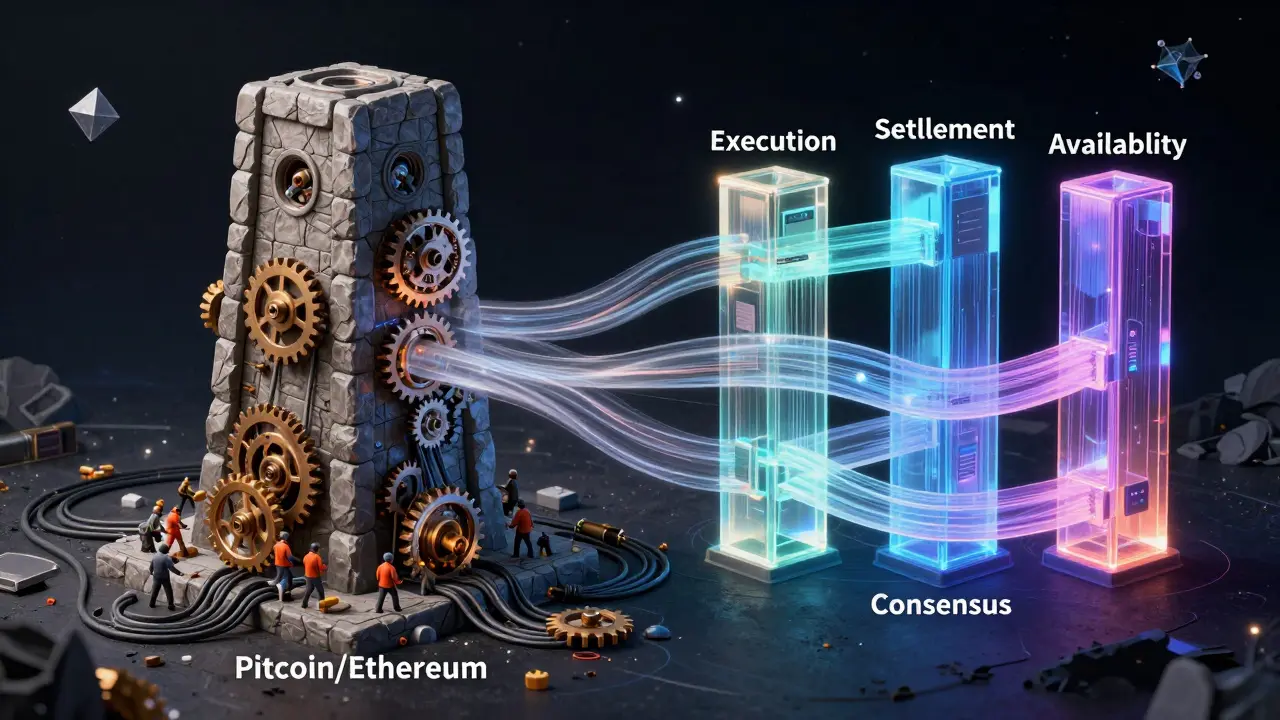
Most people think of blockchains as single, all-in-one systems - like Bitcoin or Ethereum - that handle everything: processing transactions, storing data, agreeing on rules, and locking in final results. But that’s changing. A new approach called modular blockchains is flipping the script. Instead of one chain doing it all, modular blockchains split those jobs into separate parts, each handled by its own specialized chain. This isn’t just a tweak - it’s a full redesign to fix the biggest problems holding back today’s blockchains: slow speeds, high costs, and too much strain on every single node.
Why Monolithic Blockchains Hit a Wall
Bitcoin and Ethereum were built as monolithic blockchains. That means one single chain does four critical jobs:
- Execution: Running transactions and smart contracts - like sending ETH or swapping tokens.
- Settlement: Making sure those transactions are final and can’t be undone.
- Data Availability: Storing all the historical data so anyone can check if a transaction is valid.
- Consensus: Getting all the nodes to agree on what the latest state of the blockchain is.
Here’s the problem: every node has to do all four jobs. That means if you want to validate a transaction on Ethereum, you need to download and verify every single piece of data from every transaction ever made. As the network grows, your computer needs more storage, more memory, and more power. Soon, only big servers can run a full node - and that kills decentralization.
Think of it like a restaurant where one chef has to grow the food, cook it, serve it, clean the dishes, and handle the cash register. Eventually, they burn out. Modular blockchains say: let’s hire specialists.
The Four Jobs of a Blockchain - Split Apart
Modular blockchains break down those four jobs and assign them to different chains, each optimized for one thing. This is the core idea.
Execution is where users interact. This is where you sign a transaction, deploy a smart contract, or swap tokens. Chains like ZkSync, an execution layer focused on fast, low-cost transactions using zero-knowledge proofs, Optimism, a rollup chain that bundles hundreds of transactions into one to save on fees, and Polygon Hermez, a zk-rollup built for scalability and Ethereum compatibility are all execution layers. They’re fast, cheap, and designed for users.
Settlement is the final say. It’s like a supreme court for blockchain disputes. If someone claims a transaction on an execution layer is fake, the settlement layer checks the proof and confirms whether it’s valid. Ethereum itself often serves as the settlement layer for many rollups. It’s slow, but it’s secure - and that’s the point.
Data Availability is the unsung hero. Even if you’re not processing transactions, you still need to know what data was posted so you can verify them later. That’s where Celestia, a dedicated data availability layer that stores transaction data in a way that’s cheap, fast, and verifiable by anyone comes in. Instead of every node storing all data, Celestia handles just that one job. Other chains can rely on it, saving massive storage costs.
Consensus is how the network agrees on truth. In Bitcoin, it’s Proof of Work. In Ethereum, it’s Proof of Stake. Modular blockchains can plug in different consensus mechanisms - or even reuse one from another chain. You don’t need to build your own. You can use Ethereum’s consensus, or even a lighter one built just for speed.

How Modular Blockchains Compare to the Old Way
Let’s look at how monolithic and modular systems stack up.
| Feature | Monolithic (e.g., Bitcoin, Ethereum) | Modular (e.g., Celestia + ZkSync) |
|---|---|---|
| Execution Speed | Slow - all nodes process everything | Fast - execution chains optimized for speed |
| Cost per Transaction | High - network congestion drives up fees | Low - rollups bundle transactions |
| Hardware Requirements | High - full nodes need terabytes of storage | Low - nodes only store what they need |
| Customization | None - you’re stuck with the chain’s rules | High - pick your own execution, settlement, data layer |
| Scalability | Hard to scale - bottlenecks everywhere | Easily scalable - each layer can grow independently |
Modular doesn’t mean perfect. It adds complexity. If one layer fails - say, Celestia goes down - the execution chains relying on it might stall. Security isn’t automatic. You have to trust the connections between layers. But the trade-off is worth it: you get way more performance without sacrificing security.
Who’s Building This? The Key Players
Modular blockchains aren’t theory anymore. They’re live, running, and scaling.
- Celestia is the pioneer of data availability. It doesn’t process transactions. It doesn’t run smart contracts. It just stores data and proves it’s available. That’s it. And that’s enough to power dozens of execution chains.
- ZkSync and Starknet use zero-knowledge proofs to bundle thousands of transactions into one, then settle them on Ethereum. They’re execution layers with built-in security.
- Optimism and Arbitrum use fraud proofs - a simpler but still secure way to verify rollups. They’re the most popular rollups today.
- Dymension is building a modular hub where developers can launch their own execution chains in minutes, using a shared settlement and data layer.
- Polkadot and Cosmos aren’t fully modular - they’re polylithic. They have multiple chains, but they still handle execution and consensus together. They’re stepping stones toward true modularity.
The trend is clear: developers are no longer trying to build one giant chain. They’re building Lego blocks - and snapping them together.

What This Means for You
If you’re a user: transactions will get cheaper, faster, and smoother. No more $50 gas fees. No more waiting 10 minutes for a swap.
If you’re a developer: you can build an app on a chain that’s perfectly tuned for your needs. Need speed? Use a zk-rollup. Need maximum security? Settle on Ethereum. Need low cost? Use Celestia for data. You’re not stuck.
If you’re a node operator: you don’t need a $10,000 server anymore. You can run a lightweight node that only checks the data it cares about. That means more people can participate - and that’s what decentralization is all about.
The Future Is Modular
Modular blockchains aren’t just a workaround for Ethereum’s congestion. They’re the next evolution of blockchain infrastructure. Monolithic chains will still exist - Bitcoin will keep doing what it does best. But for anything that needs to scale, serve users, or support complex apps, modular is the path forward.
By 2026, most new blockchain projects will be built modularly. The tools are here. The tech is proven. The demand is exploding. The future isn’t one chain to rule them all. It’s a network of specialized chains, working together - quietly, efficiently, and at scale.
Are modular blockchains more secure than monolithic ones?
Security depends on how they’re built. Modular systems can be just as secure - even more - if they use trusted settlement layers like Ethereum. But they also introduce new risks: if one layer (like a data availability provider) fails or gets hacked, it can affect everything built on top. The key is choosing well-established, battle-tested components. A modular chain built on Ethereum for settlement and Celestia for data is far more secure than a solo chain with weak consensus.
Do I need to understand modular blockchains to use crypto apps?
No. Most users won’t even notice. Apps will still look the same - you’ll still connect your wallet, send ETH, or trade tokens. Behind the scenes, though, your transaction might be processed on ZkSync, settled on Ethereum, and its data stored on Celestia. You get the benefits without the complexity.
Is Ethereum going away because of modular blockchains?
Not at all. In fact, Ethereum is becoming the backbone. Many modular chains use Ethereum as their settlement layer because it’s the most secure. Instead of replacing Ethereum, modular blockchains are helping it scale. Think of Ethereum as the foundation - and modular chains as the smart, fast floors built on top.
Can I run a node on a modular blockchain?
Yes - and it’s easier than ever. On a monolithic chain like Ethereum, running a full node requires 1+ terabytes of storage. On a modular system, you can run a lightweight node that only downloads data from the layers you care about. For example, if you only use Optimism, you only need to verify its data and settlement proofs - not the entire history of Ethereum. This opens up node running to phones, laptops, and even embedded devices.
What’s the biggest challenge for modular blockchains right now?
Interoperability and standardization. Right now, each modular chain has its own way of connecting to others. Getting Celestia to talk smoothly with ZkSync, Dymension, and Arbitrum takes work. The industry is moving fast, but we still need common protocols for data sharing, proof verification, and cross-chain communication. Once those are in place, modular blockchains will unlock their full potential.